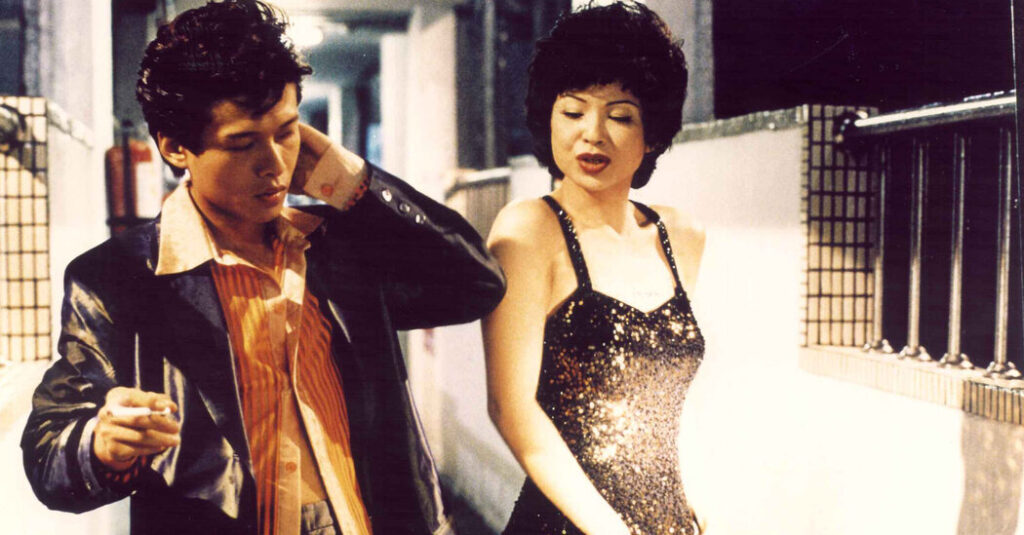
Commissioned in the late 1990s to make a film about the impending millennium, the Taiwanese director Tsai Ming-liang took the anticipated Y2K apocalypse as the subject for mordant minimalist farce. “The Hole” — a movie without exteriors, largely confined to a single apartment building — is a comedy conjoining deluge, plague, the collapse of government services, urban alienation and a series of musical numbers featuring the voice of the 1950s and ’60s Hong Kong nightclub diva Grace Chang.
“The Hole” had its premiere at Cannes in 1998. Winning the international critics prize, it surfaced in the United States as part of the traveling package “2000 Seen By,” and was shown twice in 2002 by the Museum of Modern Art (and favorably reviewed in The New York Times). Belatedly, Tsai’s film gets its first theatrical run in a new 35 mm print at Lincoln Center (with another to follow at Metrograph).
Impressive a quarter century ago, it seems even more so today.
Two residents of a Taipei public housing project, one living directly upstairs from the other, ignore government orders to evacuate their apartments. Although initially unknown to each other, the upstairs man and downstairs woman are forced by a leak that opens up a chasm in his floor and her ceiling into a slapstick, quasi-adversarial relationship.
The characters are nameless. The man is played by a laconic Lee Kang-sheng (a fixture of Tsai’s movies), the woman by Yang Kuei-mei (a popular cabaret singer who appeared opposite Lee in Tsai’s earlier “Vive l’Amour”). As the situation deteriorates, the epidemic, which, with a nod to Kafka, inspires scuttling cockroach behavior, takes hold.
As the hole expands, the two embark on a neighborly war of nerves. He throws up through her ceiling. When he peers down, she sprays insecticide in his face. “The Hole” is predicated on parallel activities. The couple’s relationship is more a matter of action than interaction. Throughout, the movie maintains an untroubled serenity. The color palette is restrained, the takes are long and there is little camera motion. The soothing sound of cascading water is near constant. For the most part the characters endure their frustrations with a measure of stoicism and ingenuity, predicated on a few props — his umbrella, her green plastic basin.
Five times during the movie, the narrative is ruptured by interludes in which, accompanied by several costumed showgirls, Yang lip-syncs and dances to a series of brassy musical numbers. Libido released, the sexual metaphors become increasingly outlandish. Ultimately, Yang’s character contracts “Taiwan Fever,” hiding herself in a pile of debris. Lee reaches out, first extending his leg through the hole and then offering a glass of water. The absurdity is compounded when he briefly pulls her up through the ceiling, cue for a magical pas de deux.
At times suggesting a pared-down combination of Samuel Beckett’s “Happy Days” and one of Pina Bausch’s splashy water dances, Tsai’s sodden doomsday is hardly depressing. Still, the romantic denouement and end-title thanking Grace Chang for her songs “to comfort us in the year 2000” can hardly be read as positive. Rather than illustrate the characters’ dreams, the musical interludes suggest a blissful dose of morphine administered as the world goes down the drain.
The Hole
Through July 16, Film Society at Lincoln Center; filmlinc.org and July 24-26, Metrograph; metrograph.com.
The post ‘The Hole’: Urban Apocalypse as Tuneful Chamber Drama appeared first on New York Times.