Damir Shavkatov’s résumé could make a college student jealous.
Mr. Shavkatov, a first-generation college graduate, started internship No. 6 this summer in New York City after working for a state senator’s office and a Fortune 500 company. His friends tell him that if anyone’s poised for a good job and middle-class life, it’s him.
But he isn’t always so sure. Mr. Shavkatov, 22, looks around — at unemployment rates rising for young college degree holders and at the artificial intelligence boom threatening to transform the economy — and worries: “The job market is really bad.”
“Even with the encouragement they give me, I still have trouble believing,” said Mr. Shavkatov, who graduated from Brooklyn College this spring and whose family emigrated from Uzbekistan when he was 9. “I just want to make my parents proud.”
For all of America’s fixation on the elite standard-bearers of higher education, few places transform fortunes more than the country’s largest urban public college system, the City University of New York.
At the Harvards and Yales of the world, mostly wealthy students earn degrees that help them mostly stay wealthy. But with its quarter of a million students — many of whom come from households that earn less than $30,000 a year — CUNY is a one-of-a-kind mobility machine.
Its campuses, including Brooklyn College, once swept more than half the top 10 spots on a prestigious think tank’s ranking of universities that propel students into the middle class.
But for a group of young adults already beating the odds, a gloomy job market — the worst for recent college graduates since the height of the coronavirus pandemic — adds another hurdle.
And it is illuminating a profound question for a metropolis teeming with inequality: If New York’s strongest pipeline of mobility sputters, what would be lost in a city built on the promise that hard work and grit can transform your life?
“That promise is under threat right now,” said Eli Dvorkin, the editorial and policy director at the Center for an Urban Future, a public policy nonprofit that has urged the city and state to invest more in paid internships and access to well-paying jobs.
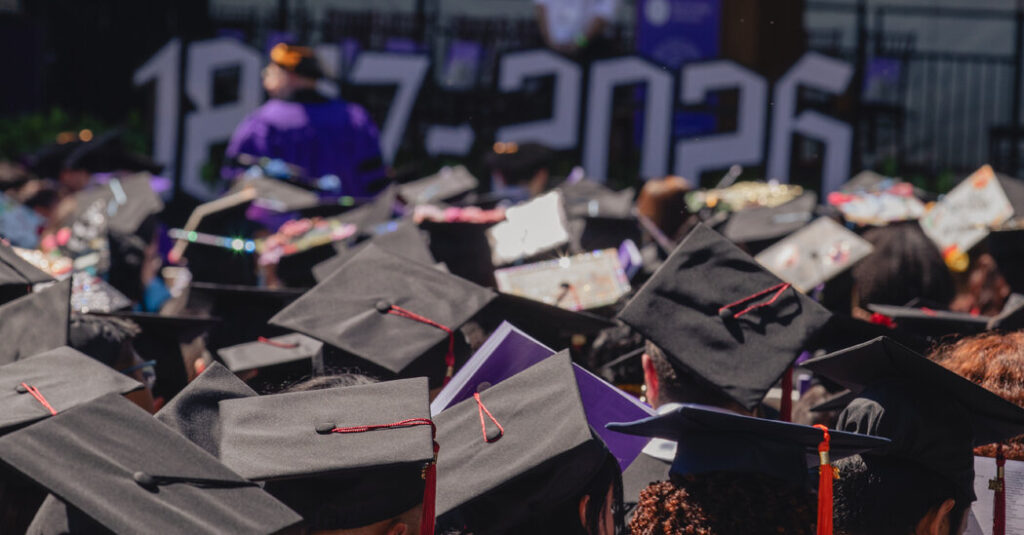
From research colleges in Manhattan to pricey liberal arts schools in the Bronx, the Class of 2026 is learning what it means to start professional life on unsettled terrain. “But CUNY students are feeling it the most,” Mr. Dvorkin said.
It’s understandable why even a star student like Mr. Shavkatov may feel a measure of anxiety. Until recently, one in three CUNY students struggled to find steady employment within 12 months of graduation, a reflection of just how tough it is for working-class students to succeed.
And the career advice they had received for a decade is being upended. National data released in recent months by the Federal Reserve Bank of New York showed that computer science and computer engineering majors — once a direct route to a well-paying job — were unemployed at higher rates than art history students.
In New York City, hiring continued to steadily decline for young professionals through the start of 2026, according to data shared by LinkedIn. And about twice as many people are applying for U.S. job postings compared with four years ago, according to the company’s numbers.
“That is a big shift in competitiveness,” Kory Kantenga, a senior economist at LinkedIn, said. “And that’s made the market very tough for early grads.”
At commencement ceremonies and on Reddit forums, the unease over the labor market — and whether the dream of climbing the economic ladder remains in sight — was a running theme. “Just how difficult is the job market for CUNY students?” one recent Reddit post asked.
“Idk what I’m doing wrong, and I’ve come to realize it’s not just me,” the leading reply said.
College leaders appear more focused than ever, experts say, on working to drastically boost job outcomes and enlist more companies to get 80 percent of students employed with a living wage within a year of graduation.
During the commencement ceremony at one CUNY school, Queens College, Donovan J. Richards, the Queens borough president, reassured graduates who might be “unsure of the worth of that degree in your hands” that even his own path took unexpected turns, with detours through music management and aviation.
“I can’t guarantee that the career you’ll ultimately lead is the career you seek right now,” Mr. Richards said.
Lindsay Greene, the president of the Brooklyn Navy Yard Development Corporation, said that economic mobility today partly depended on broadening the notion of what a “good job” is: Why can’t a 20-year-old aspire to become a welder or electrician?
And others say it depends on employers to broaden their definition of what makes a good candidate.
“We have to be honest in that too few employers see CUNY and see public school students as worth the upfront investment,” said Gregory J. Morris, the chief executive of the New York City Employment and Training Coalition.
Jeffrey Aronson, the co-founder of Centerbridge Partners, a midsize investment house, said that on Wall Street and across the Financial District, some firms “always tend to gravitate toward a certain type of student from a certain type of school.”
To Mr. Aronson, they’re missing out. His firm began tapping CUNY students as interns and fellows, and identified a huge pool of emerging talent. “They just want a chance, and they have grit,” he said.
“This is not philanthropy,” he said. “This is smart business.”
On the Upper East Side at Hunter College, which was recently ranked as the top regional university in the North for social mobility, it has been a mixed bag lately, said Travis Fox, the director of partnerships at the college, which is part of CUNY.
The next generation of nurses and teachers often land work. Arts and sciences students seem to be “spreading out across industries” in a new way, he said, with psychology students turning to user research and marketing jobs instead of clinical roles. And amid the rise of A.I., there’s “definitely some fear” among computer science grads.
But something surprising is happening, too: a wave of youth entrepreneurship. “I’ve seen more students trying to control their own destiny, be their own bosses, than I ever have,” Mr. Fox said.
“It seems like everyone’s got a side hustle,” he said. “It’s tough because they’re not seeing these stable, predictable career paths that even my generation was 10 or 15 years ago.”
Matthew LaBarca, a computer science graduate at Hunter, sometimes felt demoralized as he applied to hundreds of roles. He broke through after a CUNY event with Deutsche Bank turned into an internship and an offer to return this summer for a full-time position.
But he remains candid: He has no clue what the future, and his quest to build a better life, will hold. Around his age, his mother immigrated to Long Island from Vietnam, speaking little English and working multiple jobs to put herself through community college.
“It makes me a little anxious,” Mr. LaBarca said. “But it also makes me excited to see where my life will go.”
The post Can America’s Best Engine of Social Mobility Weather a Bad Job Market? appeared first on New York Times.