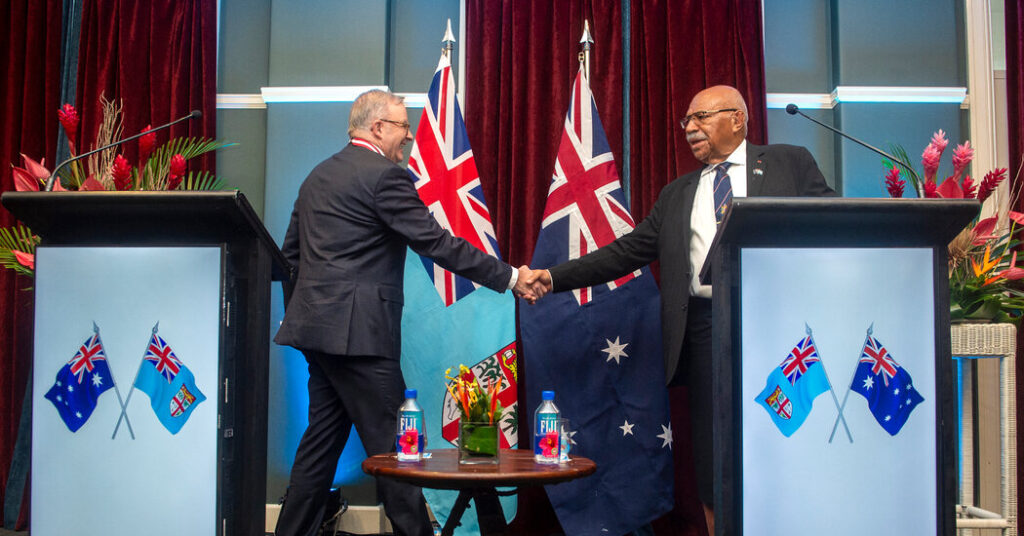
On the day that China announced that it had successfully fired a submarine-launched ballistic missile into the middle of the Pacific Ocean, Prime Minister Anthony Albanese of Australia was in Suva, the capital of Fiji.
Mr. Albanese was visiting the country on Monday to sign two long-sought security agreements with Fiji’s leader, Prime Minister Sitiveni Rabuka. A week earlier, he was smiling and shaking hands with the prime minister of Vanuatu, having finalized a treaty with that island nation. The following day, he was in the Solomon Islands, standing shoulder to shoulder with its new leader and announcing aid for education and policing.
The diplomatic blitz from the Australian leader is just the latest in what’s been a yearslong push to win over the island nations of the Pacific, by way of development assistance and smiling photo ops but also in securing legally binding mutual defense treaties and alliances.
Driving Australia’s efforts is what its foreign minister, Penny Wong, has termed a “permanent contest” for the Pacific region with an increasingly emboldened China.
The region’s 14 sovereign states, many of which are remote and small in size and population but also encompass large swaths of exclusive economic zones in the Pacific Ocean, have been the focal point of heated geopolitical rivalry because of their strategic location. Many of the islands played key roles in the fighting during World War II, and have been the site of consequential weapons testing. They are also positioned near key shipping lanes ferrying international cargo, while the ocean floor holds valuable minerals, drawing massive commercial interest in deep-sea mining.
Here is how the jostling for influence in the region has been playing out:
Australia Redoubling Ties With Pacific Neighbors
Australia historically had close ties to island nations in the South Pacific, having been former colonial administrators to some and a founding member of the Pacific Islands Forum, the region’s most important multilateral organization.
China’s interest in the region snapped into focus in 2018 when reports emerged that it was seeking to establish a military base in Vanuatu. In the years leading up to 2018, Beijing had steeply increased aid and investment into countries in the region, many of which are impoverished and vulnerable to natural disasters.
In 2022, a leaked draft of a security agreement between China and the Solomon Islands prompted concerns that the deal would open the door to Chinese security forces being deployed to the region. That year, China’s foreign minister, Wang Yi, traveled to several Pacific island countries trying to round up support — unsuccessfully — for a sweeping regional deal that would have expanded Beijing’s role in policing, maritime cooperation and cybersecurity.
In the years since, Australia has rapidly dialed up efforts to reinforce ties with the Pacific and present itself as the more desirable partner in both economic development and security. Many of the countries do not have their own militaries and have struggled with policing resources in moments of crisis, such as large-scale unrest in the Solomon Islands in 2021.
In the past two years, Australia has signed treaties with Nauru and Vanuatu and entered into alliances with Papua New Guinea and Fiji. Australia and Fiji also announced an “Ocean of Peace Alliance” in addition to their bilateral agreement, opening the door for other countries to join a regional bloc.
Sam Roggeveen, director of the international security program at the Lowy Institute, said a Chinese military outpost anywhere in the Pacific would be unacceptable for Australia because it would bring the reach of Beijing’s growing military forces much closer to its shores.
“The most significant part of all of these agreements is that they attempt to make it if not impossible, much more difficult for China to establish a permanent military presence,” he said.
China Doing ‘What Great Powers Do’
China, for its part, has always maintained its intentions were only to cooperate with the Pacific island nations as equals and has denied interest in establishing a base. A Foreign Ministry spokeswoman, Mao Ning, said this week the contest was in Australia’s imagination: “We do not engage in geopolitical rivalry or seek selfish political gains,” she said when asked about the agreement with Fiji.
Some leaders of Pacific island nations in the past have welcomed the competition, an approach that has been described as “friends to all, enemies to none” which could be leveraged to attract assistance and investment to a region in need.
James Batley, a fellow at the Australian National University and a former Australian diplomat who has served in various Pacific island nations, said over time, the countries may have come to see the limits of that balance, as China has made aggressive diplomatic pushes and flexed its military might with two ballistic missile tests in the region.
“They are paying a price for fostering a sense of competition; they can’t just quarantine themselves from the impacts of that,” Mr. Batley said.
The latest missile test may have helped cement support for Australia’s push in the region, Oliver Nobetau, Pacific islands program director at the Lowy Institute, wrote in an analysis.
“A missile test makes Pacific countries spectators in their own region, much like they were during the Second World War. Albanese’s opening is to offer something different,” he wrote.
Ms. Wong, Australia’s foreign minister, said this week that “China will continue to do what great powers do. It will continue to assert its interests.” Countries in the region must band together to protect theirs, she said.
Prime Minister Matthew Wale of the Solomon Islands had a simpler request: no more missile tests.
“We don’t want to see any more countries, China, America, anybody, we don’t want anybody testing the ICBMs in the Pacific islands region,” he said on Tuesday. “That’s the bottom line. Be our friend, but don’t threaten us.”
The post Why Australia Is Locked in a ‘Permanent Contest’ With China in the Pacific appeared first on New York Times.