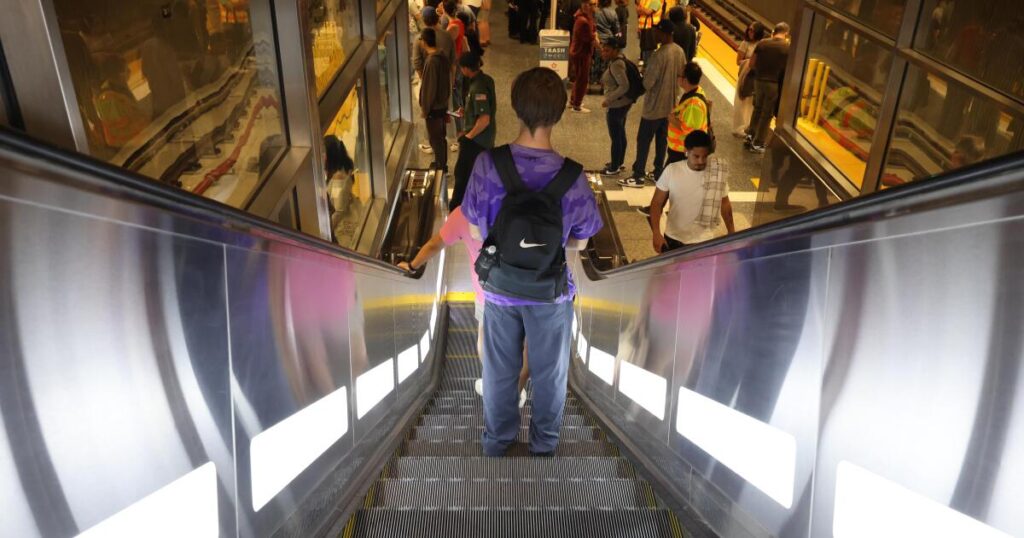
For many Los Angeles college students, public transit is often the cheapest and sometimes the only way to get to campus as gas and other costs rise. But using buses and trains can come with a price beyond the fare. Metro offers free passes for students at participating K-12 schools and community colleges, while some universities offer discounted transit passes for their students. However, college students who rely on transit have to leave for class hours early to avoid being late, weigh safety concerns, stretch already tight budgets and miss out on college life, students said.
Late buses, early alarms
For some students, using transit means getting ready and leaving long before class starts. Makeda Webb wakes up at 6 a.m. in her apartment in Willowbrook, more than five hours before her first class at Cal State Dominguez Hills, less than 5 miles away in Carson.
Even though her earliest class starts at 11:30 a.m., Webb leaves home by 8:30 a.m. because her commute usually takes 40 minutes and unreliable buses have made her late before. Some professors have even threatened to drop her from their classes if she kept arriving late, so she doesn’t take any risks.
“The bus is constantly late or breaking down,” said Webb, who does not have car. “You have to wait another hour for the next bus. … (It) makes me late for school, so I have to leave extremely early to make sure I’m on time.”
Her university offers Metro U-Pass, which allows participating university students to take unlimited bus and train rides for the semester for a flat fee. In spring 2026, the pass cost $67.50.
When Webb takes the bus in the evening after class and extracurriculars, frequent stops and unruly passengers stretch the trip to close to an hour.
“Even though I only live (half an hour) away by bus, it takes double that to get there,” Webb said.
Safety concerns
Victoria Imo, a graduate student studying social work at the University of Southern California, has a car but often takes Metro lines to avoid the high cost of gas and parking. Imo’s U-Pass is covered by USC’s mandatory transportation fee, which cost $146 for the spring semester. s.
But saving money means she has to take extra precautions. Because of safety concerns on the train, Imo thinks carefully about where she sits, often near other women, and avoids using her iPad or laptop, opting to read instead. She wears a mask and sometimes headphones without music to avoid unwanted interactions.
In the past, Imo carried pepper spray and a Taser — the latter of which she previously set off to deter an unruly man who was “yelling behind me while I was walking up the stairs,” she said. She activated the Taser so it crackled really loudly while she walked to her car.
Metro contracts with the Los Angeles Police Department and Los Angeles Sheriff’s Department for law enforcement across its systems. The agency also has transit ambassadors to complement officers, report issues and connect passengers with resources. Imo said she has not reported any safety concerns because she’s so used to them.
“I haven’t gone out of my way to give any feedback, because at this point, I feel like this is just what the train system is,” Imo said. “It seems like everyone’s used to it.”
Zak Nirenberg, an electrical construction and maintenance major at Los Angeles Trade-Technical College, said their biggest safety concern is not other Metro riders, but Los Angeles Police Department officers.
“They’re intimidating,” Nirenberg said. “Most of the time they’re on the (train), they’re looking for someone to harass or actively harassing someone.” Norma Eisenman, a spokesperson for the LAPD, declined to comment on Nirenberg and others’ concerns about officers’ presence.
Metro says safety is improving
Metro said it’s making progress on safety, pointing to recent declines in violent crime and nonviolent offenses. The agency attributed those declines to increased visible uniformed personnel, fare enforcement and partnerships with behavioral health organizations on its transit system.
In a February Metro media release, Maya Pogoda, a spokesperson for the agency, wrote that violent crime fell 6.7% in 2025 from the year before. She added that crimes involving trespassing, narcotics and weapons decreased 33%.
Metro also announced the Department of Public Safety Dashboard, which publishes safety and security data submitted by law enforcement agencies and shows a more complicated history. According to the dashboard, after Metro resumed bus fare collection following a pandemic pause, trespassing reports including fare evasion rose nearly 1,200%, from 126 in 2022 to 1,635 in 2023. In 2024, the number more than doubled to about 4,500.
Arrests also rose sharply, with LAPD and sheriff’s department arrests increasing by 81% in 2023 to about 5,000, then nearly doubling to about 10,000 in 2024. Since 2020, the top two crime types reported on Metro have been trespassing and battery. Pogoda wrote that the agency is trying to address safety through a mix of law enforcement and public services, efforts coordinated through Metro’s new Department of Public Safety.
Student passes help, but gaps remain
Even Metro programs meant to make public transit more affordable for students don’t remove every cost barrier. For some, the upfront cost of even a discounted pass can still be out of reach.
Stephanie Verdugo, a sociology major at Cal State L.A., lives on campus and relies on Metro buses to run errands and, previously, to get to work. She said her university sells a U-Pass to students for about $100 a semester, but even as a frequent transit rider, Verdugo said she couldn’t afford the upfront cost.
“I always had a very tight budget … so I could never actually buy (the U-Pass),” she said. “I would just have to pay the regular way.”
Still, even while paying Metro’s regular $1.75 fare for bus or train rides, Verdugo said using public transit has saved her money. That is partly because the agency’s fare-capping system limits how much regular fare riders can spend to no more than $5 each day and $18 each week before rides are free. “I don’t pay a lot of money considering how much I travel on the bus,” Verdugo said.
‘I’ve never been to a college party’ — when transit derails social life
Beyond getting to class, transit can also shape how much of college life students get to experience. Julian Levy, a political science student at Occidental College, lives in on-campus housing and relies on public transit to visit his family and get around Los Angeles.
Without a car, Levy said, participating in college life off campus means planning around transit schedules, deciding whether a trip is worth the time and often leaving early to get back on time. “I remember just feeling so frustrated … just because I didn’t have a car,” Levy said. “I had to leave early from (a friend’s birthday party) because of the time I would have to spend on the much slower public transit system.” One trip to an Occidental soccer game at Chapman University in Orange made Levy reconsider taking transit to away games. He had taken Metro and Metrolink to get there without any issues, but after the game, one of the few trains back was canceled. A second train eventually came, but only after Levy waited about two and a half hours on the platform. He ended up getting back to campus after midnight. “I remember thinking after that, ‘Do I really want to rely on public transit?’” Levy said. “I’ve always been able to get where I’ve needed to go, but I’ve definitely reconsidered whether something is worth the risk of getting stranded somewhere.”
Martin Romero is a contributor with the College Journalism Network, a collaboration with CalMatters.
The post These Los Angeles college students use public transit to save money. Here’s what it’s like appeared first on Los Angeles Times.