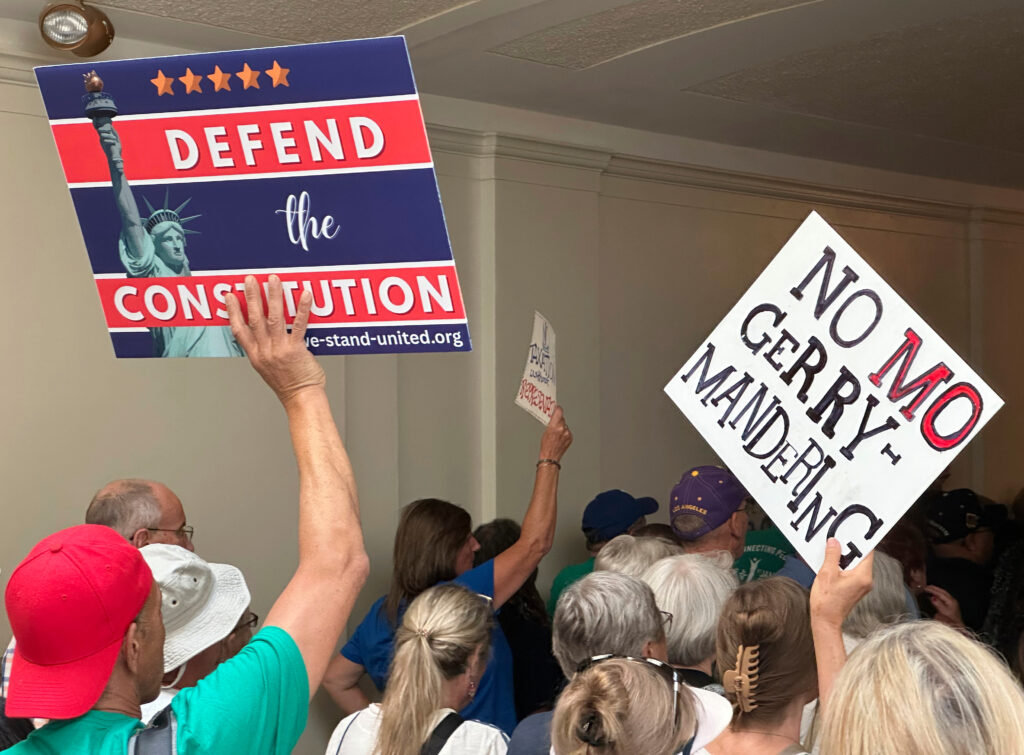
Republicans and Democrats are quietly pouring millions of dollars into a fight trying to block Missouri’s new gerrymandered congressional map, as each party scrambles for any advantage they can find in the national fight for the House majority in 2026.
Missouri is one of six states that have redrawn their congressional lines — after President Donald Trump kicked off the redistricting war by pushing Texas to redraw — with the GOP-dominated legislature passing a new map in September that would eliminate Democratic Rep. Emanuel Cleaver’s Kansas City-based seat.
But unlike in many other states, Democrats have a clearer path to try to block the map, at least for next year’s midterms. They’ve now launched an effort that operatives in the state say is attracting an unprecedented amount of money — and legal fights.
“Imagine the kind of democratic paralysis our state would be in if this happened every 10 years, or every time we decided to draw new maps,” said Aaron Blake, a GOP strategist based in Missouri. “That would just be chaos.”
Almost immediately after the map passed, Democrats in the state organized a campaign to repeal the new map through popular referendum. The campaign committee, People Not Politicians, will need to submit about 107,000 valid signatures before the Dec. 11 deadline to send the new maps to a referendum. If they submit enough valid signatures, the state would be temporarily unable to enact the new maps until voters can weigh in on the ballot measure.
Well-funded organizations on both sides have since rushed into the state, duking it out in a fight that has already spawned a complicated nest of court cases and some aggressive tactics seeking to undermine Democrats’ referendum campaign.
If the state’s new maps do come to a referendum, some Republicans are concerned voters might reject their bid to aid Trump’s effort to skew the odds of maintaining control of the House in Republicans’ favor.
“It will be a very uphill battle for Republicans if [the referendum] is on the ballot,” Blake said.
Democrats in Missouri, meanwhile, are confident they’ll have enough signatures to push the maps to a referendum — and they’re optimistic voters will be on their side when it comes time to vote on the maps.
“[Republicans] are afraid for this to go on the ballot, because they believe that Missourians will vote it down,” said Doug Beck, the top Democrat in the state Senate. “That’s why they’re trying as hard as they can to not let it go to the ballot.”
The Republican National Committee and the National Republican Campaign Committee donated a combined $100,000 days after the Put Missouri First PAC, the GOP’s ballot measure-focused committee, was formed. That was followed by two separate $1 million contributions from the Trump-aligned Securing American Greatness PAC and the American Action Network, the nonprofit arm of House Republicans’ primary super PAC.
Officers for Put Missouri First — including the group’s treasurer and a law firm that shares the organization’s address — did not respond to interview requests.
On Wednesday, Donald Trump Jr. urged his social media followers to support the effort to block the referendum — a sign of the battle’s growing significance to Republicans outside of the state.
For the most part, Democrats in Washington have stayed out of People Not Politicians’ signature gathering campaign. But Democratic-aligned dark money groups have stepped in to contribute over $1.25 million to People Not Politicians, including a $500,000 contribution from American Opportunity Action, a newly-created left-leaning nonprofit that is also supporting a ballot measure campaign in Michigan to block a rewriting of the state’s constitution.
The committee also received $250,000 from former Rep. Cori Bush, the Missouri progressive who was first elected in 2020 but lost a primary in her St. Louis-area district last year. Bush is running for Congress again in the same seat, which would be largely unaffected by Missouri’s new map.
That level of fundraising from both parties is striking for a ballot measure fight in a state with a long history of referendum battles. Benjamin Singer — who has worked on different referendum committees in Missouri since 2018, and is the campaign director for a group seeking to put a constitutional amendment in front of voters to strengthen the state’s referendum laws — said he’s never seen a ballot measure fight with as much money coming in for both sides of the issue.
“They haven’t dominated with the big money, because they haven’t needed to,” he said.
Some opponents are seeking to impede Democrats’ signature collecting through questionable tactics. The Kansas City Star obtained a copy of a contract offering a canvasser for People Not Politicians $5,000 to stop collecting signatures. The paper could not identify the source of the contract, which POLITICO has not independently verified.
And Missouri Attorney General Catherine Hanaway, a Republican, has sought to use Trump’s aggressive anti-immigration moves to target a firm working on signature collection for People Not Politicians that she accused of employing “illegal aliens.”
In a pair of social media statements, Hanaway said her office is investigating the firm, Advanced Micro Targeting, and said she’s contacted ICE about the situation. Advanced Micro Targeting has denied Hanaway’s claims.
Hanaway is also fighting against a potential referendum in the courtroom — she filed a federal lawsuit asking a judge to declare that a referendum to block the legislature’s new maps violates both the U.S. Constitution and Missouri’s Constitution, leaning on principles of the “independent state legislature” theory that the Supreme Court largely rejected in the Moore v. Harper case in 2023.
In a statement, Hanaway said “Missouri will not allow out-of-state political groups to silence the voices of our citizens or override our state’s constitutional process. The Missouri Attorney General’s Office will defend the authority of Missouri’s elected representatives at every turn.”
Zachary Bluestone, a Trump-appointed judge assigned to the case, said he’ll decide whether to block the referendum ahead of the Dec. 11 deadline to submit signatures.
The federal case is one of at least seven lawsuits filed over the new maps or the potential referendum. Among those is a case brought to a Missouri state court by the ACLU, which has partnered with People Not Politicians, seeking to nullify the new congressional districts on the grounds that mid-decade redistricting violates a clause in the state’s constitution.
People Not Politicians is separately suing Republican Secretary of State Denny Hoskins for his handling of referendum procedure, including authoring language for the potential ballot measure that frames the old maps with six GOP-leaning seats as “gerrymandered,” and the new district lines with seven GOP-leaning seats as being a “more compact” map that “better reflects statewide voting patterns.”
“What’s going on in Missouri is an example of constitutional hardball,” said Travis Crum, a professor at Washington University Law School in St. Louis who specializes in election law.
And even if the ballot referendum goes in front of voters, it isn’t a guarantee the map will be blocked for 2026. The plethora of redistricting-related court cases in Missouri are being adjudicated in hearings and rulings that will likely occur before the end of January — giving state election officials enough time to schedule a potential ballot measure election next year, operatives and court watchers said.
“I just think the noise has peaked or will be peaking between now and mid-January,” Blake, the GOP consultant, said.
A version of this article first appeared in POLITICO Pro’s Morning Score. Want to receive the newsletter every weekday? Subscribe to POLITICO Pro. You’ll also receive daily policy news and other intelligence you need to act on the day’s biggest stories.
The post Inside the overlooked multi-million dollar fight to block Republicans’ Missouri gerrymander appeared first on Politico.