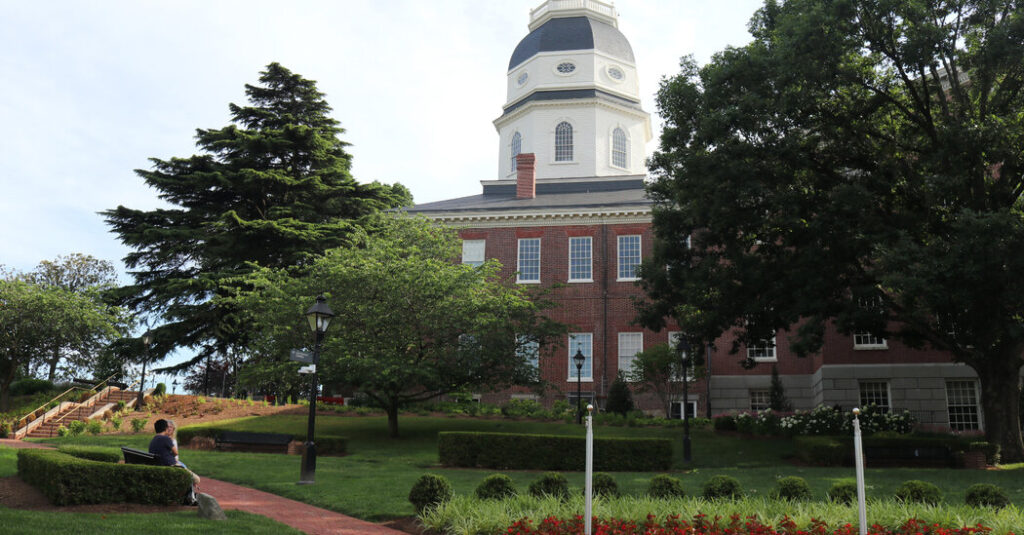
Democratic lawmakers in Maryland announced on Tuesday that the legislature will reconvene in August to craft a plan that could lead to a new round of redistricting, though not before the 2026 midterm elections.
Of the state’s eight House seats, just one is reliably Republican. The last time legislators tried to redraw the state’s House districts, in 2022, a Maryland judge struck down a map championed by Democrats as a violation of the state’s constitution. Now Democrats plan to push for an amendment to the constitution to ensure redistricting ahead of the 2028 elections will pass legal muster.
If three-fifths of lawmakers in both the Maryland House and Senate approve the amendment in a special session, the question will go to the voters in November. The Democrats have large enough majorities in both houses to pass the amendment without Republican votes. If voters approve the amendment, Democratic lawmakers would be on stronger legal footing to redraw maps for future elections, and join the redistricting wars that began on President Trump’s orders in Texas.
Those battles have since spread to California, Missouri, North Carolina, Florida, Tennessee, Louisiana and Alabama. Court-ordered maps have also changed the political dynamics in Utah and Ohio.
“For months, I have said that inaction is not an option and we cannot sit on the sidelines while voting rights, fair representation and the foundations of our democracy come under attack across the country,” Gov. Wes Moore of Maryland, a Democrat, said in a statement.
Republicans, though outnumbered, vowed to fight the plan.
“It is absolutely shameful that the Annapolis political machine is willing to expend so much time and energy disenfranchising more than a million Republican voters in this state,” said Delegate Jesse Pippy, the Maryland House minority whip, in a statement. “It certainly flies in the face of Governor Moore’s motto of ‘Leave no one behind.’”
The announcement reflects the latest wrinkle in a national battle of gerrymandering, and could ensure that the battle extends into the next political cycle.
In the early summer of 2025, Mr. Trump, seeking to gain a partisan advantage in the 2026 midterms, persuaded Texas officials to draw a new map that favored Republicans. California responded with a map favoring Democrats, and other states followed with gerrymandering of their own.
When voters approved the drawing of new, Democrat-friendly maps in Virginia, the parties seemed to have evened the score. But the state Supreme Court ruled that the amendment had not been passed properly. Then the U.S. Supreme Court weakened protections for Black-majority House districts in the South under the Voting Rights Act, triggering another round of Republican redistricting.
The back and forth has left Republicans with an advantage of anywhere from three to 12 seats.
Mr. Moore, the Maryland governor and a likely 2028 president contender, was outspoken about his ambition for a new map in Maryland. With the backing of Representative Hakeem Jeffries, the Democratic leader in the House, Mr. Moore pushed for a map that would create an all-Democratic delegation.
But he ran into the unyielding opposition of Bill Ferguson, the State Senate president, who is also a Democrat. Mr. Ferguson argued that a new round of redistricting would most likely face the same constitutional problems that thwarted the attempt in 2022. And if the issue ended up in the courts, he insisted, the outcome for Democrats could be even worse than the status quo.
Though Mr. Moore and others exerted significant pressure, Mr. Ferguson kept up his resistance until the clock ran out, which may have led to his narrower than usual win in the Democratic primary in June.
Still, the plan for a special session was announced on Tuesday by Mr. Ferguson, along with the House speaker, Joseline Peña-Melnyk, also a Democrat.
“After recent court decisions weakened the federal Voting Rights Act and created new uncertainty around congressional redistricting, Maryland needs a clear legal path forward,” Mr. Ferguson said in a statement. “This special session will allow the General Assembly to do its part while ensuring that Maryland voters make the final decision.”
The special session is scheduled for Aug. 3 to 5, the last possible days to pass an amendment if it is to make it on the November ballot.
The post Maryland Moves Toward Redistricting Ahead of 2028 appeared first on New York Times.