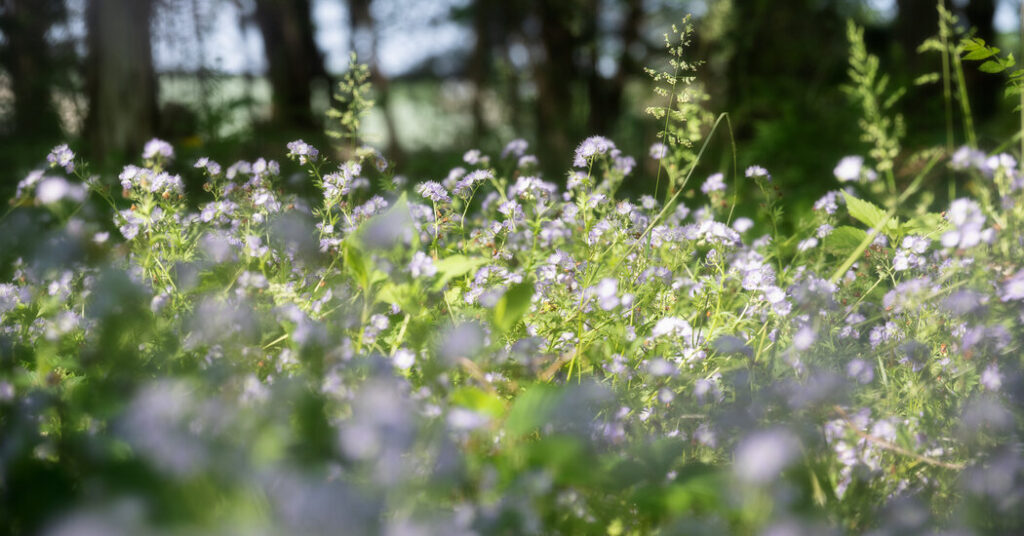
In the summer of 2020, my husband, Ryan, and I bought a house in Portland, Ore., with a sizable backyard containing little more than a decrepit lawn. For many prospective homeowners, a crisped rectangle of grass on the verge of death would probably not be a selling point. We found it irresistible: an ideal canvas for our dream garden. That fall, we hired a contractor to rip out what remained of the lawn and got to work.
From the start, we tried to balance several conflicting priorities. We wanted our garden to be beautiful and bountiful — teeming with fruits, vegetables and flowers — but we had also resolved to conserve water, minimize the use of fertilizer and exclude synthetic pesticides. We intended to maintain a functional oasis where we could relax and entertain friends, yet we were also determined to provide plenty of habitat and resources for wildlife. This was an opportunity to steward a parcel of our living planet, however small.
Throughout the garden, we planted hardy, drought-tolerant perennials: lavender, Coreopsis, Penstemon, sea holly, sunroses and Sedum. Here and there, we mixed in some favorite flowers that required a bit more pampering, like peonies, dahlias and Peruvian lilies. We dug a small pond and bog, laid a flagstone path, espaliered a couple of fruit trees along the fence and built raised vegetable beds in the back. We set up a compost bin, installed drip irrigation and began to mulch.
Two years later, the once sterile landscape was reborn, vibrant and lush and bustling with life. Insects were the first to arrive. I was especially captivated by the diversity of wild bees, most of which I never knew existed. Tiny, metallic blue mason bees teleported between apple and cherry blossoms. Glittering green sweat bees swooped upon the poppies. Fluffy-bellied leafcutter bees sliced through the air with vegetal clippings clasped between their legs.
The pageant of small, winged visitors soon expanded to dragonflies, hoverflies, butterflies and beetles. Then came substantially larger animals: songbirds, hummingbirds, birds of prey, jumping mice and a mischievous family of raccoons that, based on the aftermath, routinely held some sort of bacchanal in the pond. I was confident that the garden we were cultivating was not only attractive and productive but ecologically beneficial, too.
But the more I engaged with the wider community of wildlife gardeners, the more my confidence wilted. Wherever I turned — local nurseries, online forums, best-selling books — like-minded gardeners seemed to care about one thing above all else: whether their plants were native. A vast majority of plants sold in North American nurseries are foreign species imported sometime in the past few centuries. In contrast, native species are those with long evolutionary histories in the particular regions they inhabit. Native plant champions argue that, unlike recently introduced species, native species are thoroughly adapted to their surroundings and have longstanding, mutually beneficial relationships with one another. Therefore, they claim, native plants are far better at providing food and shelter for wildlife and maintaining the integrity of their ecosystems.
Growing natives is not new. Indigenous peoples have cultivated native species for millenniums, and some nursery owners have encouraged American gardeners to focus on native plants since at least the early 20th century. In the past decade, however, what was once regarded as a niche concern of the environmentally conscious has begun growing into a nationwide movement. Surveys from the National Garden Association and the National Wildlife Federation indicate that since 2019, the share of U.S. gardening households buying native plants has ranged from about one in five to nearly one in three. Eighty-two percent of horticultural professionals agree that consumer interest in natives is increasing, and more than half of those who sell natives plan to expand their selection.
Taking all this in, I began to question our garden’s true ecological value. Sure, we had planted a few Pacific Northwest natives, but most of the plants we selected originated elsewhere. I had been thinking of our garden as a miniature Eden, replete with everything local wildlife needed. Now it seemed more like a poorly stocked international aisle at a supermarket, offering a few exotic curiosities yet lacking the familiar essentials.
As I continued researching the supposed virtues of native species, one name in particular kept resurfacing: Douglas Tallamy. A professor of entomology at the University of Delaware, a conservationist and a frequent public speaker, Tallamy is the nation’s foremost expert advocate for gardening with native plants. Collectively, his six books have sold more than half a million copies, soaring in popularity in recent years. Many of the native plant movement’s followers regard Tallamy with the kind of deep reverence typically reserved for spiritual leaders. Based on three decades of research, he is convinced that the coevolved relationships between native plants and insects sustain all terrestrial food webs and that typical American gardens, landscaped with lawns and showy exotics, are essentially ecological wastelands. He argues that foreign and invasive plant species — most of which have been introduced through the ornamental plant trade — are some of the primary causes of the so-called insect apocalypse and the current staggering rates of biodiversity loss more broadly.
For Tallamy, these insights simultaneously underscore a calamity and point to its potential resolution. The types of plants we choose to bring into and keep out of our gardens will “determine what nature will be like in 10, 20 and 50 years from now,” he writes in “Bringing Nature Home.” “Increasing the percentage of natives in suburbia is a grass-roots solution to the extinction crisis.” Success, he emphasizes, can spring from the individual rather than from government. “As gardeners and stewards of our land, we have never been so empowered — and the ecological stakes have never been so high.”
Tallamy has expanded this argument into an initiative that he calls Homegrown National Park. Across the nation, at least 40 million acres are covered with mostly foreign turfgrasses that demand huge volumes of water, fertilizer and fuel yet have little ecological value. Much of this grass resides on private property. Tallamy wants to inspire a mass movement to replace half of this acreage with “productive native plant communities.” If such an effort were successful, it would create a mosaic of new wildlife habitats larger than all the national parks in the contiguous United States combined — a prospect that gives Tallamy shivers.
Although Tallamy’s expertise and passion were compelling, I harbored some skepticism about the native plant doctrine. Given how drastically different the world is today compared with even a century ago, I wondered whether the bygone circumstances in which species evolved could really be so important. If introduced plants were so ecologically inferior, it was difficult to explain why our yard in Portland was pulsing with bees and birds. Like many other gardeners, I also bristled at the narrow-minded attitudes of the most extreme nativists. Before I started ripping up my flower beds, I needed to address a few pressing questions. How did Tallamy arrive at his conclusions? Beyond his own work, how much science supported the native plant movement? And if its central premise was correct, then what should a modern-day, ecologically responsible garden look like, exactly?
There seemed to be no better place to start seeking answers than in Tallamy’s own yard. Native trees, shrubs and flowers abound on his gloriously wooded, 10-acre property in southeastern Pennsylvania, the culmination of a nearly 30-year restoration effort. Even the long unpaved driveway leading to his house is shaded by an archway of overlapping boughs.
When I reached its end one warm spring morning, I found myself directly beneath a magnificent, 70-foot-tall white oak that Tallamy planted as an acorn. Around his house, pollinators flitted among buttery wood poppies, fringe-petaled Phacelia and nodding red columbines. The trills of wrens and vireos resounded overhead, accompanied by the occasional drumming of woodpeckers. Over the next several days, we traipsed through Tallamy’s property — a patchwork of forest, meadow and marsh — conversing about plants and looking for wildlife.
It was not difficult to find. At one point, we came upon a cluster of American carrion beetles lapping up the sap of an oak tree, a behavior Tallamy had never before observed. Soon after, while inspecting the leaves of a pawpaw, we discovered a peculiar insect known as a clavate tortoise beetle, which resembled a miniature bearskin rug encased in a disc of gelatin. I then literally stumbled onto one of our most exciting finds of the week: a thrumming cloud of small native bees, hovering just above their burrows, waiting for the chance to mate.
One night, we set up a couple of bug-beguiling lights near Tallamy’s home. Hundreds of moths gradually emerged from the darkness, some arriving as lightly as a snowflake, others convulsing through the leaf litter. As the night unfolded, larger and more striking individuals joined the initially small and homely congregation: a Harris’ three spot with hypnotic, monochromatic swirls; a sunset orange Isabella tiger moth; and a small-eyed sphinx with scalloped wings that seemed to be cut from marbled endpaper. Just before midnight, when I was thinking of retiring, the species we had most hoped to see came crashing through the canopy: a luna moth, massive yet ethereal, with long swooping tails and wings the color of absinthe. All told, Tallamy has now documented more than 1,370 moth species and 62 species of breeding birds on his land, which constitute 44 percent of all moth species and 33 percent of all bird species in the state.
When Tallamy and his wife, Cindy, a retired entomologist, bought their property in 2000, it was nothing like this. Historically, much of the land was farmed and mowed for hay. In the areas where wild plants still grew, there were hardly any trees and few natives. Instead, they found an impenetrable tangle of invasive shrubs and vines: multiflora rose, oriental bittersweet, Japanese honeysuckle and autumn olive, all of which tend to spread aggressively, outcompeting natives. Tallamy had to cut paths through the overgrowth just to navigate the landscape.
When he started searching the vegetation for insect life — something he does everywhere, out of habit — he was shocked by how little he found. He had a hunch about the conspicuous absence: Perhaps there were no insects because, despite the leafy abundance, there was little they could eat. We tend to think of milkweed-dependent monarch butterflies and other insects with restrictive diets as exceptions to the general voracity of their kind: the hordes of vampiric aphids, swarms of locusts and ceaseless trails of foraging ants. The reality, Tallamy explains, is that most leaf-eating insects are exceptionally picky eaters.
Plants deter herbivores with an extensive apothecary of toxins, repellents and digestive inhibitors. In response, insects must develop countermeasures, like the ability to neutralize or sequester a particular class of compounds. The ensuing coevolution results in widespread dietary specialization. Around three-quarters of leaf-eating insect species in any given location on the globe are eating only plants within a single taxonomic family. In many cases, they are restricted to one or a few lineages within that broader group.
Insects, in turn, are perhaps the single most vital conduit of energy from plants to animals. Birds illustrate this point especially well. By Tallamy’s reckoning, nearly all terrestrial bird species in North America rely primarily on insects, in particular plump and nutritious caterpillars, to feed their young and maintain breeding populations. An average brood of six to eight chickadees demands 3,000 to 5,000 feedings over the 16 days from hatching to fledging, most of which will be caterpillars, other insects and spiders.
The displacement of native plants on his property, Tallamy reasoned, had severed the most foundational threads of the local food web, depriving insects of sustenance and thus endangering all the other animals that depended on them. Surely the same thing had been happening across the continent for centuries. When he surveyed the scientific literature for relevant studies focused on how invasive plants alter food webs, however, he didn’t find any that met his criteria. So he decided to fill the gap.
In the past three decades, Tallamy and his colleagues have published numerous studies demonstrating that native plants typically support more biodiversity than introduced species and that gardening can play an important role in restoring wildlife habitat. Their research has shown, for example, that hedgerows dominated by invasive plants have 91 percent fewer caterpillars than indigenous varieties and that yards landscaped primarily with native plants have 66 percent more bird species than conventional yards. One especially celebrated study determined that Carolina chickadees breeding in urban and suburban yards raised enough young to sustain their populations only when the mass of trees and shrubs within and around those yards was at least 70 percent native.
By scouring records of insect diets, Tallamy and his collaborators have further revealed that, across the United States, small groups of keystone plants — on average, just 14 percent of the natives in a given region — feed more than 90 percent of local butterflies and moths. Trees and shrubs consistently rank highest in terms of how many insects they support, in part because they are larger and longer-lived. These studies became the basis for the National Wildlife Federation’s popular online tool for gardeners, the Native Plant Finder.
In tandem, Tallamy and Cindy applied the findings to their own garden. They used tractors, chains, shears and saws to fell, uproot and destroy as many invasives as they could. In some cases, Tallamy also applied herbicides. Eliminating all introduced species proved impossible. Multiflora rose still forms a few thickets. Porcelain berry and mile-a-minute weed produce copious seed and regenerate from resilient roots. Japanese stiltgrass is absolutely everywhere, carpeting the ground like a forest of dwarf bamboo.
On the whole, however, Tallamy regards the restoration as a triumph. Instead of jumbled invasives, there are now towering stands of native trees — oaks, maples, beeches, cherries, plums — and myriad native shrubs and understory plants, such as sassafras, winterberry and azaleas. Tallamy estimates that he and Cindy planted only 10 percent of those trees and shrubs. Most arrived as seeds via rodents, birds and wind. By tipping the scales toward natives, they gave the ecosystem the time and opportunity it needed to regenerate itself.
“The Earth is falling apart, and everyone feels, Well, what can one person do?” Tallamy says. “I’ve got a whole list of things one person can do.” His central message to his readers, he says, is that “they are not just homeowners. They are the hope and future of conservation.”
Tallamy’s penchant for grandiose claims is one reason he has faced criticism from some scientists and gardeners. His unabashed and polarized attitudes toward native and introduced species have proved even more controversial. In our discussions, Tallamy described invasive species to me with palpable contempt, sometimes referring to them as “ecological tumors.” His critics contend that he and other nativists place too much emphasis on origin, idolizing indigenous species, vilifying migrants and eliding the messiness of real-world ecosystems in the Anthropocene.
Most of the species that humans move from one area to another never become problematic. Only a portion of foreign species survive relocation, and only a fraction of the survivors become invasive. Experts agree, however, that certain introduced species have been undeniable ecological disasters. One of the most infamous examples is the brown tree snake, which reached the shores of Guam shortly after World War II, most likely aboard a cargo ship. Liberated from their usual predators and surrounded with abundant and naïve prey, brown tree snakes thrived, consuming so much of the native fauna that more than half of the island’s bird and bat species became locally extinct. Similarly, when horticulturalists accidentally brought a parasitic Asian fungus to North America in the late 19th century, it devastated the continent’s once vast and majestic stands of native chestnut trees.
In other cases, however, introduced species have few noticeable effects or provide ecological benefits. At first, Pacific oysters introduced to Europe’s North Sea smothered native mussels. Over time, however, the two species became more compatible, forming mixed, multilayer reefs in which oysters dominate but simultaneously shelter mussels from predators. These hybrid reefs also seem to be more resilient to extreme weather. In Puerto Rico, introduced tree species have quickly repopulated deforested land in which natives initially struggled to grow. Over several decades, the forests evolved into novel communities in which both natives and non-natives flourished.
One of Tallamy’s most prominent critics is the esteemed entomologist Arthur Shapiro, emeritus professor at the University of California, Davis. Shapiro has shown that more than 30 percent of California’s butterfly species use introduced plants as hosts for their larvae, typically because those species are either related to their native foods or happen to have similar leaf chemistry. Some North American butterflies have even expanded their geographic ranges and reproductive seasons by adapting to foreign plants. Groups of anise swallowtail, for instance, breed so well on fennel, which was most likely introduced by Europeans in the early 19th century, that they began producing additional generations each year. Monarch butterflies migrating along the West Coast frequently rest and shelter in groves of tall, winter-blooming eucalyptus trees, which a merchant sea captain imported from Australia to the United States in the 1850s. Introduced plants have enabled butterflies and moths to extend their ranges in New England, the Northwest and Europe as well.
On a more fundamental level, a vocal cohort of ecologists, historians and philosophers argues that the concepts of native and invasive species — which they equate with xenophobia and militarism — should be reworked or abandoned. Ecosystems, they say, are not delicate, finely knit tapestries that permanently unravel if they lose too many threads. They are more like modular conglomerates in a state of constant flux. Environments are always changing. Species move around on their own. And at this point, humans have so radically altered the planet’s climate, landscapes and biogeography that recreating the habitats in which most species originally evolved is impossible. In their view, native purists are obsessed with preserving a static and idealized version of nature that never really existed.
From a deep-time, planetary perspective, there is no distinction between native and non-native. All life is equally Earthly. All extant species are branches of a single ancient trunk. Every newborn island, freshly thawed sheet of bedrock or other novel biome must be populated with creatures whose histories lie elsewhere. On more relatable timelines, however, ecological belonging is a meaningful concept. Coevolution is not some rarefied process that occasionally spits out a few unusually codependent species. All species coevolve in networks in specific places, under certain conditions, over particular periods of time. The relationships they form with one another and their environments define their ecosystems.
Such communities are resilient to an extent, but if the most fundamental connections within them collapse too quickly, so will the systems as we know them. Promoting some plants over others does not mean we judge them to be inherently superior or the others to be wicked. Rather, it recognizes that different life forms are connected to each other in different ways. Certain species tend to reinforce and renew the ecosystems in which they take part, whereas others, through no fault of their own — and often because of our own blunders — may imbalance or exhaust them.
The most formidable challenges to Tallamy’s grand vision are not the nuances of nativeness but the realities of scale. The idea of a Homegrown National Park is galvanizing. I interviewed several scientists who agreed that it would have legitimate ecological benefits. But no gardening movement, however big, can create enough wildlife habitat to avert the extinction crisis. More than half the land in the contiguous United States is devoted not to gardens, parks or golf courses but to farms and ranches. Another 30 percent is managed forest, much of which is logged. Less than 6 percent is occupied by cities, major suburbs and their constituent green spaces. The 20 million acres of grass lawn that Tallamy proposes converting to native plant communities amount to a mere 1 percent.
Tallamy acknowledges this constraint, yet in books, talks and interviews, he continues to declare the power of the average gardener to determine the future of conservation, of North America’s biodiversity and of “nature” itself. In reality, reversing the current rates of biodiversity loss, which are inextricably linked to climate change, will require substantial reforms to industrial agriculture, forestry and energy systems, not to mention transcending the vested interests and corrupt politics that have long prevented such change. Gardening with an ecological mind-set can be empowering, rekindling a sense of agency that is all too easily extinguished by the overwhelming pressure of a planetary crisis. But when green-thumbed idealism grows to ungainly proportions, blocking out the wider world — when it begins to seed the public with the impression that their backyard oases alone can decide the fate of life on Earth — it risks becoming a dangerously smug and naïve conceit.
Within the gardening community, the significance of a plant’s origins remains contentious. On one end of the spectrum, sanctimonious nativists admonish anyone who dares to grow a single plant not indigenous to their ZIP code. On the other, die-hard ornamentalists refuse to relinquish their beloved exotics, denouncing the push for more natives as puritanical. In my interviews with professional gardeners, landscape designers and other plantspeople who have been inspired by Tallamy, however, they rarely insisted that Americans uproot every non-native plant on their properties. Rather, they tended to favor a hybrid approach of strategically incorporating introduced species into majority-native plantings.
The evidence that Tallamy and his peers have amassed persuasively demonstrates that prioritizing native plants is one of the most effective ways for gardeners to provide habitat and resources for wildlife. Review papers synthesizing nearly 200 studies have echoed their findings, as has new research emerging from multiple independent labs in the United States and abroad. Perhaps the single most beneficial change a gardener can make, Tallamy says, is planting a native tree or shrub.
At the same time, there are valid ecological reasons to include introduced species in a garden, too — a point that even Tallamy concedes. The interactions between native plants and herbivorous insects on which he fixates, while undeniably important, are still just one aspect of any green space, cultivated or wild. There’s so much more to consider.
The climate is now changing so rapidly that many species are struggling to adapt. Researchers have found that introduced species sometimes outperform natives in coping with the extreme and volatile weather that will increasingly characterize future climates. A consortium of experts based in part at the University of California, Davis, has highlighted certain trees, shrubs and flowers from Asia, Australia and South America, in addition to numerous North American species, as suitable choices for streetscapes and gardens in California’s Sacramento Valley because they are pest-resistant; noninvasive; tolerant of drought, heat and cold; and, in some cases, beneficial to local wildlife.
“This part of California used to be a grassland with historically few tree species,” says Emily Meineke, an entomologist at U.C. Davis. (She is not directly involved with the consortium.) “Given how much we need shade, can we really argue that we should only plant native? If we still want to have functional plant communities, I think we have to look at every avenue. I can’t imagine Davis transitioning to future climates without some component of introduced species.”
Non-natives can also significantly expand the resources available to pollinators. Insects, birds and other creatures that sustain themselves with pollen and nectar typically have more flexible diets than leaf-eating species because, unlike leaves, flowers evolved to attract animals. Yet many ecoregions have seasonal gaps during which few if any native plants are blooming. Introduced species can fill those voids, which is especially helpful as climate change threatens to push native pollinators and flowers further out of sync. Recent studies have also revealed that some garden cultivars are as attractive to native insects as their wild progenitors — and, in a few cases, preferred — possibly because their flowers are more colorful, longer-lasting or more alluringly shaped.
Other introduced species provide gardeners themselves with sustenance, medicine, beauty and joy. A majority of fruits, vegetables and herbs that U.S. gardeners enjoy growing at home evolved elsewhere and are now so dependent on intensive human care that they have essentially no chance of becoming invasive. Some natives spread or seed too vigorously to be practical in a typical urban garden or are too drab to suit most gardeners’ tastes, whereas many ornamentals are self-contained yet spectacular, enthralling us with radiant hues, intoxicating scents and exquisite patterns that natives cannot always match.
And then there are the all the environmental considerations that are not strictly related to the origins of garden plants: conserving water, protecting and nurturing soil, preventing pesticide drift and fertilizer runoff and providing topographically distinct microhabitats (tall grass, dense shrubs, sand, mud), to name a few. To fully support wildlife, a garden needs more than vegetation. Rocks, logs and stumps instantly provide shade and shelter for small animals, breeding grounds for insects and unique foraging opportunities for birds. Likewise, a persistent body of water is one of the most important and appealing resources a gardener can offer all sorts of creatures. If an in-ground pond or bog is not feasible, a container pond is an easy alternative: a free-standing pot, tub or barrel filled with water and a few aquatic plants.
I’ve come to regard an emphasis on gardening with natives as a useful but by no means infallible heuristic — a proxy for a plant’s potential to integrate with a particular ecosystem. Plants are not interchangeable commodities. They are animate individuals with distinct roles in their communities. The most specific and relevant questions any ecologically minded gardener can ask about their plants have more to do with conduct than origin: not so much “Where are you from?” as “What will you do? What will these plants do for the soil, for wildlife, for people and for the ecosystem at large?” Perhaps the most ecologically responsible way to garden is neither by exalting natives to the exclusion of all other species nor by dismissing them as romanticized relics, but by practicing intentional multiplicity — by planting in plural.
Gardening attunes us to fundamental truths that much of Western culture continues to resist: that we are neither above nor apart from the multitudes of other living beings all around us; that our fates are intertwined; that we will only thrive together. Each of us with the opportunity to care for a part of our living, breathing, leafy planet — whether a rural estate, suburban yard or container garden on a city stoop — can choose to deny or embrace these truths. A garden can perpetuate a legacy of hubris and self-serving extraction — of continually depleting the earth. A garden can also celebrate, nourish and renew the relationships that sustain our world.
Although I can’t quite bring myself to tear up six years of growth in my own yard and start over, I’ve begun a long-term campaign to substantially increase the proportion of native species, selectively replacing certain ornamentals, keeping others and making use of every available niche. So far, I’ve added seven compact native trees and shrubs — including an Oregon crab apple, cascara and serviceberry — and dozens of native flowers. This fall, I’m going to take advantage of a shed reconstruction project to replant an adjacent bed, substituting a drought-tolerant native willow underplanted with a mix of native grasses and shrubs for some densely ruffled dahlias that are useless to pollinators and overrepresented Sedums. I’ve also started replacing patches of creeping jenny and speedwell — rapidly spreading Eurasian ground covers I already had reservations about planting — with native strawberries, which according to Tallamy’s research feed more butterflies and moths than any other small flowering plant in this region.
I thought it would take at least a couple of years for the native plants to settle in and entice new residents, but I’m already noticing a difference. I cannot recall previously seeing a single caterpillar in the garden, yet in the past month I’ve discovered the caterpillars of a native butterfly and sphinx moth feeding on yarrow and primrose. Other moths appear to be pupating in the leaves of several native trees and shrubs, stitching them into makeshift bedchambers. Five native bee species recently visited the garden for the first time, bringing the total tally to 32. And something is definitely nibbling the cascara.
This May, a birdhouse Ryan and I set up several years ago finally welcomed its first occupants: a pair of black-capped chickadees. For more than two weeks, we watched them fly tirelessly to and fro every few minutes, foraging meals from nearby trees. Nearly every time they returned, they had a caterpillar, moth or spider in their beaks, eliciting a frenzied chorus of tin-whistle cheeps from the seemingly insatiable nestlings.
Given the many sophisticated and subtle ways in which plants and animals communicate — including chemical messages that waft off leaves and permeate the air — I can’t help wondering if the insects and birds detected the sudden influx of native vegetation. I’d like to think that, on some level at least, the local wildlife recognizes our efforts to be better neighbors and stewards: that they experience our garden not as theft or intrusion but as a refuge, a reparation and a mutual reinvigoration of the world we make together.
Ferris Jabr is a contributing writer for the magazine and the author of “Becoming Earth.” His work, including several features for the magazine, has been anthologized in four editions of “The Best American Science and Nature Writing” series.
Balarama Heller is an artist in New York. His work focuses on archetypal symbols found in the natural world. His book, “Sacred Place,” was shortlisted for the 2025 Paris Photo / Aperture First Book Award.
The post I Wanted an Ecologically Responsible Garden. It Was Harder Than I Thought. appeared first on New York Times.