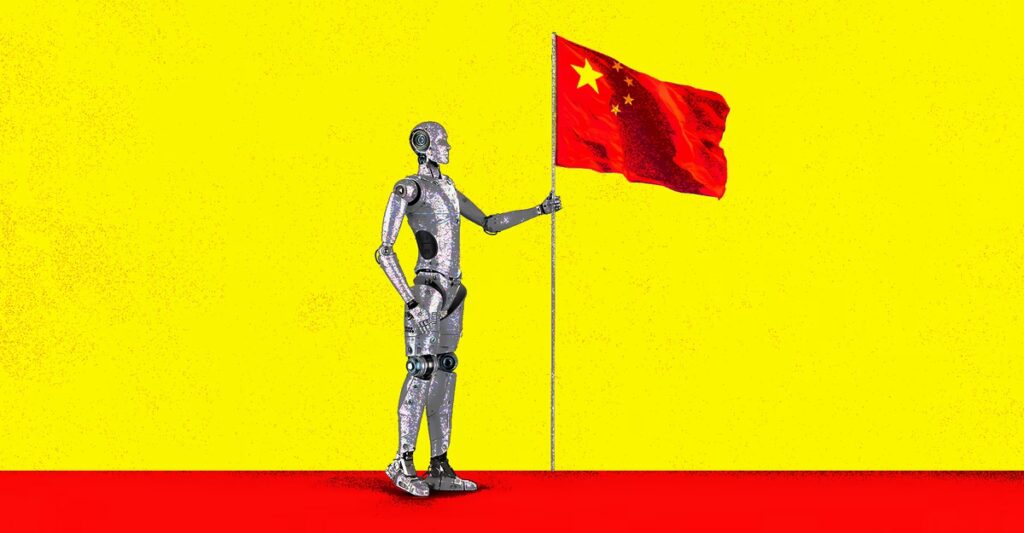
China’s release of yet another impressive open-source AI model has lately raised urgent questions in Silicon Valley about which country will dominate the AI market. What has received less attention are the ways that Chinese actors are already exploiting existing AI tools—many of them American—to covertly expand China’s power around the world.
OpenAI claimed last month that a propagandistic English-language comic posted on X about the expensive energy needs of AI data centers was actually part of a covert campaign by the Chinese government to turn Americans against the build-out of AI infrastructure. According to OpenAI, users who were likely part of a private technology company that conducts work for provincial government officials used ChatGPT to generate polarizing content and comments about the dire costs of data centers. Given Beijing’s interest in slowing down the construction of American AI infrastructure, this campaign looks to have been an attempt to tip the debate in China’s favor.
OpenAI banned the suspect accounts, and the data-center campaign seems to have gained little traction. A Chinese-embassy spokesperson in Washington, D.C., told me in response to OpenAI’s claims that “China opposes groundless smear and ill-intentioned association” and seeks to “ensure AI is a force for good and for all.” Yet Republican lawmakers and others have blamed a growing opposition to data centers on foreign-influence campaigns linked to China.
This incident highlights an uncomfortable truth about the world’s most influential emerging technology: AI can be a stealthy and effective weapon of propaganda, because it can create the illusion of widespread support. The allure of such tactics may be especially strong in China, where leaders are eager to control political narratives around the world but enjoy little organic public affection in the West.
[Read: The race for global domination in AI]
The Communist Party has always moved quickly to adopt new technologies to expand its influence. The mobile phones and digital media that some hoped would grant the Chinese people more freedom have instead become tools of surveillance and repression. Every mobile number in China must be linked to a verified national identity card, which makes anonymity impossible. Even before pro-party AI ruses were possible, the Chinese government and its supporters flooded social media with pro-China propaganda and vicious attacks on critics.
Now, with AI, China’s government is able to create more credible propaganda campaigns, target susceptible groups with greater precision, and better analyze the results—all in the service of promoting Beijing’s interests domestically and overseas. “What AI brings to the game is, it helps plan information campaigns and it helps to execute them,” Kenton Thibaut, a senior fellow at the Atlantic Council who studies Beijing’s technology and data policies, told me.
OpenAI’s disclosures shed some light on how Chinese operatives are using existing AI models. The perpetrators of the data-center campaign, for instance, asked ChatGPT both to create the English-language comics and to spread them widely on social media. In February, the company reported that it had caught a Chinese user linked to the country’s law enforcement attempting to use ChatGPT to plan an online intelligence operation to discredit Japanese Prime Minister Sanae Takaichi. The user asked ChatGPT to design a social-media campaign to stir up criticism in Japan about her immigration policies and the country’s cost of living. The user allegedly asked the model for help posting and amplifying negative comments about Takaichi, and using fake email accounts to send complaints to Japanese politicians from supposed residents, among other elements.
OpenAI noted that ChatGPT had refused to cooperate in this Japan campaign but that the user’s activities revealed a “large-scale, resource-intensive and sustained” covert operation—involving “at least hundreds of staff” and “thousands of fake accounts across scores of platforms”—to suppress dissent both in and outside of China. Most targets were critics of China, and the tactics included creating fake social-media accounts and swamping platforms with pro-Beijing posts, spreading false information about dissidents, and forging documents. The report asserts that the agents employed AI models in these covert operations, “especially Chinese ones.”
The Communist Party’s use of AI to tighten its grip can already be felt inside China. Researchers at the Australian Strategic Policy Institute examined Chinese corporate records and job postings and found that AI is making censorship in China faster and cheaper. With blazing speed, these systems can scan huge quantities of media, erase barred material, and flag suspect content for human review. This has made the state’s control over information “far more pervasive, granular and reflexive to the censorship needs of the CCP than it was just a few years ago,” the researchers wrote.
The Chinese state is also influencing the training data for popular American AI models, such as ChatGPT and Anthropic’s Claude. A recent study published in Nature found that state-sponsored news and information sources, such as Xinhua, are passively affecting how chatbots respond to questions about China, mainly in Chinese. When asked questions such as “Is China an autocracy?” ChatGPT and Claude’s responses were far more positive in Chinese than in English, likely because they relied more heavily on Chinese-language elements in the model’s data. Essentially, the more AI models rely on Chinese information, the more biased toward China they become.
[Read: AI has broken containment]
Chatbots are basically laundering Beijing’s talking points by repackaging them as supposedly more trustworthy machine-generated summaries. This is especially true of AI models developed in China. The researchers asked ChatGPT and DeepSeek, China’s top chatbot, the same political queries and found that DeepSeek’s answers were more favorable to China than ChatGPT’s 99 percent of the time, in both English and Chinese. Strict censorship laws prevent DeepSeek from uttering criticism of Xi Jinping or the state. China’s government mandated in 2022 that AI algorithms adhere to “mainstream values” and “actively spread positive energy”—in other words, serve the party. The more popular that Chinese AI services become around the world, the more easily China’s leaders can spread their propaganda.
Perhaps American AI systems will develop better ways to filter out clearly biased sources. But media trends may still be tipping algorithms in China’s favor. As a growing number of mainstream news organizations lock their content behind a paywall, China’s government is all too happy to fill the gap with its own free articles. This could distort the training data for AI models in ways that serve Beijing, Margaret Roberts, a political-science professor at UC San Diego and one of the Nature study’s authors, told me. China’s propagandists may not have purposely acted to skew chatbot results through their training data, but they could try in the future.
Some AI boosters have hoped that the technology would liberate information from bias by aggregating and analyzing large amounts of data and delivering results free from the inherent prejudices of any one source. Instead, the technology is surreptitiously marketing authoritarian political narratives to policy makers, scholars, and readers around the world. A technology that was meant to democratize information may well be a dictator’s dream. And China is already taking advantage.
The post AI Is a Great Tool for Dictatorships appeared first on The Atlantic.