Last week, somewhere amid the World Cup frenzy, a now-viral video circulated of Norwegian striker Erling Haaland mid-mouthful in a restaurant, glancing left and flinching at his own reflection. One post on X sharing the video racked up more than 31 million views in mere days. But here’s the thing: It isn’t him.
Fact checkers traced the footage to a slapstick skit by the Chinese comedian Jin Long, posted to TikTok in mid-June. The corrections were duly noted, and yet the clip kept traveling anyway. By the fourth week of the 2026 World Cup, the internet had already decided who Erling Haaland is. AI or not, in the video, Haaland was in character.
If the old model of stardom was a white-knuckle grip on your own image, the new one, as evidenced in Haaland’s recent internet fame, is being a character so vivid, so relentlessly meme-able, that AI can do the hype thing for you. The celebrity, therefore, becomes something like an open-source character, only loosely tethered to the human who has the face.
And the Haaland fake didn’t spawn from nowhere. It came out of China, where the striker has already become somewhat of a meme sensation. He has spent the past few months fronting a commercial for a Chinese herbal drink, gamely attempting Mandarin, being turned into song and being rechristened Habao (roughly, “Ha Baby”) by fans who delight in the gap between the on-pitch destroyer and the off-pitch golden retriever. As his popularity in China exploded, Haaland launched official Douyin and Weibo accounts, and quickly amassed millions of followers. The reflection clip was one artefact in an entire cottage industry of AI Haaland memes and edits, all riffing on the same joke.
Here’s WIRED’s complete guide to the 2026 FIFA World Cup.
What, then, actually happens when deepfake becomes fan art?
This is increasingly how sports fandom works online. Athletes are no longer consumed solely through highlights or post-match interviews but as evolving characters with recognizable quirks and storylines.
They’re also now getting the full fandom treatment previously reserved for fictional characters, in lore, canon, character arcs, edits. A recent report from AI sports content firm WSC Sports found that Gen Z in particular feels more connected to individual athletes than they do teams, and a survey by the consulting firm Oliver Wyman found that social media content from athletes is the single largest driver of Gen Z sports engagement.
So once a footballer becomes a character, the fans stop being mere spectators and can instead have a say in content. The “fanon,” which refers to the material the audience invents to fill the gaps the canon leaves, is now highly susceptible to AI. You no longer need the athlete to generate the lore; the audience can synthesize it on demand, and the character absorbs it seamlessly. It isn’t surprising, then, that Haaland’s deepfake was so readily embraced online. The content doesn’t have to be real, it just needs to fit the character fans have created.
Yet, perhaps what the Haaland-ification of it all suggests is a strange shift away from a mere deepfake panic. Though much of the public was, in fact, fooled by the AI video, a meaningful share of the audience is actively opting in and sharing nonetheless.
And fans have been doing this sort of thing for years. When the @deeptomcruise account started posting eerily perfect Tom Cruise deepfakes on TikTok in 2021, the response was delight in the millions. Similarly, an AI-generated track mimicking Drake and The Weeknd that appeared in 2023 created its own fan hype, getting streamed enthusiastically before the labels could get it pulled.
That same year, the Balenciaga Pope fooled half the internet for an afternoon, which actually resulted in more praise for the Balenciaga coat than it did concern over AI. Which just goes to show that if you like someone or something enough, you’ll suspend your disbelief and just roll with it.
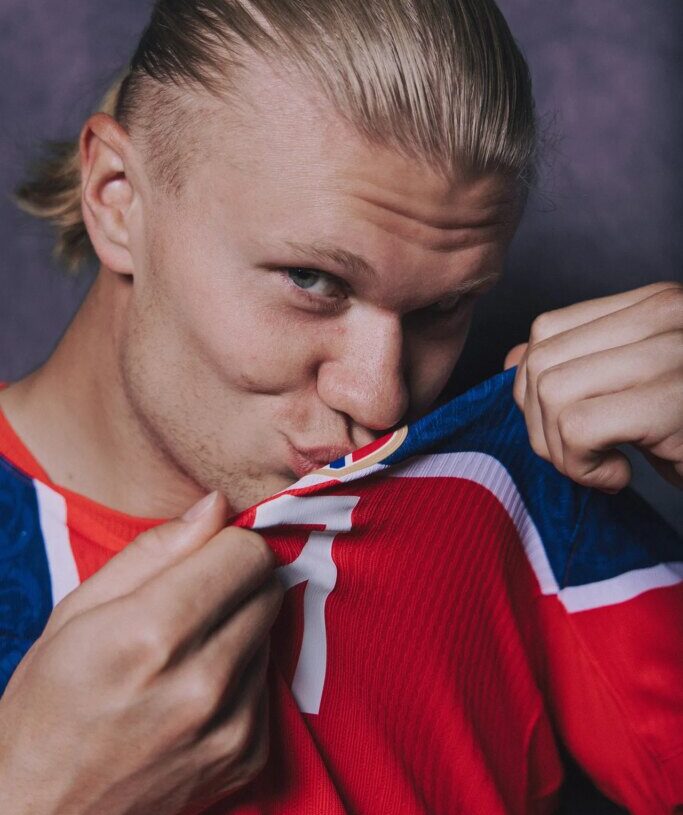
After all, Haaland was always going to be a star of this tournament—Norway’s first World Cup since 1998, a striker chasing the Golden Boot—but it’s his audacious displays of personality off the pitch that made him its unlikely main character. Modern footballers are supposed to be monomaniac automatons, media-trained and brand-protected. The Haaland canon is pretty much the opposite. His personal Snapchat account of 3.3 million followers and climbing is a masterclass in unpolished celebrity.
Through the account, Haaland has become a lovable internet persona, spawning countless memes, edits, and fan interactions that treat him more like a recurring character than an athlete. The joke, mostly, is the contradiction. On the pitch, Haaland is a frightening 6-foot-5-inch Viking-coded goal machine whose celebration face looks like something carved into a longship. Off it, he’s posting nostril-angle selfies, bald filters, Q&As, and comedic videos.
French player Kylian Mbappé is another footballer meme-ified and AI-ified amidst the internet’s current fixation with the World Cup. Making its rounds online, the “Dictator Mbappé” AI memes recast him as Mao and Kim Jong Un, usually soundtracked—with the internet’s flair for tonal chaos—by an ominous nasheed.
Despite the roots of the meme actually going back as early as 2023 after a dispute over a kebab joke, it has resurrected in this year’s tournament tenfold, showing up this time in AI-rendered fiction too (much like when Dictator Mbappé, naturally, shows up in Ancient Greece). Hype in football has always worked this way at some level; every transfer rumor runs on the fans’ appetite to believe.
But the old fantasy machine needed raw material from Haaland doing real things in the real world. And although Haaland, to give the guy his due, does indeed pump out plenty of comedic content on his own, AI now enables the fans to crank out new material manufactured to spec. The old celebrity economy depended on access to the star. The new one depends only on the audience’s willingness to keep the story going.
This article originally appeared on WIRED Middle East.
The post Erling Haaland Is Everywhere at the World Cup. Most of It Is AI appeared first on Wired.