In 1942, safe in the United States but with family and fellow Jews suffering the torments of Nazi Germany, the Polish-born artist Arthur Szyk poured out his rage in an intricate illustration just nine inches square that he called “Anti-Christ.”
Now enlarged to striking effect, the artwork — a fascist bestiary with victims on the gallows, swastika-bearing vultures and a glowering Adolf Hitler, eyeballs agleam with tiny skulls — greets visitors to an exhibition opening Sunday at the Museum of Jewish Heritage — a Living Memorial to the Holocaust, in Lower Manhattan.
The show, “Art of Freedom: The Life and Work of Arthur Szyk” (pronounced Shik), includes dozens of artworks that have been rarely or never displayed. The exhibit is a major step in a growing revival following decades of obscurity after heady celebrity during World War II and ignominy, though no prosecution, during the Red Scare of the 1950s.
The exhibit also portrays a lesser-known side of the stridently antifascist Szyk — as an avid popularizer of the American Revolution nearly a century before Ken Burns.
“I am but a Jew, praying in art,” Szyk wrote in a dedication to one of his most famous illustrated works, a Passover Haggadah.
Sara Softness, the show’s curator, said it aimed to portray “an artist rooted in his Jewish identity, but not exclusively — a person of the world, with allegiance to many nations, religions and forms of justice advocacy who looked to history to make a parable for the present.”
It includes a richly illuminated Declaration of Independence that Szyk completed in 1950, 10 years after immigrating to the United States and a year before his death in Connecticut, as well as a sketchbook of drawings he made in Paris around 1928 of Revolutionary War-era figures, uniforms and weaponry.
The pencil and pen-and-ink sketchbook fed into a series of 38 watercolors called “Washington and His Times” that Szyk produced in 1930-31. A president of Poland bought them in 1935 for President Franklin D. Roosevelt, who hung them in the White House. (They are now at the Roosevelt Home and Library in Hyde Park, N.Y.)
Szyk, stocky and bespectacled, is still largely remembered, when at all, as he described himself: Roosevelt’s “soldier in art” whose caustic caricatures, one survey suggested, were more highly prized by American military trainees than pinups.
Eleanor Roosevelt, in her newspaper column, “My Day,” in 1943, said Szyk fought the Axis “as truly as any of us who cannot actually be on the fighting fronts.”
A 1946 film short by Universal Pictures, “Cartoon Crusader” spooling at the entrance to the exhibition, calls his illustrations “powerful as an atomic bomb.”
But Szyk’s oeuvre as a miniaturist whose illuminated letters and ivied borders recalled medieval books of hours and Mughal paintings ranged widely.
He illustrated biblical stories of Job, Esther, and Ruth, and the “Song of Songs”; Flaubert’s “Temptation of St. Anthony”; two joke books called “The Jew Who Laughs”; “The Canterbury Tales”; “The Arabian Nights”; “The Rubáiyát” ; Hans Christian Anderson’s fairy tales; “The Ten Commandments”; and the racial struggle for civil rights in the United States
Szyk designed magazine covers, postage stamps, bookplates and stained glass windows. His Passover Haggadah published in 1940 was initially priced at $520, about the cost of a low-price automobile. A valuable vellum edition, dedicated to King George VI of England, is part of the exhibit.
The Museum of Jewish Heritage’s show covers many of these genres. The exhibit relies heavily on material from an obsessive collector, Irvin Ungar, a rabbi turned antiquarian, who provided 35 of the 39 original artworks shown.
This includes the Paris sketchbook, which potentially explains how Szyk was able to study his material before producing his caricatures and other works.
“I never knew it existed,” Ungar said of the sketchbook, which he bought about eight years ago. His latest book, “Reviving the Artist Who Fought Hitler: My Life with Arthur Szyk,” is to be published in May 2026.
The museum’s president and C.E.O., Jack Kliger, said he had often been in touch with Ungar. The impetus for the show came less than a year ago, when Sindy Liben offered to donate four Szyk pieces, bought from Ungar. Liben’s husband, Barry, chairman of the conglomerate Tzell Travel Group, had died in 2020.
One of the pieces, “Modern Moses” from 1943, depicts Moses linking arms with Jewish fighters. Another is a rare black-and-white poster by Szyk from the 1930s commemorating a 1920 battle of Jewish settlers and Arab militiamen..
The museum’s chairman emeritus, Bruce Ratner, became a fervent supporter of the show, eager to stress Szyk’s antifascist message.
One 1949 piece that was considered for the permanent collection proved impractical for the museum to pursue — Szyk’s 30-foot-tall Torah ark at the Forest Hills Jewish Center in Queens, which is seeking a new location. “It’s too big,” Kliger said of the ark.
Ungar, 76, said it all went back to his wedding 50 years ago. He was searching for bridal party gifts and, in a bookstore on the West Side of Manhattan, came across a 1956 first reproduction of Szyk’s Haggadah. These cost only $25, steeply down from 1940, when it was called the most expensive new book in the world.
Thirteen years later, Ungar said, he gave up his pulpit to become an antiquarian bookseller, founding his firm Historicana and immersing himself in all things Szyk. “My job,” he says, “was to know what he ate for breakfast and the color of his pajamas.”
Ungar said he took a second mortgage on his house in California and spent hundreds of thousands of dollars acquiring Szyk material, much of it originally collected by Szyk’s daughter, Alexandra Braciejowski, who died in 2016. Her older brother, George, who fought with the Free French forces in World War II, died in 1958.
Szyk was born in Russia-controlled Lodz, Poland, on June 3, 1894, to a middle-class secular Jewish family descended from rabbis; they considered themselves equally Polish and Jewish. His father, Solomon, director of a textile factory, was blinded in a workers’ job action. Early on, Arthur sometimes spelled his surname as the Austrian/Galician “Schick” but later reverted to the Polish version.
According to the book “Arthur Szyk: Artist, Jew, Pole” by Joseph P. Ansell, the young Arthur learned an early lesson in the power of art: He was expelled from school for creating a caricature of the czar. But in 1909, at 15, he was sent to study art at the Académie Julian in Paris. He spent four years there, drawn especially to medieval art, and found inspiration in the Bible.
In 1914, Ansell writes, Szyk toured Palestine and the Middle East, witnessing the struggles of Zionist settlers. When World War I broke out, he returned to Europe and was drafted into the Russian army. After the battle of Lodz he simply left and returned home to join a theater group, where he met Julia Likerman, who became his wife. He soon produced a book of anti-German cartoons, “Revolution in Germany.”
In 1921 Szyk returned to Paris, with Julia. Amid the exploding avant-gardism in art, dance and music, he focused on his Orientalist miniatures, producing 20 paintings for a biblical Book of Esther, with Julia as a model.
Later that decade, Szyk worked on an illustration some would call his masterpiece — a rendition of the Statute of Kalisz, signed in 1264 by Boleslav the Pious, Grand Duke of Poland, affirming civil liberties for the nation’s Jews. This was followed by another cherished project, “Washington and His Times,” to celebrate the 200th anniversary of Washington’s 1732 birth. Most pieces measure barely 4½ by 6½ inches.
With war clouds darkening, Szyk began lampooning Hitler, as a wolf in sheep’s clothing among other guises. He also updated his Passover Haggadah, tagging the ancient Egyptians with swastikas, which publishers insisted he remove.
Szyk also updated the text by portraying the Wicked Son as a renegade Jew with a Hitleresque mustache.
With the onset of war, Szyk’s caricatures grew increasingly venomous. In 1940, he and Julia left for the United States and a series of shows. Szyk also produced a set of medieval tableaus exemplifying Roosevelt’s Four Freedoms — of religion and speech, from fear and want.
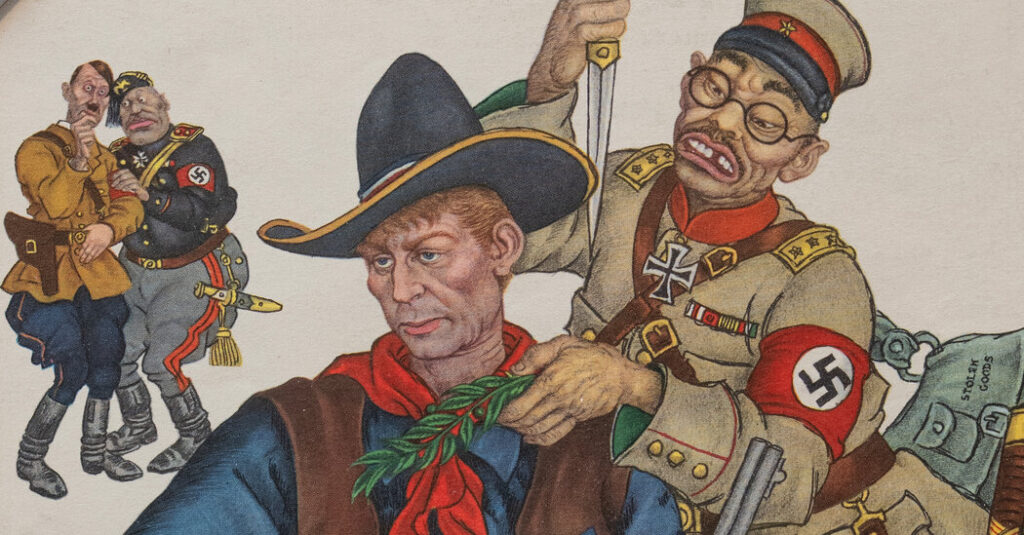
After the Japanese attack on Pearl Harbor, Szyk turned out graphic covers for Collier’s, and an illustration for Esquire depicting Hitler and Mussolini watching a Japanese soldier about to plunge a dagger into the back of an unsuspecting American cowboy, among images later deplored as racist. Szyk mounted many exhibitions and regularly published cartoons in The New York Post, the daily PM and Chicago Sun.
Szyk’s “Anti-Christ,” painted in 1942, appeared on the cover of a magazine called The Answer in 1945, shortly before Hitler’s suicide, with the caption “This is Germany.” The New York Times Book Review also headlined the work, renaming it “Chaos.”
Szyk never learned that in 1942 the Nazis sent his mother, Eugenia, and brother, Bernard, along with their Polish maid, Josefa, to the death camp Chelmno, where they were all killed.
After the war, Szyk raised money for Israel and produced an elaborate illumination of its 1948 statehood declaration. He had turned increasingly away from Poland, now in the grip of the Soviet Union. Instead, in 1950, he painted an illuminated version of the American Declaration of Independence; at nearly two-by-three feet, it was the largest work of his career.
During the anti-Communist furor, the House Committee on un-American Activities associated Szyk with seven subversive organizations, a smear that left him incredulous after all his celebrations of the United States.
But before facing the consequences, Szyk died from a heart attack — his third in two years — at home in New Canaan, Conn., on Sept. 13, 1951. After a flurry of tributes, he fell into obscurity that began to lift only in the 1990s. In 2000 he was resurrected in a major exhibition at the Library of Congress and two years later at the United States Holocaust Memorial Museum in Washington that took as one of its themes “Action — Not Pity.”
Art of Freedom: The Life and Work of Arthur Szyk
Through July 26, 2026, Museum of Jewish Heritage, Edmond J. Safra Plaza, 36 Battery Place, Lower Manhattan; mjhnyc.org, 646-437-4202.
The post Arthur Szyk: Spotlight Returns to a Forgotten ‘Soldier in Art’ appeared first on New York Times.