Robert Morris migrated from England to the American colonies as a teenager and established himself in the mercantile industry. During the Revolutionary War, his trading ships attacked British vessels and seized their cargo; after the conflict, the Founding Father became a millionaire, likely the country’s first. He later invested in frontier real estate—a good bet made too soon. Morris went bankrupt, spectacularly, and spent the years 1798 to 1801 incarcerated in a Philadelphia debtors’ prison.
Five decades later, John D. Rockefeller took a $1,000 loan from his grifter father and used it to buy an equity stake in an agricultural-trading firm. He made a fortune selling food and dry goods to the Union Army during the Civil War, and pushed his gains into an oil-refining business. By the 1910s, the Standard Oil baron had become the country’s first billionaire.
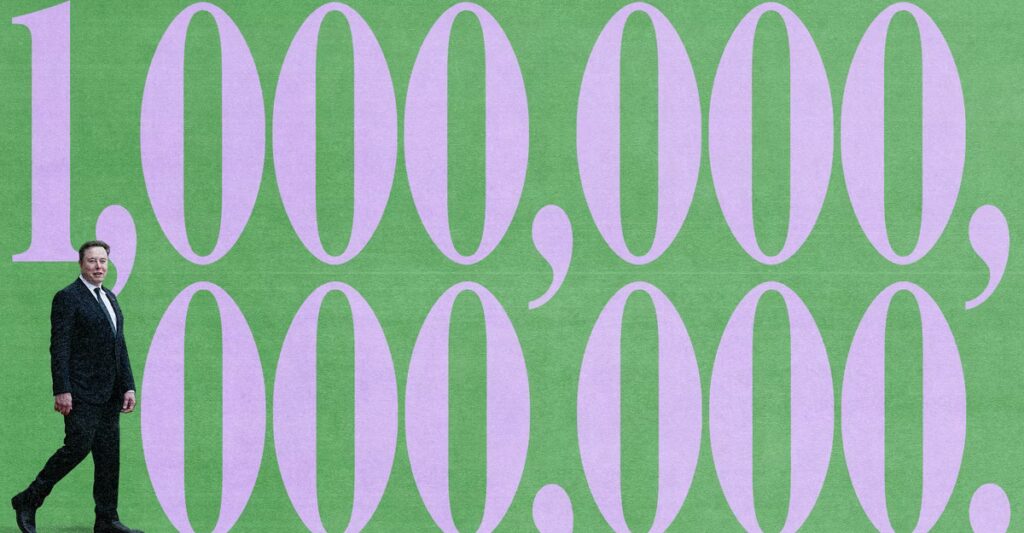
Last month, Elon Musk became the country’s first trillionaire when his rocket, satellite, and telecommunications company, SpaceX, went public. Not just that: He became the richest person in human history, surpassing Rockefeller, Cosimo de’ Medici, and the 13th-century Malian emperor Mansa Musa.
The moment feels unsurprising, perhaps inevitable. It took 100 years to go from the era of the millionaire to the era of the billionaire, and another 100 years for us to enter the era of the trillionaire. If Musk hadn’t gotten there, someone else would have, thanks to the magic of compound interest, if nothing else. Twenty individuals or families are worth more than $100 billion today, according to Forbes. Another 3,408 are worth more than $1 billion.
Still, Musk becoming a trillionaire is not the product of a stable, long-standing trend so much as it is the product of a radical, recent one in which the country’s capital class has pulled away from everyone else. The number of American billionaires has nearly doubled in a decade; the net worth of the country’s richest person has increased tenfold, after accounting for inflation. And the average family’s holdings? Those have grown a more moderate 40 percent. Wealth inequality is at a record high, higher than it was when protesters with We are the 99% banners were taking to the streets and the president was referring to inequality as the “defining challenge of our time.”
Inequality remains a defining challenge. It remains a problem America is failing to solve or even meaningfully address as the social and political consequences become more entrenched and more dire.
The issue, to be clear, is not Musk himself. Say what you will about the guy, but he made his billions the way we would want any billionaire to make their billions: advancing the technological frontier, greening the planet, buying a socially cancerous microblogging site and somehow making it even more malignant. (I jest. He lost money on Twitter.) The issue is the policy infrastructure that allows people like Musk to become not rich, not super-rich, but plutocrat-rich.
That policy infrastructure includes—well, where to start? The preferential treatment of investment income versus labor income. Low taxes on business profits. Arcane provisions that allow companies to paper over their net incomes. Right-to-work laws. The allowance of non-compete clauses. The carried-interest loophole. Setting the federal minimum wage below the poverty line. The permissibility of debt loading and asset stripping by private-equity firms. The creation of pass-throughs, which allow business owner-operators to shield their earnings from taxation. Minimal levies on estates and gifts. Weak anti-trust enforcement.
[Read: Elon Musk is dropping a boulder in a kiddie pool]
As globalization and technological change have amplified market inequality, Washington has not only kept these policies in place but rejiggered them to benefit the rich even more. The top marginal individual income-tax rate is a few percentage points lower than it was a quarter-century ago, and less than half as high as it was in the 1940s and ’50s. The top corporate rate is 14 percentage points lower than it was from 1993 until 2017. The amount you can leave your heirs tax-free currently sits at $15 million; when George W. Bush took office, it was $675,000. The United States does less to tamp down on inequality now than it did 15 or 50 years ago. It does less to hold down inequality than nearly any other high-income nation does.
As a result, the richest are becoming far, far richer than the rich; the rich are getting much richer than the middle class; the not-rich are getting nowhere. From 1989 to 2022, the amount of wealth a person needed to join the 1 percent climbed by $8.4 million, whereas the threshold to hit the median rose by $83,000. The share of assets owned by the top 0.1 percent climbed from 8.6 percent to 14.4 percent; the share of assets owned by the bottom 50 percent declined. In 2025 alone, the net worth of the country’s billionaires increased by 22 percent, from $6.7 trillion to $8.2 trillion. Today, Musk is worth roughly 30 percent more than the country’s 400 richest Americans were worth in 1989, combined.
This concentration of capital is anathema to a thriving democracy. If money is power, Musk is now 5,208,333 times as powerful as the average American household, and he has used that power to deprive children in foreign countries of life-saving medication and scientific laboratories of much-needed financing. In general, hyper-wealth gives the hyper-wealthy outsize sway over the country’s laws, regulations, elections, tax code, and courts—perverting policy outcomes, destroying social trust, destabilizing the polity’s sense of itself, increasing polarization, and ultimately destabilizing the political system too. “The more unequal income distribution is in a democracy, the more at risk it is of electing a power-aggrandizing and norm-shredding head of government,” the political scientists Eli Rau and Susan Stokes have found. And inequality isn’t great for the economy, either. It erodes human capital. It slows growth.
The good news is that policy can undo what policy has done, helping the many rather than the few. The bad news is that people like Musk will be standing in the way.
The post The Age of the Trillionaire appeared first on The Atlantic.