On a sunny November afternoon, I walked past Gulbenkian Hall, a centre for modern art, which opened in 1962 on al-Tayyaran Square near the Tigris River in downtown Baghdad. A philanthropic initiative of Calouste Gulbenkian, an Armenian businessman, who built a fortune after helping exploit Iraq’s oil resources, supported the construction of the museum with an ochre, latticed façade. Gulbenkian Hall seemed like a metaphor for Iraq: its gates shuttered, its treasures gone, its future uncertain.
[time-brightcove not-tgx=”true”]
The rich trove of early twentieth-century artworks it housed—by the Iraqi master Abdul Qadir al-Rassam and by former Iraqi soldiers of the Ottoman Empire—was relocated to Saddam Hussein’s Centre for the Arts in the 1980s. Soon after the American invasion of Iraq and the fall of Saddam Hussain on April 9, 2023, thousands of modernist paintings, prints, and photographs were looted from the Saddam Center of the Arts and other museums in Iraq.
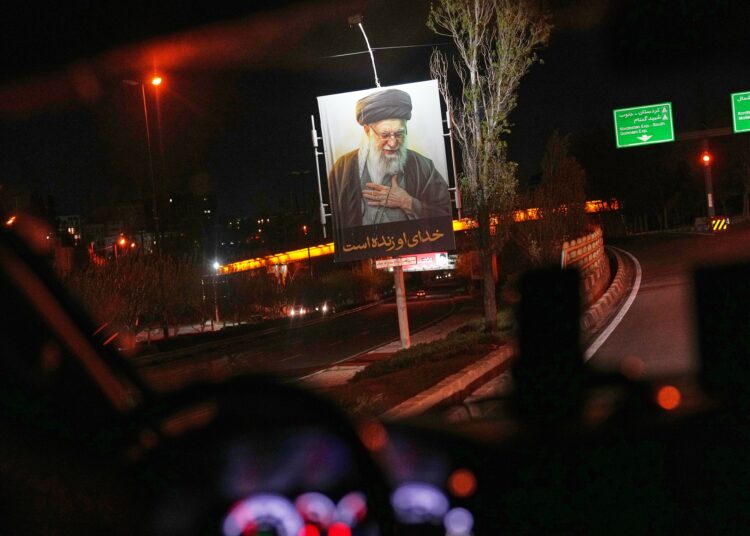
As I stood outside Gulbenkian Hall, old Baghdad seemed like profane ruins of an undesirable civilization. In labyrinthine souqs by cascading plateaus of trash, customers haggled over Europe’s fashion waste. Children from blue-collar warrens straddling the road strutted about. Some walls still carried the scars of shrapnel, and despairing alleys were submerged in rainwater. And the face of Qais al-Khazali, the leader of Asaib Ahl al-Haq, a powerful Shiite militia, gazed down from a monumental billboard. Twenty two years after the fall of Saddam, Iraqis are still waiting for transformative political and economic change.
Rituals of democracy
Sectarianism is embedded in Iraq’s political order. The unwritten diktats of the ethno-sectarian political system, designed by the Americans and their allies, stipulate that the prime minister must come from the Shia majority, the speaker of the parliament from the Sunni communities of central and Western Iraq, and the largely ceremonial president from the Kurds, concentrated in the semi-autonomous region in northern Iraq.
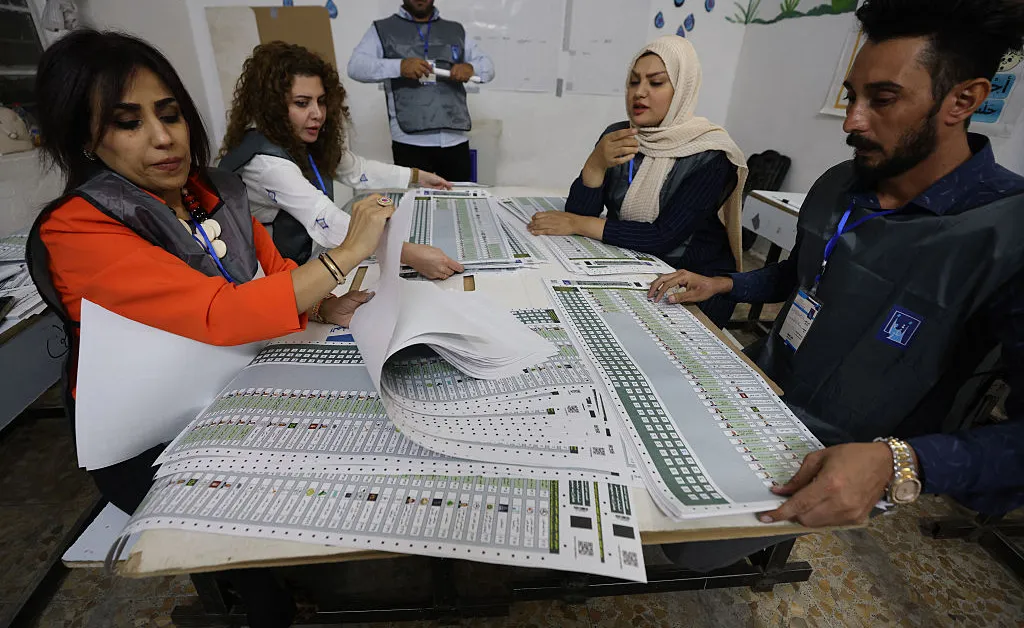
On Nov. 11, Iraq held its sixth parliamentary election of the post-Saddam era, and 7,743 candidates competed for 329 seats. Prime Minister Mohammed al-Sudani’s Reconstruction and Development Coalition was the main contestant, along with his allies in the Shiite Coordination Framework, whose familiar faces have dominated Iraqi politics since 2003.
Iraqis chose to keep things as they are. Twelve million voters, or 56.11% of the electorate, in a nation of 46 million, propelled al-Sudani to electoral triumph. Al-Sudani envisioned a Mesopotamian renaissance with handsome investments in infrastructural projects. His cabinet included former members and spokesmen of Shiite armed groups. His term was stable, but its beguiling normality masked social inequalities and eroded women’s rights.
The election results naturalized the ascent of Shiite militias in Iraqis politics. Qais al-Khazali, the leader of Asaib Ahl Al Haq Shiite militia backed by Iran, rebranded himself as a politician and his party, the Sadiqoun Bloc, won 27 seats. Al-Khazali, who fought the U.S. occupation forces, has signalled a softening of his position towards Washington. The Badr Organization, another Shiite militia backed by Iran, won 21 seats, and Harkat Hoqouq, a political outfit representing Kataib Hezbollah militia, won six seats.
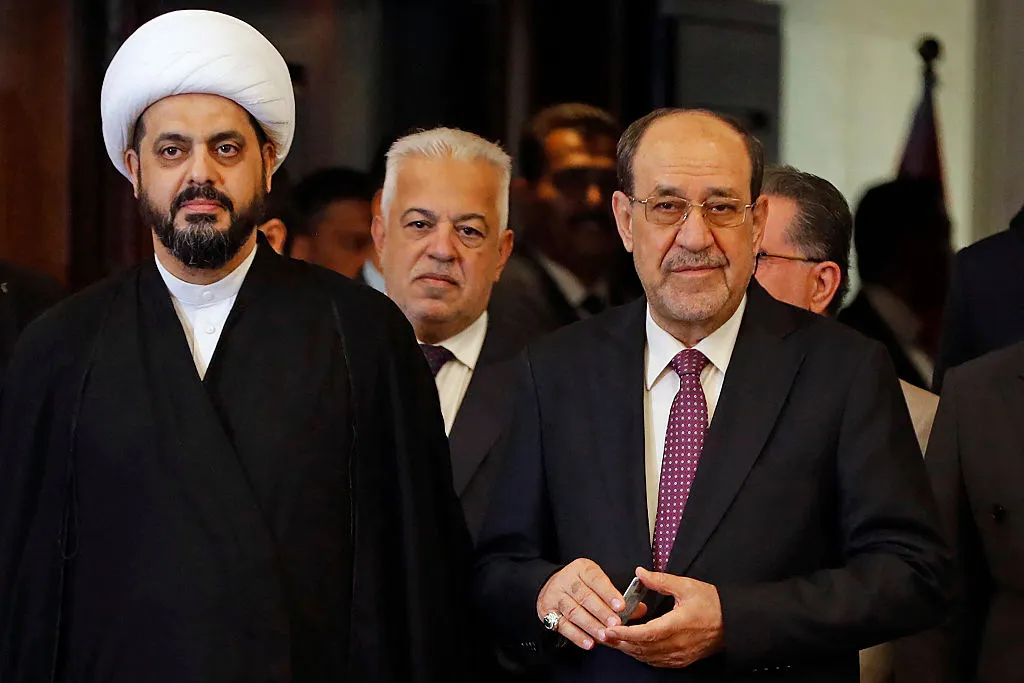
The election also readmitted the former prime minister, Nuri al-Maliki to political life. He was accused of fuelling sectarian strife, blamed for the fall of Mosul to the Islamic State, and spent several years in exile in Iran and Syria. Maliki, who leads the State of Law Alliance, a Shiite coalition, won 29 seats. Sectarian fearmongering had already permeated the elections campaign. Voters were besieged by obsolete slogans urging the Shiites “not to give it away” and reminding the Sunnis that they were part of a wider Muslim community, the Ummah. Maliki’s rehabilitation portends naked authoritarianism, further erosion of civil and press rights, and a return of bitter societal divisions.
The Taqadum party led by Mohammed al-Halbusi, an influential leader of the Sunni minority and former speaker of the Iraqi parliament, is among significant winners with 27 seats. And Muqtada al-Sadr, the influential Shiite cleric and politician, whose candidates won the largest number of seats in 2021 elections, boycotted this election. Al-Sadr has stayed away from the political process since the last elections after his negotiations with rival Shiite blocs to form the government failed.
Civil movements tried to do away with the sectarian mould of politics. Sajad Salim, a young, independent member of parliament, known for his criticism of Shiite militias, was first barred from contesting elections. The decision, which followed attacks by Shiite militias, was later overruled, but Salim still lost. Shurouq al-Abaychi, a former member of parliament, ran in Baghdad, as part of Tahaluf al-Badeel, or the Alternative Alliance, a secular, reformist coalition opposed to the ruling establishment of sectarian parties. Their defeat was an unexpected blow; she was in shock and declined to make a comment. Her coalition issued statements saying campaigners used their political clout and money to intimidate people and swing results to their favor.
How power works
What is hailed as a celebration of democracy was, at times, described as an exercise in biopolitics, in which a citizen’s biometrics became the decisive marker for reward and retribution. In the run up to the elections, al-Abaychi of the Alternative Alliance, told me that some Shia powers were “intimidating” ordinary Iraqis to secure their votes. Since state jobs are won through cronyism and bribery, livelihoods were also at stake. A government worker privately told me he was voting for a Shia figure who granted him a ministerial job. “They would know.”
In Baghdad, vote buying is the talk of the town. A young man who drove a jalopy for a living claimed to have received $70 to vote for a Sunni coalition, a considerable sum for the shoals of underpaid and forgotten. Diaspora Iraqis, the millions of those who fled sanctions, wars, and the necropolitical death worlds of the occupation were denied a say in the future of their homeland. The marauders who perpetrated the post-2003 sectarian violence weren’t.
In 2021, coronavirus was an excuse to close polling stations abroad. This time the Iraqi political establishment justified the move to prevent diaspora Iraqis from voting abroad by legislating that the designated voter cards can be issued solely in the home country. Expatriates needed to place their life on hold, travel across the world, and navigate bureaucratic hurdles to be eligible to vote. The recent census did not include expatriates but the decision is believed to affect millions of eligible voters living outside Iraq.
Iraq’s progressive voices could still unsettle the entrenched conservatives. Some Iraqis view the decision to close polling stations outside their country as a disciplinary stratagem spurred by the diaspora support for the mass protests, known as the Tishreen uprising, which started in October 2019. At that time, millions of Iraqis joined the protests and demanded the downfall of a corrupt political system midwifed by Beltway hawks and neoconservative ideologues, which has ended up beholden to the mullahs of Iran.
The Tishreen movement gained popularity among the faraway and hopeless. Donations flooded in from Chicago, London, and beyond. Security forces and paramilitary groups with links to the ruling establishment killed around 600 protesters and injured more than 20,000. Repression and the pandemic eventually forced a bitter end to a brave attempt at achieving an egalitarian future.
The 2021 elections resulted in a modest rise of secular parliamentary opposition, but they failed to disrupt the sway of the Sunni and Shiite powers, who often form cross-sectarian alliances to safeguard their rule. Victorious in the recent elections, the sectarian political establishment of Iraq is now gearing up to tighten their grip on power and share its spoils.
The victors of Iraqi elections often enter a familiar rigmarole of bargaining and deal-making to form the largest parliamentary alliance and put a government in place. This has proven a dubious and lengthy process to assert power over the state apparatus. Billions are at stake as winners seek to sustain patronage networks, co-opt independents, and assert their dominance. It is no wonder that most Iraqis regard elections as a foregone formality and the reigning order as irredeemably flawed. For the time being, the Coordination Framework, the alliance behind al-Sudani’s initial ascendance, seems poised to retain unity among Shia blocs.
It is unclear if al-Sudani will retain his position. Many outsiders think that he is making “Iraq great again.” His allies praise his tenure as prime minister for the innumerable infrastructural projects undertaken at his orders, the rise in private investments, and crucially, for keeping the country afloat in a burning region. He made overtures to Washington, projecting a version of a prosperous Iraq gradually assuming the role of a stabilizing peacemaker.
An abode of misery and distress
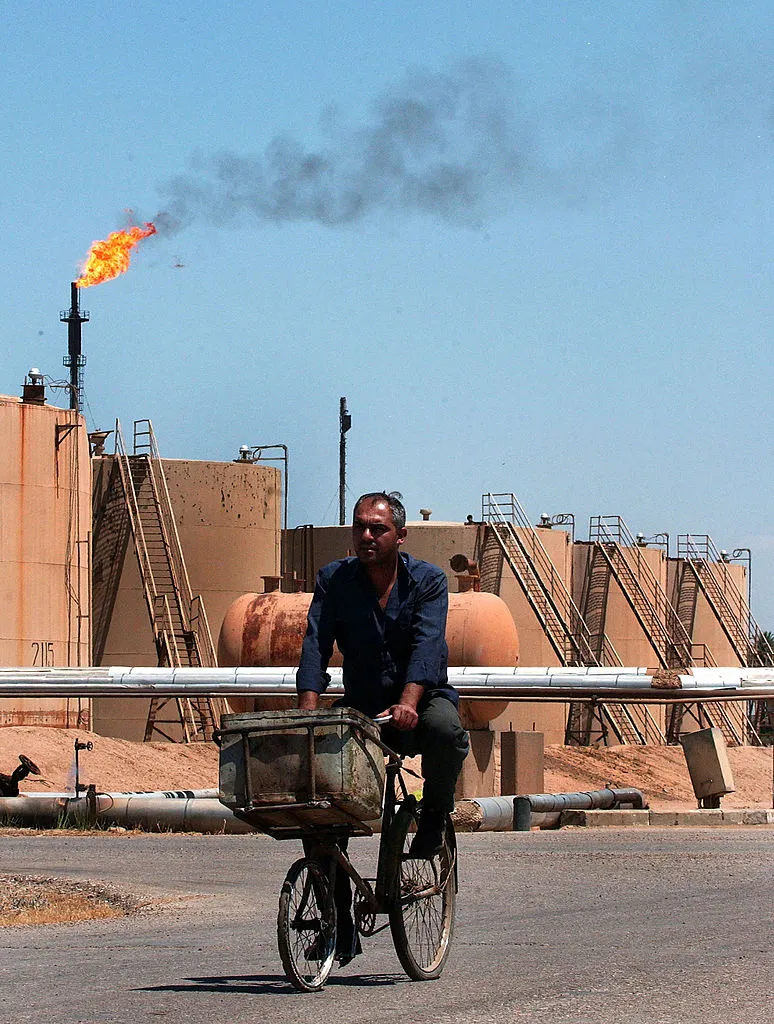
Al-Sudani inherited the chronic ailments of a broken nation. He might have tried to improve certain aspects of Iraqi life but, as a protégé of Shiite politics and a face for the Shiite Coordination Framework, he was unwilling to challenge the powers of Shiite militias. His reconstruction drive intends to normalize this political reality and the pursuit of unrestrained, rapacious fossil fuel extractivism when climate change is intensifying.
Water scarcity and pollution are creating an ecological and societal ruin in southern Iraq. Enfeebled, Baghdad has left its fate in the hands of upstream neighbours, receiving less than its entitled share of water. Iraq’s reservoirs are often near depletion, its southern waterways are dying, and its marshes remain imperilled by the oil industry. Iraqi farmers are abandoning their plots and migrating to overcrowded, underserviced urban areas. An agreement with Turkey recently promised sustainable water releases and modernizing projects, but still tied cooperation with Turkish firms for oil sales from Baghdad.
Iraq desperately needs reconstruction, but what we got so far has been poorly planned and inequitable, enriching the well-connected and opening avenues for corruption, while many live in squalor with limited access to electricity. Much of old Baghdad has been left to rot, its modernist heritage decaying, its leafy suburbs disfigured and gentrified.
Baghdad’s historic artery, the famed al-Rasheed street, is now a living image from an Oriental fantasy. Slivers of al-Rashid street have been transformed into a replica of Doha’s soulless Souq Waqif. Its façades were redone and the adjacent alleys left to crumble. A tramline will soon dissect al-Rashid. The allure of Arabian Nights appears irresistible.
These projects seem less an effort to resuscitate the city’s ailing heart than a top-down affair intended to stoke nationalism, make the city profitable, and appeal to Western governments and elite investors. The downtrodden are left behind. To many, this ancient capital, Baghdad, remains, as the Abbasid poet ‘Abd al-Wahab al-Maliki had described it, “a fine home for the wealthy / but an abode of misery and distress for the poor.”
The post The False Promise of Democracy in Iraq appeared first on TIME.