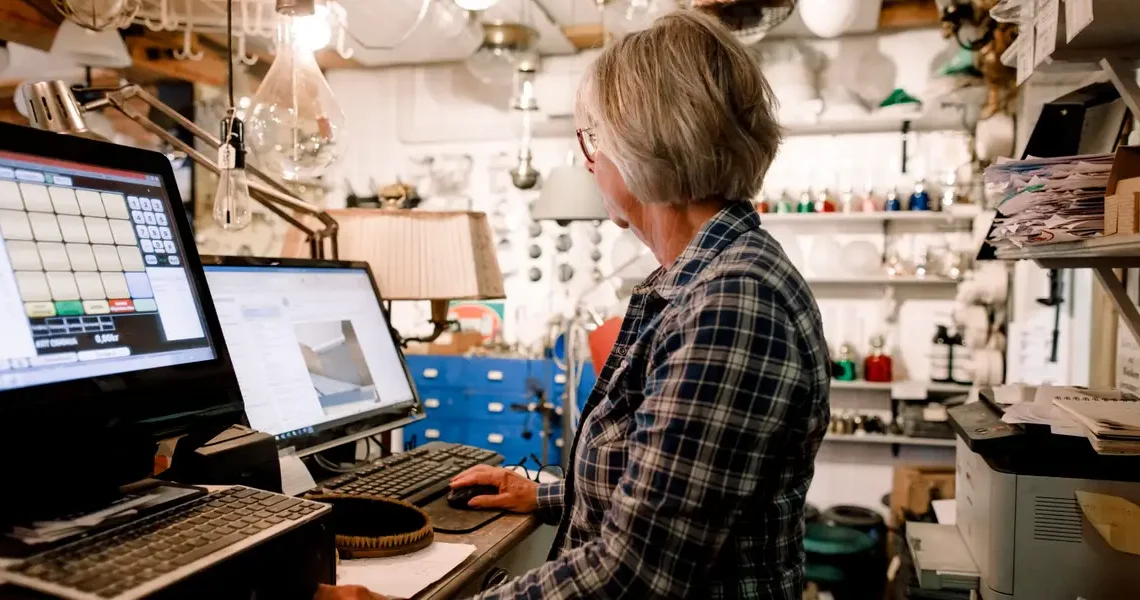

Sparkles Homes, which makes a bevy of bedazzled products for discount stores like HomeGoods, was under pressure when tariffs hit their supply chain. AI ended up being a lifesaver for the business, automating various processes and reducing marketing costs.
“I know there’s a lot of people worried about AI taking jobs, but, for us specifically, that’d be the only reason why the company is still in business,” said founder and CEO Brandon Lind. “And why the five people that still work for me do still have a job.”
A growing cohort of small business owners is using AI to cut costs and keep things running. A US Chamber of Commerce survey found that 58% of small businesses used AI in 2025, up from 23% in 2023. But AI adoption also carries unexpected consequences.
For Amy Wood, the founder and CEO of Flint Avenue Marketing, a small boutique agency in Lubbock, Texas, AI has been useful for website work and even staffing. She uses an AI assistant named “Rachel” to man the phones at their remote-first office, and a sales assistant named “Sonny” to help her track down leads.
It’s also led to some snafus. Sonny sent an obviously AI-generated email to a new lead recently, who wrote back with a “long diatribe” making fun of the AI. Rachel had a tendency to console callers, even if they’re not upset; Wood had to tell her to stop apologizing.
“If you just set it up and set it and forget it, it will create chaos,” Wood said. “It will amplify whatever chaos you have happening in your company.”
Small businesses are learning that AI is not a simple plug-and-play productivity booster. It can speed up processes and make life easier, but it can also create surprise costs, awkward errors, and an uneasy reliance on software that business owners don’t fully control.
How small businesses are adapting to AI
Ara Kharazian, the lead economist at Ramp, said that small firms are still less likely to use AI than their larger colleagues, “but when they do, they do use it more, and they use it more intensely.” Small businesses adopting AI are paying a median of about $21 per employee, compared with $11 across businesses of all sizes.
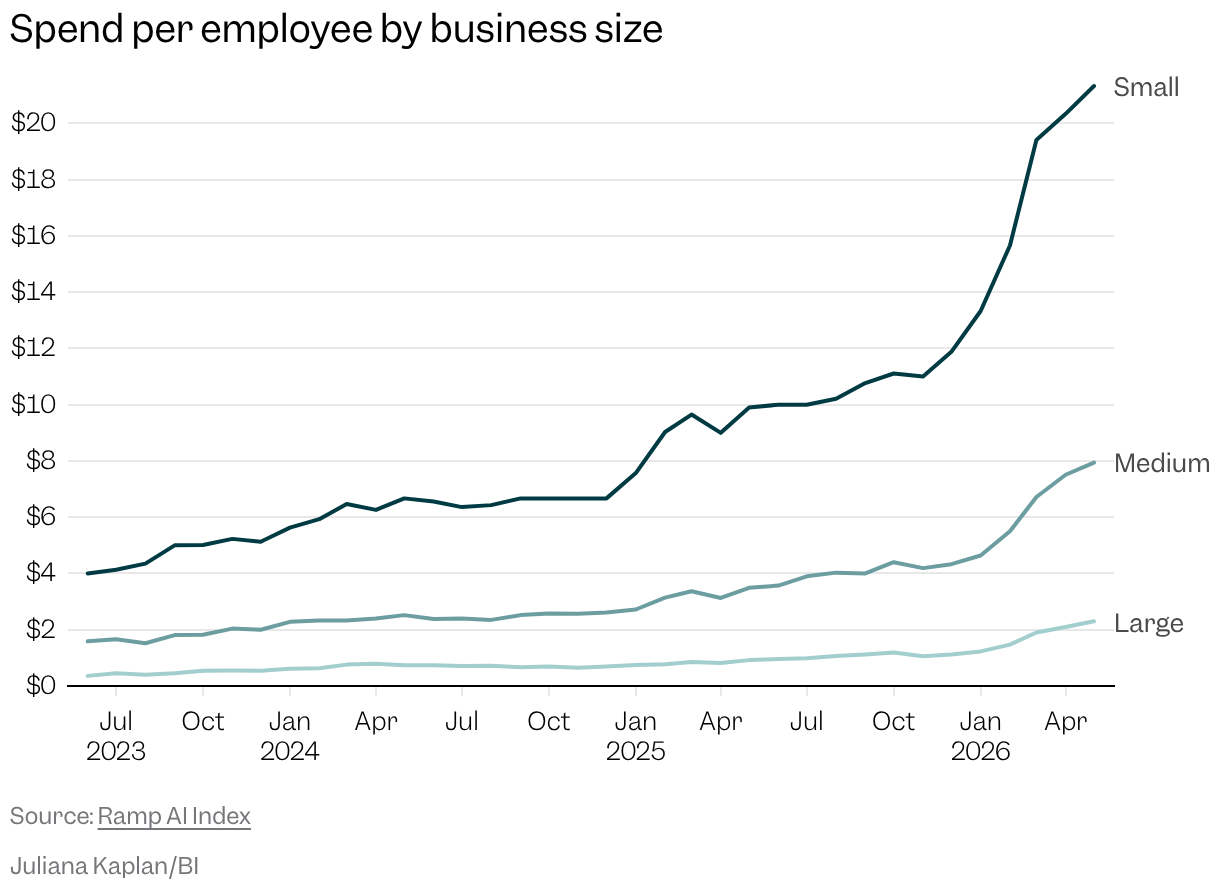
Firms with 0 to 49 workers spent, on average, $607 per worker in 2025, according to an analysis from the Federal Reserve Bank of Atlanta. In 2026, they expect to spend $1,034. Small businesses are also increasingly paying for more than one AI service, said Chi Mac, one of the authors of a report from the JPMorganChase Institute.
That’s why some owners are starting to think about AI the way they think about other operating expenses. Bill Belknap, the president of AEONRG, a construction contracting firm, said he includes AI costs in his overhead for projects. Wood now sets aside $500 a month as a buffer in case AI prices raise.
“I’m worried more that I would get something deployed and then get all dependent on it as part of my workflow, and then the prices jack up,” Wood said. “We’ve spent so much time getting our processes and everything in order, we would hate to lose that investment if all of a sudden the platform doubles in price.”
CPA Mark Gallegos said he sees smaller businesses inheriting AI costs through the software they already use, which have incorporated new AI functions. A browser might offer to summarize or turbocharge a spreadsheet, and workers click in without thinking about it.
“That’s where they don’t understand that there is an additional cost, just like anything else,” Gallegos said.
There’s also a pre- and post-ChatGPT divide in how quickly small businesses adopt AI. A JPMorgan Chase report found that for firms started in 2023, it took nearly two years for 10% of them to begin paying for at least one AI service. Firms started in 2025 took just six months. Millennial small business owners are adopting AI at the highest rate, followed by Gen Z and Gen X.
And the small businesses on the AI train are plowing ahead.
“The folks who are active adopters are generally enthusiastic and actually tell us they want more,” said Tammy Halevy, the executive director of small business organization Reimagine Main Street. “They want more use cases, they want more automation, they want more and more and more.”
Striking the right AI balance
Taking a gamble on AI is still riskier for smaller businesses that get by on razor-thin margins. That’s leading some to enact their own guardrails on the fly, whether it’s telling AI receptionists to chill out or creating careful guides to tokens.
Lind learned that the hard way: He once accidentally spent $1,000 on AI while trying to generate stock images. His LLM began creating thousands and thousands of pictures, burning through tokens along the way. He responded by putting a daily spending limit on the company’s AI usage and giving workers an AI guide with adages such as treating tokens like money and starting with the least expensive model that can do the job.
“We really need to be careful on what we’re spending, and we need to make sure we’re using AI as a tool to benefit us, and not something that’s going to put us in a worse position,” said Lind.
Wood said that, for instance, when her business received an influx of calls, she had to top up tokens to power her receptionist — a situation that wouldn’t happen (hopefully) with a human manning the phones. But even if costs rise, she’ll stay all in.
“People don’t want to hear that necessarily, but it’s still less than hiring someone,” she said. “If I hired a receptionist and a salesperson and an SEO person and an executive assistant, all of those positions are pretty much handled by AI right now.”
Read the original article on Business Insider
The post Small businesses hired AI to save money. Now they’re budgeting for its bad habits. appeared first on Business Insider.