Not long after Emil Joseph Bove III first donned the robe as a federal appeals court judge in September, one of his new colleagues was surprised upon catching a glimpse of the background image on his iPhone. It was the photo of Donald J. Trump, bloodied by a would-be assassin’s bullet in Butler, Pa., with one fist raised in the air.
A former personal lawyer for Mr. Trump, Judge Bove is not the first jurist to hold on to a political memento or two from a past life.
But the Butler photo, which was described by three people with knowledge of it, caused discomfort on the close-knit 14-seat appeals court for Pennsylvania, New Jersey and Delaware. It touches on a central question about Judge Bove, who before joining the bench was known as an attack dog for Mr. Trump: whether his loyalty to the president might override his commitment to the rule of law.
Those concerns echo a broader issue facing the country’s judiciary, as Mr. Trump fills the 13 courts of appeal with judges who have voted overwhelmingly for his agenda. About a third of federal appellate judges are now Trump appointees.
Some of those who have worked closely with Judge Bove on the U.S. Court of Appeals for the Third Circuit, and who spoke on the condition of anonymity to describe internal matters, said the answer in his case is not yet clear. They offered a nuanced picture of how the young judge, 45, is acclimating to his new role. His jurisprudence has been broadly aligned with White House policies on diversity and immigration, but he has not yet ruled on a case that clearly involves Mr. Trump’s personal interests.
Beyond the photo on his phone, which has not been previously reported, Judge Bove has drawn public criticism for attending one of Mr. Trump’s campaign-style rallies in December. The incident led to an ethics complaint that is being considered by the chief judge of an appeals court.
Nancy Gertner, a retired federal judge, said Judge Bove’s attendance at the rally suggested that he still saw himself as Mr. Trump’s advocate. “When he was nominated, my concern was that he was not just the president’s lawyer, but a zealot,” she said. “He was doing and saying things that were inappropriate. And he’s continuing to do so now.”
As he approaches the end of his first year on the Third Circuit, Judge Bove’s rulings have been reliably conservative. On a bench that prides itself on a tradition of centrist collegiality, his acerbic solo dissents have irritated some judges and lawyers.
But he has also shown a knack for persuading others — mostly the court’s five other Trump appointees — to join his opinions. And he has recused himself from political matters he had touched while he was at the Justice Department in early 2025, which legal experts point to as an indication that he is cognizant of his ethical obligations.
In interviews, some who have worked closely with Judge Bove praised his work ethic and polite manner with other judges. By all accounts, he has thrown himself into the job, rising early to drive more than an hour to his chambers in Newark, N.J., and using a text-to-speech app to listen to books and opinions on the way.
A spokesman for the court said Judge Bove declined to comment. At his confirmation hearing last year, he insisted, “I’m not anybody’s henchman.”
Judge Bove, one of three of Mr. Trump’s former personal lawyers whom he has nominated for the appellate bench, pushed hard for Mr. Trump’s policy agenda as a senior official at the Justice Department. His age and résumé (two clerkships and nine years as a federal prosecutor) have also driven speculation that Mr. Trump might choose him to fill a potential Supreme Court vacancy.
To Mr. Trump’s supporters, Judge Bove’s elevation to the federal bench represents a course correction from the first Trump term. Then, nominations were guided by the leadership of the Federalist Society, a pipeline for conservative legal talent that has drawn fire from Mr. Trump when his nominees rule against him. Now he is reshaping the bench by turning to lawyers he feels would be more loyal to him and his agenda.
Robert Luther III, who advised Judge Bove during the confirmation process, said that his detractors had wrongly caricatured him as “some sort of unhinged monster, whereas in reality he is an extremely thoughtful, deliberate, soft-spoken guy.” At the same time, Mr. Luther added, “he certainly has the fight that Donald Trump wants.”
‘Close to Crossing the Line’
Judge Bove’s legal career has been characterized by his desire to secure victories, a drive that has propelled his rise while generating friction with colleagues and judges.
He spent nine years as a federal prosecutor in the Southern District of New York, where he won guilty pleas or convictions of a Russian spy, two pipe-bomb terrorists, a Hezbollah operative and the brother of the president of Honduras.
But members of the defense bar complained about what they said was Judge Bove’s abrasive style. And in 2020, a federal judge harshly rebuked a team of prosecutors that he helped lead for failing to disclose exculpatory evidence to a defendant; he apologized at the time. Judge Bove left government the next year and joined a law firm with headquarters in New Jersey.
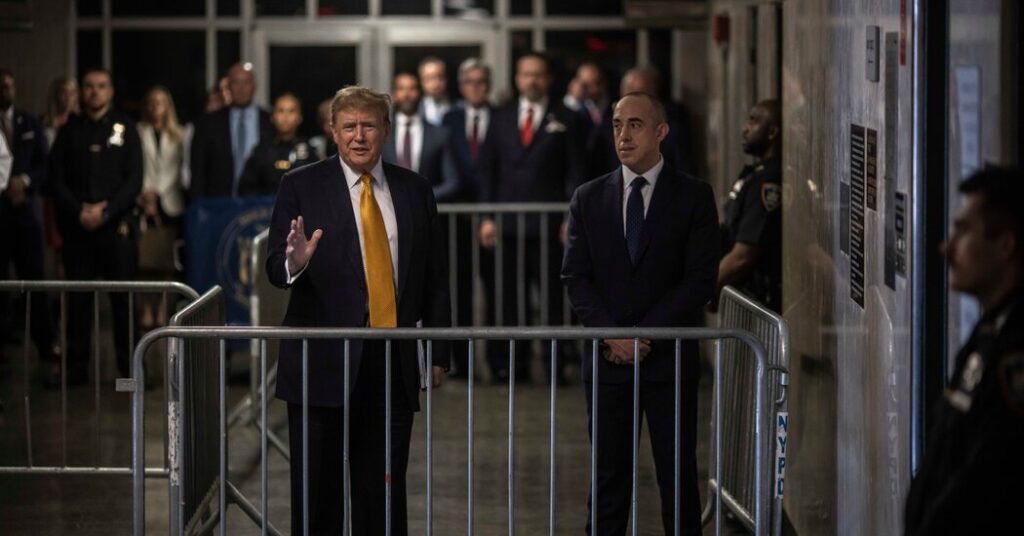
In 2023, he joined forces with Todd Blanche — now Mr. Trump’s pick for attorney general — to defend Mr. Trump from multiple criminal indictments. The move was a gamble. The former president was teetering on the brink of disgrace. During a trial stemming from Mr. Trump’s hush money payments to a porn star, Judge Bove and Mr. Blanche sparred vigorously with Judge Juan M. Merchan, who said they were “dangerously close to crossing the line of zealous representation.”
After Mr. Trump returned to office last year, he named Judge Bove to a top job at the Justice Department, where he quickly gained a reputation as a hard-driving enforcer.
One of Judge Bove’s old colleagues from the Southern District accused him of moving to dismiss a criminal indictment against Eric Adams, then the mayor of New York, as a reward for Mr. Adams’s supporting Mr. Trump’s policies. Judge Bove denied that charge to the Senate, and said the decision was made by Justice Department leadership.
Then, last summer, a former Justice Department official said that Judge Bove had raised the possibility of defying a court order amid a legal showdown over planes carrying deportees to El Salvador. The day after the meeting in which Judge Bove was accused of discussing defiance, the administration failed to comply with an order from Judge James E. Boasberg to turn the planes around.
Judge Bove has said he does not remember the remarks attributed to him but acknowledged in a court filing that he “contributed to privileged legal advice” in the case.
Adapting to the Bench
Mr. Trump nominated Judge Bove to the bench in June 2025, as the federal judiciary was consumed by cases challenging the president’s novel claims to executive power. District court judges were making headlines almost daily by blocking Mr. Trump’s agenda.
The administration pushed back by nominating Judge Bove and other Trump-aligned conservatives to the courts of appeal. Senate Democrats tried to paint Judge Bove as a Trump loyalist in his confirmation hearing. He barely squeaked by, with a 50-to-49 vote in the Senate.
Questions over how Judge Bove would adapt to the bench persisted. After the Senate vote, but before his swearing in as a judge, he continued to work at the Justice Department. Weeks later, his Third Circuit colleagues were discussing the image of Mr. Trump that one of them had spotted on his phone. And a reporter spied him at a campaign-style rally held by Mr. Trump at a Pennsylvania casino.
He told a reporter who spotted him there that he was “just here as a citizen coming to watch the president speak.” Fix the Court, an advocacy group, filed a complaint saying he had violated rules that prohibit judges from engaging in “political activity.”
But Judge Bove has also taken measures to safeguard his independence.
Last summer, after his Senate confirmation, he met with Alina Habba, another former personal lawyer for Mr. Trump who was then the acting U.S. attorney in New Jersey, according to two people familiar with the meeting. While such meetings between judges and prosecutors are common, this one could have posed an ethics issue because of an active lawsuit in Judge Bove’s circuit over whether Ms. Habba could keep her job without Senate confirmation.
But when that case reached his appeals court, Judge Bove recused himself from considering the matter.
He also recused himself from a lawsuit about the government’s attempt to deport Mahmoud Khalil, an activist whose case overlapped with his earlier role at the Justice Department.
Jeremy Fogel, a retired federal judge who consults with judges on ethics questions, said the two recusal decisions were clearly required by the judicial code of conduct. “In both of those instances, he followed the rules,” he said.
Regarding the iPhone image, Judge Fogel said that while it did not pose an ethics problem, it did raise the question of how Judge Bove was balancing his private views with his public role, particularly given his attendance at the Trump rally.
On the bench, Judge Bove has shown restraint, at least when compared with other appellate appointees of Mr. Trump, one of whom tried to draw attention to an opinion by littering it with obscenities. At a series of oral arguments earlier this year in Philadelphia, he was a muted presence, often yielding the floor to his colleague Judge Stephanos Bibas, another Trump appointee and former law professor who brings some of the energy of a lecture hall to the courtroom. Judge Bove too seemed immersed in even the weedier points of law, chiming in with narrow, pointed questions and sipping from a bottle of water.
In written opinions, Judge Bove has hewed to a conservative line.
In April, he wrote a ruling vacating $250,000 in punitive damages awarded to a woman who was injured by police during an arrest. He flagged “questionable rhetoric” at trial by the plaintiff’s lawyer, who invoked the death of George Floyd.
He also wrote for a panel that found a New Jersey police officer was entitled to a trial to determine whether he had been discriminated against as a white man. In that case, along with another about Pennsylvania mail-in ballots and a third about attorneys’ fees for some immigration cases, Judge Bove made himself the voice of the court’s conservative wing on an issue of national import.
But the opinion that has attracted the most notice so far was Judge Bove’s first, a dissent from a routine order.
Thomas Batista Ramos, a migrant from Brazil, was making a last-ditch attempt to avoid being deported. After considering Mr. Ramos’s initial emergency motion for less than a day, two other judges on the appeals panel, appointees of Barack Obama and Ronald Reagan, agreed to temporarily pause the government’s efforts to deport him so the court would have more time to decide.
Judge Bove indicated he disagreed with their two-sentence ruling, without explanation, as is typical. When the court issued a more lasting ruling nine days later, the two other judges had come around, denying Mr. Ramos’s request because he had filed in the wrong court.
Judge Bove could have stayed quiet. Instead, he seized on the chance to explain why his colleagues had erred in not siding with him immediately.
The court was wrong, Judge Bove wrote, to “have interfered with D.H.S. operations for an instant.” In his view, the delay unjustly harmed the executive branch, which had to pay for seats on planes and beds at detention centers.
The case would now be heard by a different court, but Judge Bove still felt compelled to weigh in on its merits. Judge Gertner called the opinion “gratuitous” and “sophomoric.”
But for conservatives, the outspoken defense of Mr. Trump’s deportation agenda was heartening.
Michael Fragoso, the former chief counsel to Senator Mitch McConnell, has posted what he called a “trolling meme” showing Judge Bove alongside Judge Aileen M. Cannon of the Southern District of Florida, who issued a series of rulings favorable to Mr. Trump when he was being prosecuted, as newly minted justices on an expanded Supreme Court.
Judge Bove, Mr. Fragoso said in an interview, was already proving himself capable of persuading his peers.
“Anyone can write a law review article in a dissent,” he said. “What’s harder is getting to a sound outcome as part of a three-judge panel.”
Kitty Bennett contributed research.
The post Emil Bove Defended Trump in Court. Then Trump Made Him a Judge. appeared first on New York Times.