I have a letter that my father wrote to the rabbi at Temple Sinai in New Orleans, where he was a third-generation member, 60 years ago. We were part of the local Jewish establishment; our family had arrived in Louisiana from Germany back in 1836. I was 12, the age when Jewish boys would typically be preparing for a bar mitzvah.
My father was upset about a national publication for Jewish children, called World Over, that I had brought home from the temple’s Sunday school. He had two objections: First, World Over was “pretty strong Zionist or Israeli propaganda,” and second, it contained “open criticism of American policy in Vietnam.”
Not long after this, my Jewish education came to an end; maybe most American Jewish boys my age were going to be bar mitzvahs, but not I. For years after that, my family never did anything explicitly Jewish. Our preferred way of being Jewish was disappearing.
Back then, World Over represented the direction in which American Judaism was heading. Politically, most American Jews were liberal Democrats (and still are). Most were also ardently Zionist, and they considered that to be a liberal stance — to them it meant supporting a fragile social-democratic nation established as a home for refugees, which had wrested its independence from the British Empire and immediately had to defend itself against the hostile armies of the surrounding countries. My father, who considered himself a Southern gentleman, was neither liberal nor Zionist, so he was deeply uncomfortable with the standard-issue American Jewish positions of the day.
Over the years, I have moved toward the way of being Jewish that my father rejected. But today, my way of being Jewish stands as another orphaned version of American Jewishness, as my father’s very different version was all those years ago. With jarring suddenness, it now seems no longer possible to be at once comfortably Jewish, and also Zionist, and also liberal, and also fully accepted outside the Jewish world.
Jewish America is in a kind of collective identity crisis, as the new contours of our place in the world, since the Hamas massacre of Oct. 7, 2023, and Israel’s brutally conducted subsequent wars, have emerged. Open antisemitism has awakened from one of its periodic slumbers.
I have spent the past few years researching my family’s history, going back to our roots in Germany in the late 18th century. What that has made clear to me is how fraught the project of Jewish membership in the wider world has always been. For most of Jewish history, the great majority of Jews have lived in separate, self-contained, observant Jewish communities. Then, with the coming of the Enlightenment, in parts of Western Europe, Jews were gradually — the word will sound strange in 21st-century America — “emancipated,” meaning that the ubiquitous restrictions on where we could live, what work we could do, where we could study and what rights we had were lifted or at least loosened.
This process was always controversial, externally and internally. The relatively few non-Jews who were champions of Jewish emancipation — people like the German historian Christian Wilhelm von Dohm, the author of “On the Civil Improvement of the Jews” (1781) — usually saw the Jewish character as having been warped by centuries of oppression, and wanted Jews to change as the price of acceptance. We would adopt last names. We would cease to engage in our traditional occupations of peddling, trading and money lending. We would give up our custom of de facto self-regulation and submit to the full authority of the state.
Such opportunities were available, or even attractive, to only a few Jews. The traditional Jewish community, with its all-encompassing rituals and sense of solidarity, could be a comfortable place, one that not everyone longed to escape, if that became an option. “There were locks inside the ghetto gates in most cases before there were locks outside,” the historian Salo Baron wrote in a famous essay in 1928.
The familiar categories of Judaism — Reform, Conservative, Orthodox — arose, first in Europe and then in the United States, out of disagreements about exactly what post-Enlightenment Judaism would entail. Reform Judaism, aimed at revising Jewish practice so that it would seem less strange to outsiders and would be more consistent with prosperous non-Jewish life, immediately engendered, in reaction, the stricter versions of Judaism.
These disagreements among Jews were over profound questions, pitting particularism against universalism. Are we properly understood as a people, a proto-nation, with a highly distinctive way of life, or as another of the many ethnic groups in the American melting pot, one that happens also to have a religious tradition? Long before the establishment of the state of Israel, debates over Zionism were a way of arguing about this.
My father was an adherent of the Pittsburgh Platform of 1885, the founding document of American Reform Judaism. One of its central precepts was this:“We consider ourselves no longer a nation, but a religious community, and therefore expect neither a return to Palestine … nor the restoration of any of the laws concerning the Jewish state.”
This renunciation of all-encompassing Jewish identity tied to a physical place was never especially popular with Eastern European-origin Jews who were then arriving in the United States and soon would become the American Jewish majority; back then, the idea of living as fully accepted Americans adhering to universal values was a fantasy that only prosperous German Jews could entertain. Even the Reform movement had dropped its opposition to Zionism by the late 1930s, because the rise of the Nazis made it obvious that the future of Jews in Europe was bleak.
In the New Orleans of my childhood, where change in all forms was not welcomed, we lived in an anachronistic Pittsburgh Platform bubble. Maintaining it was, increasingly, hard work: The Holocaust and Israel didn’t comport with our preferred version of the Jewish condition, so we tried not to talk about them. Elsewhere, Jewish America was overwhelmingly Zionist.
The American Jewish majority is now having its own struggle over the compatibility of Jewish identity and mainstream life. By the last decades of the 20th century, Jews whose families had come from Eastern Europe had become mainly middle class while continuing to think of themselves as being on the side of the underdog. (German Jews’ political comfort zone was something closer to elite liberalism, of a kind that is familiar today even as German Jews as a strong category are not.)
The old barriers that for decades had governed where you could live and work and study and socialize were falling; a 20th-century, American version of Jewish emancipation was underway. It has seemed for half a century or more that one could achieve — through being successful, culturally Jewish, Zionist, liberal and not especially observant — the blended status that has persistently eluded Jews.
This set of certainties has evaporated. Today, Israel is the pariah nation of the world, and “Zionist” has become an epithet, something it’s unacceptable to be, at least in progressive circles. Politicians running in Democratic primaries are routinely prompted to distance themselves from Israel, and, often, from the idea of an explicitly Jewish nation-state; in the Republican Party, politicians feel pressure from the extreme anti-Israel turn taken recently by conservatives like Tucker Carlson, Candace Owens and Megyn Kelly, who command large audiences that include many of their voters.
From the outside, this may seem to be a problem with a straightforward solution: America’s old-line Jewish organizations need only drop their unqualified, criticism-silencing embrace of the Israeli government’s actions. Then younger-generation Jews can lead us into a new non-Zionist version of American Jewishness, one that regards Theodor Herzl’s embrace of political Zionism as a relatively recent and eminently correctable mistake in Jewish history. From the inside, though, the situation looks very different, and not nearly that simple.
I have made a decades-long journey from my exit from Temple Sinai to being an engaged member of a Conservative congregation in New York, which it’s fair to describe as observant and mainly on the left politically. The return to power of Benjamin Netanyahu, at the head of a far-right coalition, in 2022 was a devastating blow, compounded by his government’s failure to prevent the Oct. 7 attack and its conduct of the wars that followed.
But the idea that a psychological divorce from Israel is possible seems fanciful. Almost half of all Jews live there; many of us have Israeli friends and relatives. Most of us are regular visitors. It’s hard to imagine a week going by on our resolutely apolitical internal email list, heavily devoted to recommendations of plumbers or electricians, that doesn’t mention Israel as a routine aspect of life’s logistics.
Many American Jews grew up (unlike me) in a world of Jewish day schools, Jewish summer camps, gap years studying in Israel between high school and college, little blue tin boxes in which a few coins for Israel would be deposited just before the Sabbath. In many American Jewish families that fled Europe, it was the luck of the draw whether they wound up in the United States or Israel. Thriving synagogues where Israel isn’t mentioned, where the Israeli flag isn’t displayed, where the congregation doesn’t say a weekly prayer to the Jewish state, are rare, even in the Reform movement. This lived experience makes it clear why a Washington Post poll last year showed that three-quarters of American Jews agree that Israel is “vital for the long-term future of the Jewish people,” even as the poll respondents were also harshly critical of the Netanyahu government.
Most political movements fail. Zionism’s success in establishing a Jewish state wasn’t inevitable — nothing is — but it’s easier to understand in the context not only of the mass murder of Jews in Europe and, after the Second World War and into the 1970s, our expulsion from most of the Middle East and North Africa, but also of Jewish tradition.
The main story line of the Hebrew Bible is of an exiled people’s search for a homeland. Long before Herzl, Jews prayed facing Jerusalem, and at least notionally have longed for the rebuilding of the Temple there. Zionism touched a deep collective yearning for self-determination, for self-protection, for freedom from perpetual outsider status. All this makes the idea that Israel and Zionism can easily be factored out of American Jewish life seem almost fantastical. It asks us to give up a portion of our souls.
The American liberal Jewish majority has rapidly entered an environment of increasing violent attacks on synagogues and other Jewish institutions, ubiquitous conspiratorial and obsessively anti-Israel demagogues with mass followings, heightened intramural tensions with Israelis, forced choices between Zionism and membership in the progressive world and often bitter private conflicts within congregations and families. Whatever sense of serene belonging we once had is rapidly disappearing. What do we do now?
It helps to begin by adjusting expectations. It’s an illusion to think that Jewishness can ever be entirely comfortable or that our identity can be made to comport seamlessly with some set of universal ideals. We are, historically and also in the present, much more outsiders than insiders. It should not be surprising to have that made manifest again now.
The way of being Jewish that I have found, after a long journey, is to be more observant, and more particularist, than I was raised to be. The way I was raised didn’t last, because it jettisoned too much ritual and too much solidarity. A life of Jewish practice and a sense of shared peoplehood is, for me, a foundational source of joy and structure and meaning, which in no way precludes discussions of all the issues that are roiling the Jewish world right now — which, believe me, we never stop arguing about.
My own advice for the perplexed among liberal American Jews would be, first, participate actively in the religious life of the community. That will connect you deeply to your people, back through time and everywhere in the world in the present. Second, and inextricably linked, study the Torah and the other essential texts.
There you will encounter anything but a world of simple moral verities. Our patriarchs and matriarchs were all deeply flawed people, and the consistent failings of our people were collective as well as individual. Understanding that makes for a much better vantage point from which to contemplate the situation of Israel today than being subjected to litmus tests about Zionism from people who don’t understand how deeply embedded it is in most Jewish hearts.
Like many aging sons, I find myself reflecting on my similarities and differences with my father. On the surface, we wound up in quite different places, geographically, politically and Jewishly. But we both, in the end, have been Jews who occupy a liminal space: almost belonging, but not quite. These days, that feels like an inescapable collective destiny.
Nicholas Lemann is the author of “Returning: A Search for Home Across Three Centuries.”
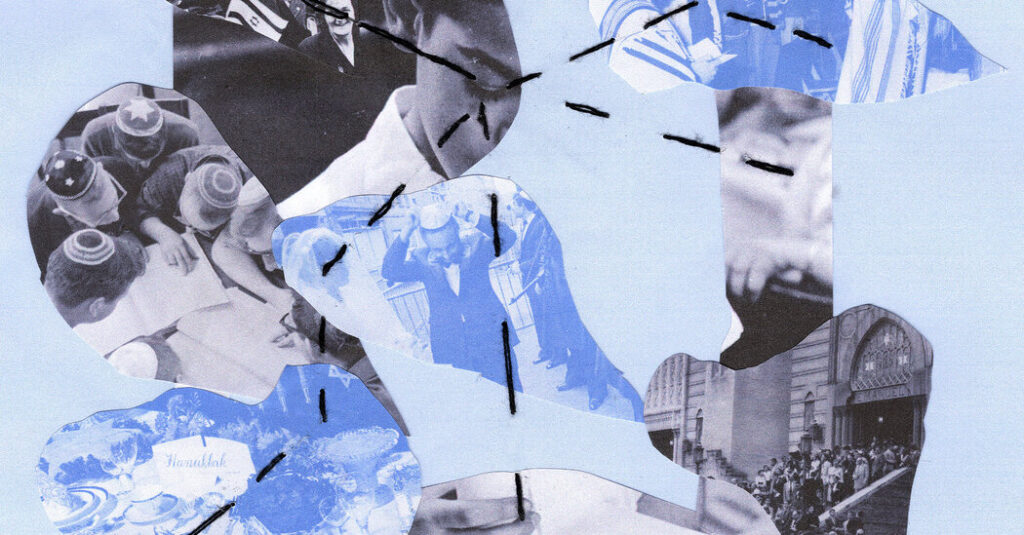
Source photographs by Bettmann, Ira Gay Sealy, Underwood Archives, Fairfax Media Archives, william karel and Nocella/Getty Images
The Times is committed to publishing a diversity of letters to the editor. We’d like to hear what you think about this or any of our articles. Here are some tips. And here’s our email: [email protected].
Follow the New York Times Opinion section on Facebook, Instagram, TikTok, Bluesky, WhatsApp and Threads.
The post The Collective Identity Crisis of Jewish America appeared first on New York Times.