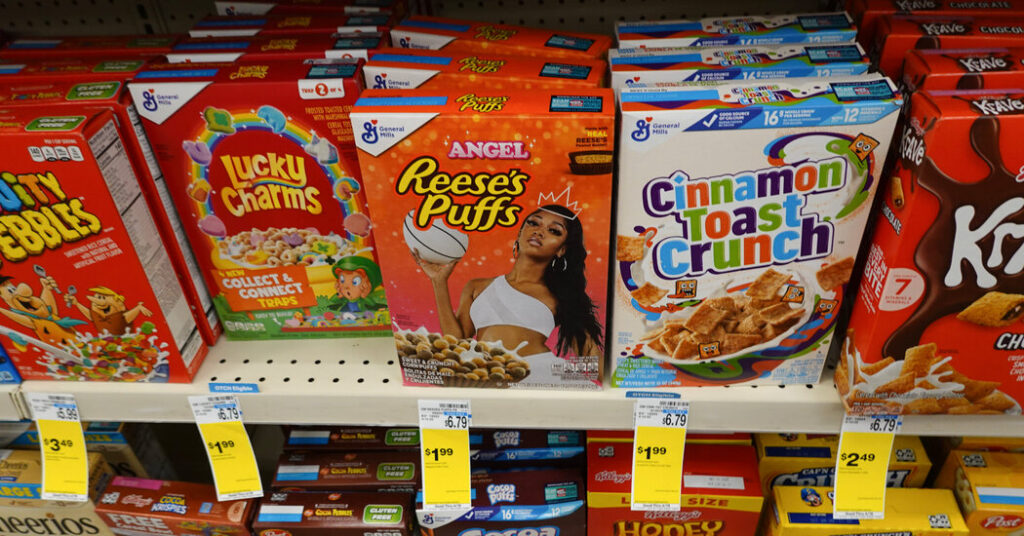
Step 1: Jot down your ideas and share with a partner.
-
How often do you eat American breakfast cereals, like those pictured above? Are you a fan?
-
Does it matter how healthy breakfast cereals are? Why, or why not?
Step 2: Read a Times article about a recent study.
Read the New York Times article “American Breakfast Cereals Are Becoming Less Healthy, Study Finds,” published on May 21. It begins:
Breakfast cereals, a heavily marketed, highly processed mainstay of the American diet, especially among children, are becoming less healthy, filled with increasing amounts of sugar, fat and sodium, according to a study published Wednesday in the journal JAMA Network Open. The study also found that cereals’ protein and fiber content — nutrients essential for a healthy diet — have been in decline.
The findings, based on an analysis of 1,200 new or reformulated cereal products introduced in the United States between 2010 and 2023, are likely to add fuel to the ongoing debate about the relationship between processed food, mounting childhood obesity and the rising prevalence of chronic diseases.
Step 3: Analyze the study.
1. What was the scientific question that researchers wanted to answer?
2. How did researchers plan and carry out their investigation?
3. What do you notice in the above graphs, taken from the study? What story do the graphs tell?
4. What new data did the investigation yield? (Data is the factual information collected during observations, experiments or studies.)
5. What explanation did researchers construct using the data they collected and interpreted to answer their original question?
6. What significance does this research have for science, the world or our lives?
7. What is one thing you learned about this study or about how scientists approach their work?
8. What further questions do you have about this research and its significance?
Step 4: Work with others to come up with your own scientific investigation.
In this study, researchers tried to better understand trends in the nutritional content of new or reformulated breakfast cereals. Collaborate with others to propose another scientific investigation about nutrition. For example, a scientist might want to investigate the nutritional content of different types, brands or flavors of yogurt.
-
What scientific question might you want to answer?
-
Briefly describe how you might design a study using similar techniques mentioned in the article to try to answer that question.
More?
• Science Practice, a new resource aligned with the Science and Engineering Practices for the Next Generation Science Standards, aims to help students better understand how scientists actively gather evidence-based knowledge and solve problems. Learn more about this feature in this introductory post.
• See all the lesson plans in this series.
The post Science Practice | A Study on Breakfast Cereals appeared first on New York Times.