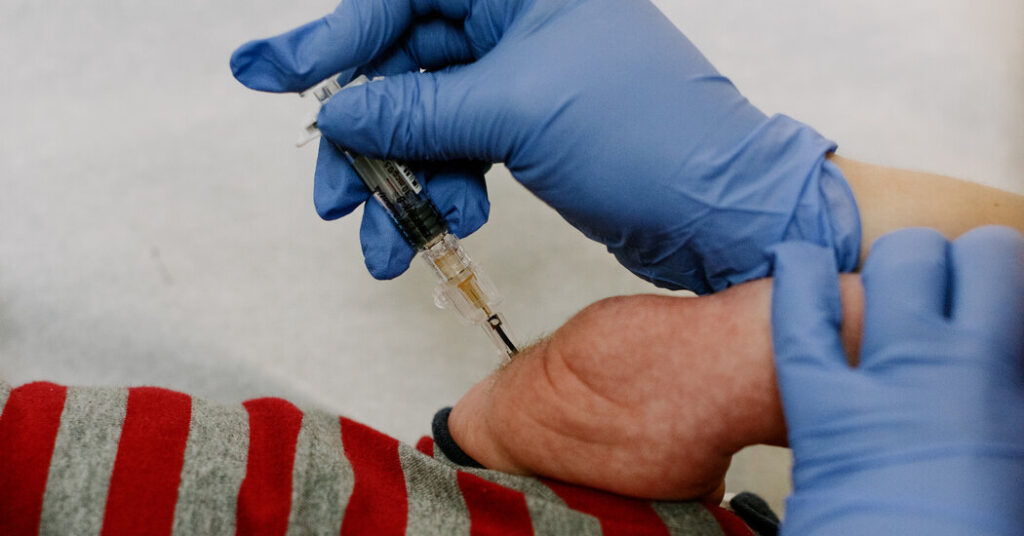
An influential advisory committee convening on Thursday may reverse a decades-old recommendation that all newborns receive the hepatitis B vaccine, which guards against an infection that can leave lasting liver damage.
Since 1991, the Centers for Disease Control and Prevention’s vaccine advisory committee has recommended that all newborns receive the hepatitis B shot. (The panel later recommended catch-up vaccinations for children who were not immunized as babies; it first recommended the vaccine in 1982 for people who were at high risk.)
But some of the nation’s top health officials and President Trump have cast doubt on a vaccine that doctors call lifesaving. Health Secretary Robert F. Kennedy Jr. has repeatedly questioned whether babies should continue to receive the vaccine on their first day of life, arguing that the disease is mainly transmitted through sexual contact and sharing needles. But the virus can also pass from mother to child at birth. In September, Mr. Trump said that he thought children should not get the shot until age 12.
Members of the C.D.C. advisory panel, who were handpicked by Mr. Kennedy, were poised to vote on whether to limit the use of the shot in September but postponed the decision after a confusing and often chaotic meeting.
While most adults who contract hepatitis B will recover, young children who contract the disease are at far greater risk of becoming chronically ill. Babies receive three doses of the vaccine; the initial shot is given on the first day of life.
Rates of hepatitis B fell sharply in the decades after the C.D.C.’s recommendation: Acute infections reported among children and teens dropped by 99 percent between 1990 and 2019. And while overall childhood vaccination rates have declined for years, rates of infant immunization against hepatitis B in particular do not appear to be falling.
Still, Dr. Debra Langlois, a pediatrician at University of Michigan Health C.S. Mott Children’s Hospital, said that most weeks, she speaks with parents who do not want their babies to receive the shot.
How does hepatitis B spread?
Hepatitis B, which can be up to 100 times more infectious than H.I.V., spreads when bodily fluids, like blood and semen, from an infected person enter someone else’s body. The virus can pass from person to person through sex or shared needles, including equipment used for tattooing or piercing.
An infected mother can pass hepatitis B to her baby during birth. And the virus can linger in microscopic traces of bodily fluids, meaning that specks of dried blood that end up on nail clippers, towels, tooth brushes, razors or other items can be infectious for a week.
“It’s not just the stigmatizing exposures,” said Dr. Langlois. “It can be every day household exposures with a family member that doesn’t know they have it.”
The disease has become relatively rare in the United States. The C.D.C. estimates that about 640,000 U.S. adults have chronic hepatitis B, though many adults do not show symptoms.
Hepatitis B is more common in other countries, especially in parts of Africa and Asia, in part because of low vaccination rates. The World Health Organization estimates that there are around 1.2 million new infections of hepatitis B each year globally. In 2022, the organization noted, over one million people died after contracting the virus, largely because of liver complications.
Antiviral drugs can help prevent liver damage, but there is no cure for the disease.
Why do doctors recommend the hepatitis B vaccine at birth?
Most pregnant women in the United States are screened for hepatitis B in the first trimester. But screening isn’t perfect, and testing negative in the first trimester “doesn’t mean you cannot contract hepatitis B later on,” said Dr. Amanda Kost, a family medicine doctor at University of Washington Medicine. Some research suggests as many as 14 percent of pregnant women may not get tested, which may be because of inadequate prenatal care or because they refuse the test. There is also a rare risk of false negatives. These screening gaps are one reason doctors recommend a first dose of the vaccine the day a baby is born.
If a woman tests positive for hepatitis B during her screening, doctors will closely monitor her and sometimes administer an antiviral treatment during her third trimester. On the first day of life, her baby will receive hepatitis B immune globulin, an injection that helps provide antibodies. This, along with the vaccine, can prevent transmission.
Without these interventions, an infected mother is “virtually guaranteed” to transmit the virus to the baby, said Dr. Jaime Deville, a pediatric infectious disease physician at the University of California at Los Angeles School of Medicine.
Children who contract hepatitis B will develop either a short-term or chronic infection. Short-term infections can last for a few weeks to several months. Most children under the age of 5 do not have symptoms. Those who do can develop jaundice, fatigue, nausea, vomiting and muscle aches.
But babies who are infected in the first year of life have about a 90 percent chance of developing a chronic infection. And about 30 percent of children infected between the ages of 1 and 5 develop chronic hepatitis B. Left untreated, chronic infections can lead to irreversible liver damage, scarring, failure and cancer over time. These complications can be deadly.
How safe and effective is the vaccine?
Hepatitis B vaccination protects around 98 percent of healthy infants, according to the C.D.C. Many studies have shown that side effects from the shots are typically mild and temporary, and can include fatigue, headache, fever or soreness at the site of the injection.
Dr. Elisa Hampton, a pediatric hospitalist at University of Virginia Health, said the first thing she asks patients who don’t want to give their newborns the vaccine is: “Tell me your concerns.” Often, they reply with some version of: “Why should I give this to my baby, anyway?”
“The answer I give is that it’s a safe vaccine,” she said. “It is very effective. And if you could start your baby’s protection from this minute, at birth — that would be what we recommend.”
Dani Blum is a health reporter for The Times.
The post The Hepatitis B Vaccine Is Under Threat. Here’s What at Stake. appeared first on New York Times.