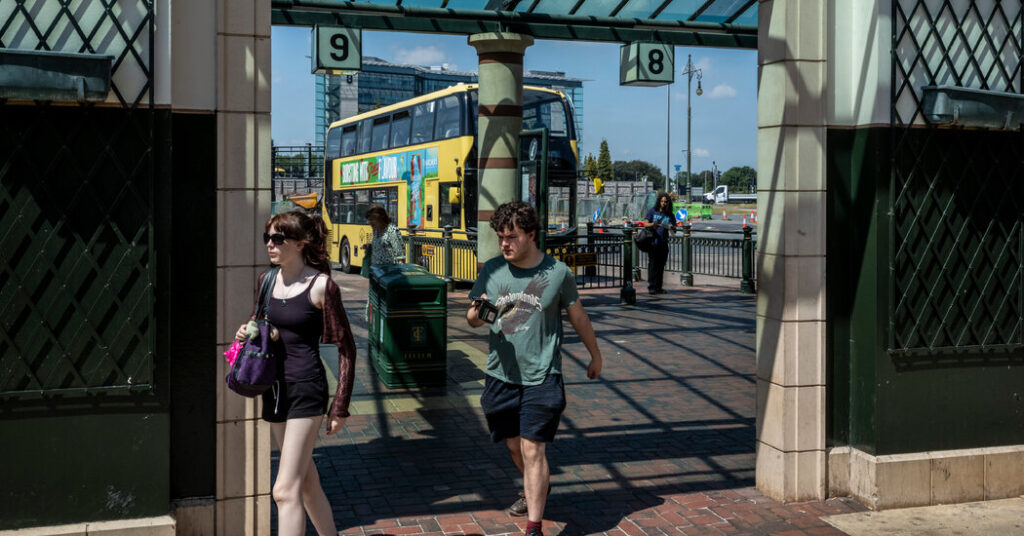
As she waited to board the 126 bus that would take her home to Leigh, a town outside Manchester in northwest England, Emily Armstrong counted the ways the service had improved.
“It’s definitely got a lot better — there are way more buses than before,” said Ms. Armstrong, 19, as she sat in the shade outside the Trafford Center, a mall near Manchester.
She praised the fact that the city had rolled out discounted travel for people aged 18—21 (passengers between 16 and 18 travel free on many services). And she likes the convenience of paying by simply tapping a card or her phone, rather than buying a paper ticket. “You don’t even have to speak to the driver any more,” she said.
These are all features of the Bee Network, a tightly regulated public transit system introduced in 2023 in Greater Manchester, which includes the city and the area surrounding it. Improving bus travel has been a cornerstone policy of Andy Burnham, who was mayor of the region for nine years until last month, and who is expected to become Britain’s next prime minister. It has won the attention of local politicians elsewhere as an example of a policy that has had a direct impact on the lives of city dwellers and proved popular with voters.
In the United States, Mayor Zohran Mamdani raised expectations before he won office by promising to make New York City’s buses free for all riders. So far, there are limited signs of progress, with the Metropolitan Transportation Authority, the state agency that runs the subway and buses, opposing the idea. Last week, however, the City Council announced an expansion of New York’s discounted public transit program for low-income residents.
When Mr. Burnham became mayor in 2017, the city already had two free bus lines, created in 2002, meaning that travelers who arrive at the main rail station can travel without paying to several key parts of the city center.
But public transit across the region was, in many places, infrequent and chaotic. Under changes introduced by Prime Minister Margaret Thatcher in 1985, most municipal-owned bus services outside London were deregulated and privatized. The argument was that the profit motive and market competition would cut fares and improve journeys.
A cross-party parliamentary committee concluded in 2019, however, that “the promised benefits have never materialized,” adding: “In fact, the 30-year policy of deregulation, outside of London, has made the situation worse in most areas.” Services were cut on less busy routes, fares rose and bus use declined.
By contrast, London, where regulation remained in place, ended up with a successful integrated transportation system, Transport for London. Partly inspired by that model, Mr. Burnham used powers that were granted to his municipality well before he became mayor to take control of bus routes across Greater Manchester, bringing private operators under local regulation. When two bus companies resisted his plans, he faced them down in court.
That victory allowed him to integrate the system. He rebranded it as the Bee Network — Manchester has used the worker bee as a city symbol since Victorian times — with buses and trams painted bright yellow. Rival bus operators used to compete on popular routes, with tickets valid only on one firm’s service. Now the system is much more flexible: Two pounds, about $2.65, gets you a “hopper” ticket that lets you use several different buses within an hour. A ticket for a day’s unlimited bus travel is £5.
Punctuality and frequency of services has improved and there is smoother coordination with the city’s tram network.
“Buses are not perceived as sexy,” said Jason Prince, director of Urban Transport Group, which represents city transport authorities. He was also head of government engagement at the Greater Manchester Combined Authority during Mr. Burnham’s time as mayor. “What Greater Manchester did is, we saw re-regulation of buses as a key device to support economic output and social goals.”
He added: “What we have is these bright yellow buses, bright yellow trams, yellow bikes. And people are quite attached to the Bee emotionally. People think it’s our network. It’s almost given a boost to civic pride.”
According to Transport for Greater Manchester, the transportation authority, punctuality now exceeds 80 percent, compared with less than 70 percent before the changes.
Almost half the network’s costs are covered by paying passengers. Revenue from local taxes accounts for another 25 percent, according to Transport for Greater Manchester, and the final 25 percent comes from central government funding.
Low fares, including the £2 fare cap, are supported by those three sources of income.
Waiting for the number 30 bus in the city center, Carrie Bolger, a manager at a music venue, said transit had “improved, it is more frequent. It’s all the same network, bus and tram.” She uses the bus to come into the city for meetings.
Asked about the yellow hue of the rebranded network, Ms. Bolger, 38, described it as “very bright,” adding with a laugh: “You can definitely see the buses.”
The post How Yellow Buses Helped Fuel the Rise of the Man Poised to Lead Britain appeared first on New York Times.