The sun was high, the tide was low and the magnificent humpback lay peacefully — as if asleep — on the sandy central Oregon shore.
Lisa Norton, 54, and fellow members of the Confederated Tribes of Siletz Indians formed a circle around the whale. They laid down tobacco as an offering and prayed, thanking the whale for its life and its sacrifice.
Then, with deference and sharp knives, they got to work.
It was the first time in generations that the members had harvested a whale, said Norton, the tribe’s chief administrative officer. The traditional practice of many coastal Indigenous communities is mired in government restrictions on tribes’ hunting and fishing rights and efforts to protect marine mammals.
For decades, most Siletz members didn’t seek to harvest, Norton said. But in mid-November, Oregon State Police approached the Siletz to discuss the fate of a young whale that had stranded on a beach north of Yachats.
Local authorities, Oregon State University scientists and National Oceanic and Atmospheric Administration officials spent two days trying to get the whale back in the ocean. Thousands watched online, hoping for the mammal’s recovery.
When it became clear the whale would not recover, state police asked members of the tribe whether they wanted to salvage it. The Siletz agreed, so NOAA issued the tribe a permit to do so.
On Nov. 17, veterinarians euthanized the animal. The next day, about 20 members of the tribe gathered around the roughly 27-foot, 20,000-pound whale.
They carefully cut out the blubber, as well as the whale’s bones, skull and baleen (a feeding system made of keratin that’s attached to a whale’s upper jaw). Because of health concerns, the tribe did not collect meat for consumption.
“To be able to witness our tribal members do something that hasn’t been done for generations, and that they were able to revive — and we’re still learning, of course — that part of our tradition … thinking about that is overwhelming” Norton said. “We wanted that whale saved as much as the community. But we were honored with the gift to salvage those pieces and use them for good.”
In that way, she added, the whale lives on, too.
Tribal members worked alongside NOAA’s Marine Mammal Stranding Network and Oregon State University’s Veterinary Diagnostic Laboratory, which sent a nine-member necropsy team. They began around midday, Norton said, when the sun was shining and the skies were clear after days of rain.
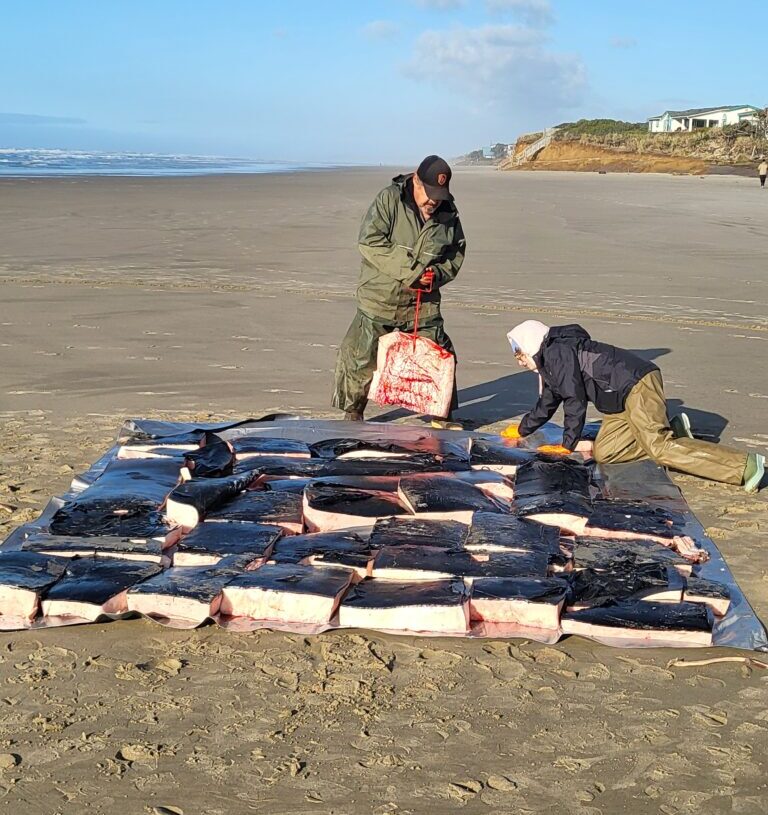
After a collective prayer, the teams worked in tandem. The scientists evaluated the mammal, slicing through skin to extract samples for study. Tribal members carved into other parts of the whale, peeling back squares to expose blubber and delicately laying them out to transport later.
Their tools were simple, Norton said: “very sharp” knives and meat hooks.
“It was this very symbiotic relationship, where they allowed us to work and we made their jobs easier in the end, too,” she said. “When they were done with the head, we had removed the blubber from the back. Then they could access the back side of the whale to take samples, and it was made easier for them to get in — the blubber is already off.”
The Siletz also taught the necropsy team certain techniques, Norton said. The team wanted to cut a sample of baleen from the jawbone, but the tribe wanted the jawbone to remain intact. A tribal member demonstrated how to sample the baleen without dismantling the jawbone.
“It was really a remarkable day of learning, both scientific learning and cultural learning,” said Kurt Williams, director of the Oregon Veterinary Diagnostic Laboratory. Williams’s team spent about five hours performing the necropsy. “It was honestly the best day I’ve had at the lab.”
“How many people get to be next to one of the great whales, a really iconic species?” Williams said. “It was a once-in-a-lifetime experience from a science and cultural standpoint.”
The tribe received help from a construction company that volunteered its tools — the company’s mini excavator helped detach the whale’s head from its body. It was part science, part art: “Our team cut back all the parts of the base of the skull,” Norton said. Then, the whale’s body weight was leveraged off the mini excavator to detach the skull from the spinal cord.
The tide crept up. The sun sank. The necropsy team had departed, and just seven tribal members remained.
“It was getting dark,” Norton said. “It was just really unsafe to continue.”
The tribal members buried the whale’s meat and some of the blubber determined to be unusable.
“We put it in this deep trench, knowing it will be washed back out to sea. It needed to go out to sea to feed the other creatures,” Norton said. “For us it was just like, this is what you do. The parts you aren’t going to use go back to nature, and nature handles that.”
About 9:30 p.m., the Siletz loaded the rest of the whale onto a piece of construction equipment for transport to their reservation. The tide had begun to lap at their heels.
The tribe’s members drove away from the beach, whale in tow, and spent the next several days harvesting the remainder of the mammal. Its blubber was cleaned, packaged and flash-frozen, its skull and bones carefully preserved.
Tribal members will collectively determine how to use the parts. The blubber may be rendered into oil, used for fuel or soap. Its bones may be used in tribal regalia, or to build paddles and clubs. The parts may be displayed in a museum, commemorating the historic occasion, Norton said. The key is that the whale’s death will not be in vain.
“We can retell the story of that whale, and that story goes on for generations,” she said. “To take this tragic thing and — we didn’t make it beautiful — but we made the best of a tragic situation. And that’s valuable.”
The post Oregon tribe harvests its first whale in generations appeared first on Washington Post.