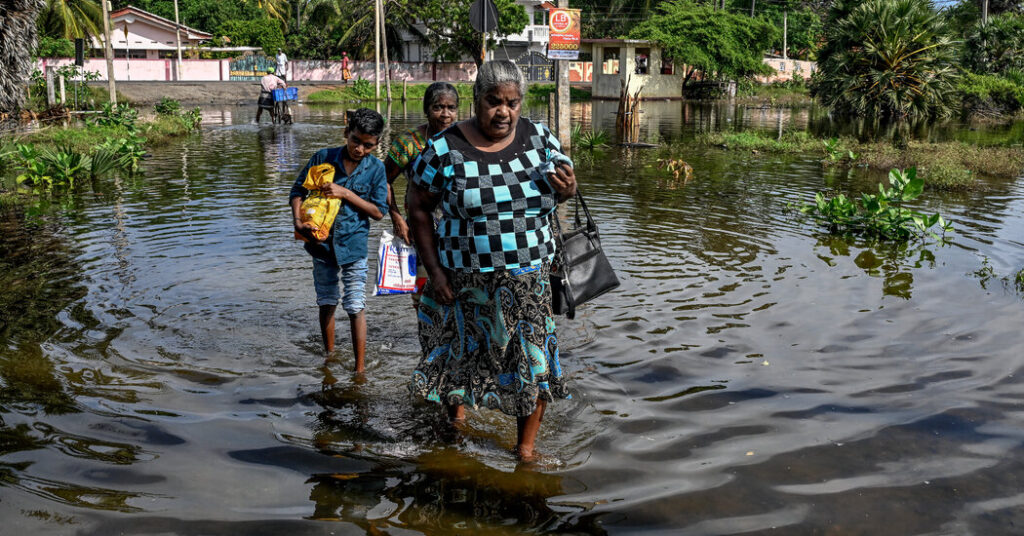
As the floodwaters from the devastating Cyclone Ditwah recede and families carry out the rites for the more than 400 people found dead, Sri Lanka is turning to a different kind of tallying.
Gutted rail lines, ravaged fields, washed-away roads and bridges, and broken dams. Altogether, the damage could cost the island nation as much as six or seven billion dollars to rebuild, initial estimates by officials show.
For a country of modest means, one still emerging from the shadows of a decades-long civil war and a choking economic collapse just three years ago, that is a demoralizing task. It is compounded by what is a particularly dispirited moment in international aid, with funding contributions for humanitarian causes plummeting so low — in large part by the precedent set by the United States to pull back as a major donor — that the United Nations has called it “an age of indifference.”
Duminda Hulangamuwa, the senior economics adviser to Sri Lanka’s president, said the government had met with major funding agencies and countries friendly to Sri Lanka on Wednesday, many of whom were helping with relief assistance and had shown a willingness to chip in for reconstruction. But they would all wait for an official assessment of the damage that the World Bank has started, he said.
“It is not going to be easy,” Mr. Hulangamuwa said in an interview.
Another senior official, Prabath Chandrakeerthi, who as commissioner general of essential services is tasked with coordinating the immediate disaster response, laid out a stark picture of how extensive the devastation has been.
The amount of damage to the country’s infrastructure was “probably 10 times” the damage caused by the Indian Ocean tsunami in 2004, he said in an interview on Thursday. That tsunami killed tens of thousands and inundated coastal areas but did not cover the swaths of the country that Cyclone Ditwah did.
The country’s rail system has faced severe damage, with less than one-third of the 1,000 miles of rail lines operational after the cyclone. Social media videos showed rail lines suspended with the bridges washed away. Mr. Chandrakeerthi said the extent of damage to the rail system was such that Sri Lanka would need “the technical assistance from other countries” to rebuild.
The economic crash in 2022, caused by corruption and mismanagement of the country’s balance of payments, doubled the poverty rate to nearly a quarter of the population. Officials fear that another 10 percent who were bordering the poverty line could be pushed into it by the cyclone’s economic devastation.
“Loss of livelihoods, rising costs and service disruptions disproportionately affect low-income households, women, children and older persons,” the country’s Disaster Management Center said in a statement.
About one-third of Sri Lanka’s population makes a living from agriculture. The more than 137,000 acres of land that have been destroyed by the floods, along with wrecked dams and canals, have inflicted a heavy economic toll just weeks after rice paddies had been planted.
Many farmers like Abdul Majid Azam, 26, in the country’s northern Mannar district, have started back at zero. The paddy he had cultivated just weeks ago could not be salvaged. Most of the fertilizer stocks in the market nearby were lost when floodwater gushed through them.
In the midday heat, he and two other farmers were back in their fields, still inundated, counting their losses and preparing to plow and plant again.
“All of this was destroyed,” he said.
Mujib Mashal is the South Asia bureau chief for The Times, helping to lead coverage of India and the diverse region around it, including Bangladesh, Sri Lanka, Nepal and Bhutan.
The post Ruined Rice Fields and Broken Rail Lines: Sri Lanka Counts Cost of Cyclone appeared first on New York Times.