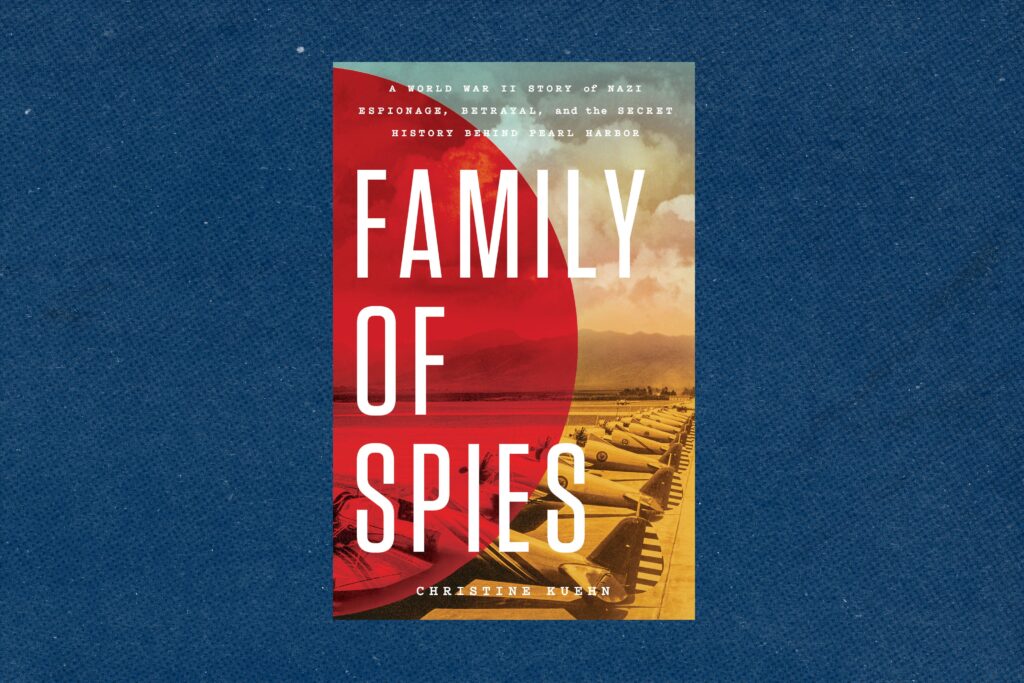
In 1994, a suburban wife, mother and journalist named Christine Kuehn received a mysterious letter in the mail from a filmmaker. Its message? A suggestion that her grandparents were Nazi spies who facilitated the Japanese attack on Pearl Harbor.
As Kuehn would soon learn, when her father, Eberhard, was a child in 1935, he moved with his half sister, Ruth, along with his brother and their parents, from Germany to Hawaii. The Japanese empire needed White spies on Oahu. The letter that Kuehn received suggested that from 1935 to 1941, her family sent intelligence along to the Japanese.
Kuehn spent three decades researching her new book, “Family of Spies: A World War II Story of Nazi Espionage, Betrayal, and the Secret History Behind Pearl Harbor,” drawing from family and government archives, countless books, and fragmented conversations with her aunt and father. The resulting narrative is hamstrung by an assumption that people must be monsters to do evil. But the tale still offers promising leads for historians and other scholars, not to mention raw material for future novelists and filmmakers, as well as a ready-made page-turner for beach readers.
Kuehn’s German grandfather, Otto, was a prisoner of war during World War I who later found his footing in the Nazi Party. When he married Kuehn’s grandmother Friedel, she brought along Leopold, her son from an earlier relationship, and Ruth, her daughter from a brief affair with a Jewish architect.
Otto and his stepson Leopold attended their first Nazi rally in 1930. During the Night of the Long Knives, in 1934, Otto was assigned to kill a man, crept into his bedroom and accepted a bribe instead. Leopold was a more diligent follower of Nazi orders. He ascended to the position of deputy in Joseph Goebbels’s Ministry of Public Enlightenment and Propaganda. Ruth, meanwhile, soon started an affair with Goebbels. Kuehn’s research led her to believe that Goebbels discovered Ruth’s half-Jewish ancestry, a development that prompted the family’s relocation. Leaving Leopold behind to serve the Reich, the family arrived in Hawaii in 1935.
Introduced to the Kuehn family by Goebbels, the Japanese government paid exorbitant sums of money to Otto and Friedel to host lavish parties so that they could collect secrets on Oahu, where the family’s Whiteness was a source of power. Ruth dated strategically, and she and Friedel opened a faux hair salon to serve as a front where they could overhear information. Otto and Friedel dressed their young son, Hans, as a sailor so that American naval men would invite the cute child aboard their ships. He was trained to report details back to his father, who conveyed the information to Japanese intelligence.
Kuehn writes with dual aims: Working from a place of love, she seeks to understand what happened to her father, but she’s also on a mission to wrestle with whether her family was evil. She bravely confronts this fearful question, but it limits the book’s interpretive range. She posits a hierarchy of monsters, topped by Adolf Hitler and other famous Nazis. The next tier includes her family. She speculates that if her grandfather had remained in Germany and worked, as he had hoped to, with Heinrich Himmler, he might “have found a way to appease Hitler on the Jewish question. The Kuehns had Jewish friends. Maybe he would have saved thousands.” Ultimately, though, she concludes that he “was a Nazi up for a role that could only have been filled by someone with profound hatred in their heart.” Rather than consider how ordinary people could contribute to evil, she moves her grandfather to the top tier of monsters.
Below her family in her imagined calculus is the mass of ordinary people. Kuehn does not think her family is ordinary. True, most people were not Nazi spies on Oahu. Nevertheless, Hannah Arendt’s account of the “banality of evil” demonstrates that many of those who carried out the horrors of World War II — and of the Nazi regime in particular — could look and act perfectly ordinary because in so many ways they were.
Kuehn’s carefully constructed narrative features some wonderful writing that helps the story glide from Europe across the globe and back again. A well-developed cast of characters and a strong sense of place make for a gripping story, despite the limitations of Kuehn’s conceptual framework. In her research for this book, she courageously delved into the possibility that she was kin not just to spies but to something worse. What may have been harder to admit is that those who cause death and destruction don’t need to be monsters at all.
Rebecca Brenner Graham is a postdoctoral research associate at Brown University and the author of “Dear Miss Perkins: A Story of Frances Perkins’s Efforts to Aid Refugees From Nazi Germany.”
Family of Spies
A World War II Story of Nazi Espionage, Betrayal, and the Secret History Behind Pearl Harbor
By Christine Kuehn
Celadon. 259 pp. $29.99
The post Her family spied for Germany in WWII. She tried to learn the truth. appeared first on Washington Post.