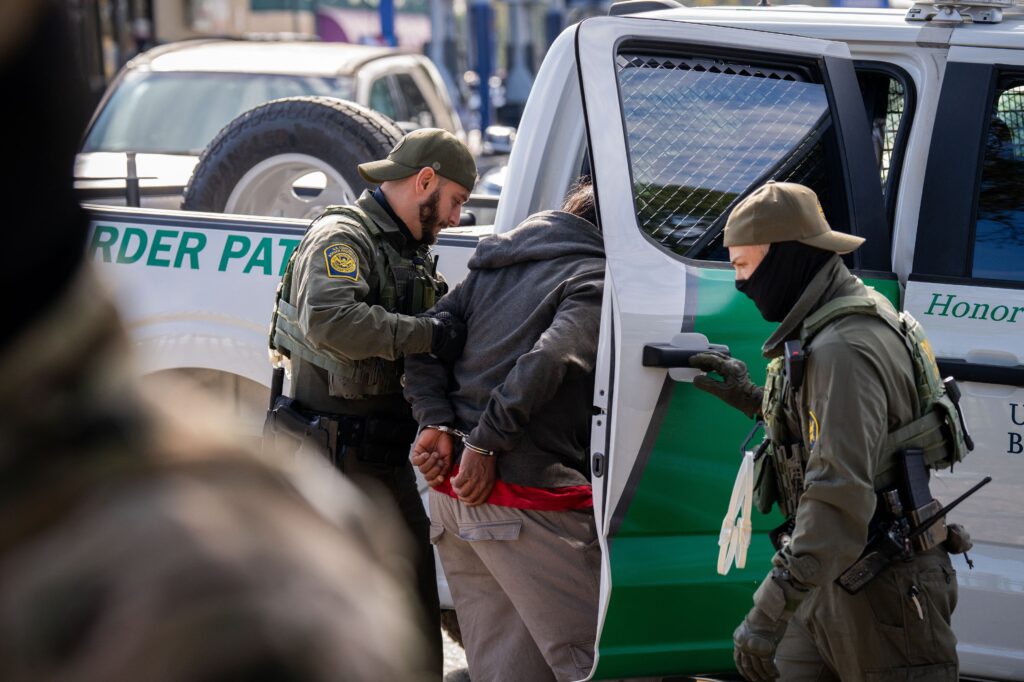
NEW ORLEANS — The Department of Homeland Security announced the start of a new immigration enforcement operation in New Orleans on Wednesday, the latest in a series of sweeps that have resulted in thousands of arrests, legal challenges and protests.
DHS said it was launching “Operation Catahoula Crunch” to target “criminal illegal aliens roaming free thanks to sanctuary policies that force local authorities to ignore U.S. Immigration and Customs Enforcement (ICE) arrest detainers.”
The announcement included a list and photos of 10 undocumented immigrants — from Honduras, El Salvador, Guatemala, Jordan and Vietnam — who the agency said had been arrested for a variety of crimes in New Orleans and later released.
“The men and women of DHS law enforcement have landed in The Big Easy,” Homeland Security Secretary Kristi L. Noem wrote on social media. “Operation Catahoula Crunch will remove the worst of the worst from New Orleans, Louisiana, after the city’s sanctuary politicians have ignored the rule of law.”
Immigration enforcement escalations in Los Angeles, Chicago, Boston and — for a shorter time — Charlotte have generated unrest. Residents have alleged civil rights abuses, and policing experts have questioned the tactics used and the training provided to agents in the rapidly growing U.S. immigration enforcement apparatus.
While DHS has said the operations are targeted at capturing violent criminals, many undocumented immigrants with no record have also been arrested. In Chicago, the agency said, immigration officers arrested more than 4,000 people in “Operation Midway Blitz,” but officials have publicly identified only about 120 of those arrested as having a criminal arrest or conviction, some for major crimes such as murder and others for nonviolent offenses such as illegally crossing the border.
In each city, whistleblowing protesters have trailed immigration agents, warning neighborhoods of their presence. In Chicago and Los Angeles especially, immigration agents were limited in their ability to manage large, hostile crowds or protesters as they worked independently of Chicago police officers, who were not permitted to assist in immigration arrests.
Across New Orleans, residents had anticipated the operation, particularly immigrants. Some businesses had closed while others posted signs saying, “ICE not welcome here.” First Grace United Methodist Church posted a sign citing scripture that read, “ICE: Whatsoever you do to the least, you do unto me.” In the first day of the operation, videos shared on social media showed agents making arrests outside hardware stores and at a building site.
For some, that signaled, as in other cities, that DHS’s sweep in New Orleans would go far beyond apprehending violent criminals.
“In reality, they are not pursuing criminals,” said Mario, a Honduran immigrant who has worked construction, and spoke on condition that his last name not be used, because he does not have a legal status in the country. “They are pursuing people who are applying for asylum and trying to become citizens. It’s a lie. They’re pursuing workers, not criminals.”
New Orleans mutual aid organizations have been watching how immigration operations played out in other cities, and several groups have collaborated with like-minded entities in Chicago, Los Angeles and Charlotte to learn new strategies. Chicago organizers said they believe the network of civilians that tracked and recorded immigration officers there helped hold them accountable, in some cases, for violent interactions.
“What we’ve learned is that even a street witness who is not recording makes these interactions less traumatic and less violent,” said Beth Davis, a press liaison for Indivisible NOLA. “So we need to get eyes on these people.”
The crackdown in New Orleans comes as state lawmakers put mounting pressure on law enforcement agencies to cooperate with DHS. Lawmakers expanded the crime of malfeasance in office, punishable by up to a decade in jail, to include government officials who refuse requests by ICE and prohibited police and judges from releasing anyone who “illegally entered or unlawfully remained” in the U.S. without notifying ICE.
“Such a law shouldn’t be necessary, but around the country and even the sheriff in Orleans Parish about a year ago indicated that she would not cooperate with ICE,” said GOP state Sen. John “Jay” Morris, who represents northern Louisiana and wrote the law. “I hate that we have to have a law to tell people they have to cooperate with federal officials.”
Lawmakers have also made it a crime to “hinder, delay, prevent, or otherwise interfere with or thwart” federal immigration enforcement, and those in violation could face fines and up to a year in jail. Some mutual aid organizations in New Orleans have been directing people to buy whistles similar to those used in other cities, but others have not, anticipating immigration agents or local police may class the use of whistles as obstruction.
On Wednesday, the ACLU filed a federal lawsuit on behalf of Immigration Services and Legal Advocacy, a New Orleans-based nonprofit, against Louisiana Attorney General Liz Murrill and other officials, alleging the state law is unconstitutional because it violates the First and Fourteenth Amendments “by criminalizing protected speech.”
Morris said the new laws could come into force if New Orleans officials or others attempt to interfere with DHS.
New Orleans police spokesman Reese Harper said that federal officials had not notified the department about when the operation would start and that police will not be involved.
“We handle the criminal aspect of the law. Border Patrol and ICE handle civil. So it’s unlawful for us to even touch that,” Harper said. “The only way we would even come in contact with them is if they called for backup, like a life-threatening situation.”
New Orleans police and the Orleans Parish Prison have operated under federal consent decrees for more than a decade, which limited their cooperation with federal immigration enforcement. The Justice Department accused New Orleans of undermining federal immigration enforcement and included it on a list of 18 immigrant “sanctuary cities.”
But a federal judge ended the consent decree last month, and police superintendent Anne Kirkpatrick said she would be a “partner” to the federal agents, although officers will not be conducting immigration arrests or asking people about their immigration status, according to a radio interview with WBOK reported by the Times-Picayune.
Local and state leaders were split on the prospect of more immigration agents in Louisiana and Mississippi.
New Orleans Mayor-elect Helena Moreno, who will begin her term in January as the city’s first Latina and Mexican-born mayor, criticized immigration enforcement tactics during surges in other cities in an interview with CNN on Tuesday.
“It’s one thing if you would have a real strategic approach on going after people … who have criminal felonies or are being accused of some very serious and violent crimes. But that’s not what the public is seeing,” Moreno said. “They’re seeing people who are just trying to survive and do the right thing — and many of them now have American children who are not causing problems in our community — treated like they are violent, violent criminals.”
The Orleans Parish Sheriff’s Office has refused to honor ICE detainers at the jail for more than a decade, but state officials last month challenged that policy under the new state law.
A spokesman for the sheriff’s office this week referred questions about the operation to New Orleans police.
Louisiana Gov. Jeff Landry (R) told Fox News on Monday that “we don’t talk about specific operations, but we certainly invite [Border Patrol official] Greg Bovino and [ICE Deputy Director] Madison Sheahan and [Homeland Security Secretary Kristi L.] Noem and all of President Trump’s great team that’s trying to make America safe to help make Louisiana safe.”
“New Orleans is a crime-ridden city that we’ve been trying to keep people safe and something we’ve been working on since I became governor of Louisiana,” he said. “I’m welcoming them to come in. We’re going to take these dangerous criminals off the streets in Louisiana.”
Asked what he thought of Kirkpatrick saying she can’t enforce immigration law, Landry conceded that “she can’t” and blamed the recently lifted federal consent decree that “decimated the New Orleans police department” and led him to create a French Quarter-based team of state police called “Troop Nola” “to get crime under control in New Orleans.”
In September, Landry requested a National Guard deployment to New Orleans, citing an alleged increase in violent crime, even though police and city leaders say crime has decreased and federal support isn’t needed.
Louisiana is a key hub in “Detention Alley,” a region that includes Texas and Mississippi that’s home to most of the country’s largest federal immigration detention centers. Louisiana’s centers house up to 6,000 detainees. The state opened the new “Louisiana Lockup” in September within the Louisiana State Penitentiary in Angola to hold immigrants whom federal officials consider dangerous. In a news conference, Noem said the prison’s “notorious” reputation — which includes a long, documented history of civil rights abuses — was a factor in choosing the facility to house undocumented immigrants.
The New Orleans immigration enforcement operation, previously dubbed “Operation Swamp Sweep” in media reports anticipating the action, instead references Catahoula Leopard Dogs, trained by early Louisiana settlers to hunt wild boar.
“A lot of people are locking their houses,” said Leticia Casildo, a co-founder of the nonprofit immigrant advocacy group Familias Unidas en Acción who immigrated to the United States from Honduras and who has lived in New Orleans for 20 years. “It’s a scary time.”
The post DHS launches new immigration sting in New Orleans appeared first on Washington Post.