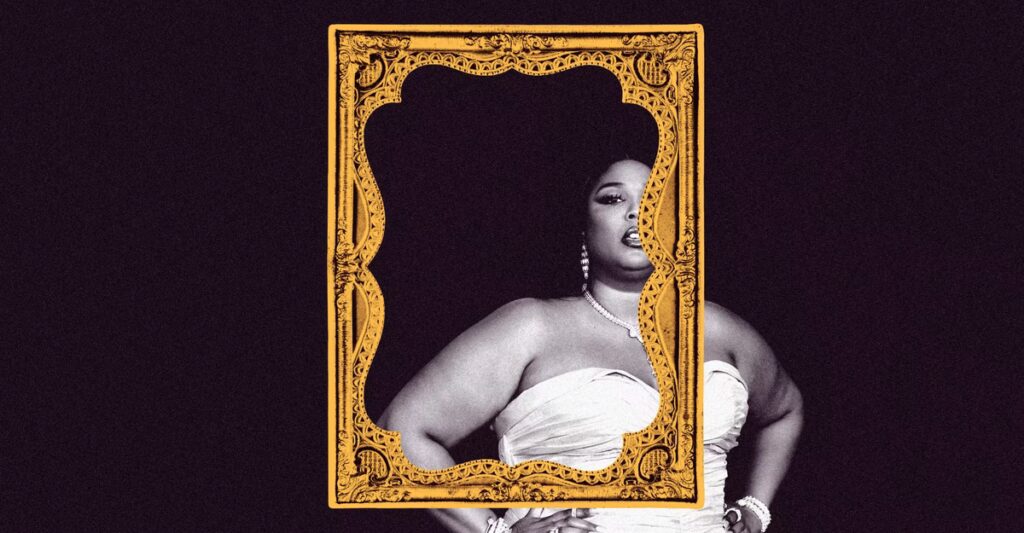
This past May, the globally famous pop star Lizzo was spotted on the side of a busy road in Los Angeles, putting up her own posters. Wearing a white crop top and a tiny skirt, she dipped a long brush into a bucket of paste and then used her body to press her new album cover onto a wall. A passing car stopped, and its driver told her that his mom was a big fan. Lizzo asked, “Did she presave my album?”
This grunt work, captured in a video posted to Lizzo’s social-media accounts, was part of a marketing campaign emphasizing her own unpopularity. Leading up to the release of her fifth studio album, Bitch, early last month, the 38-year-old singer flooded the internet with posts expressing her irritation that her music wasn’t finding its audience. She accused her label, Atlantic Records, of shirking its promotional duties. She also complained that algorithms, her personal enemies, and the decline of radio were all hindering her success. In the end, Bitch indeed floundered, selling just 2,650 copies in its first week and missing the Billboard 200 albums chart entirely.
That’s quite a fall from her previous studio album, Special, which debuted at No. 2 in the summer of 2022 and generated the double-platinum disco bop “About Damn Time.” And although entertainers fading from glory is a classic story, Lizzo’s problems come at a time when pop culture—especially in the music world—seems fascinated by failure. Fans, pundits, and even artists lately seem to be talking about flops more than successes.
Among highly online pop obsessives, perhaps the defining slang of the era is Khia Asylum: an imaginary jail containing divas who can’t reliably land a hit. It’s named for the singer Khia, who never had much success after her 2002 smash, “My Neck, My Back (Lick It).” (Khia has never commented on being memorialized so rudely.) Bebe Rexha, a singer who’s bounced around the industry for a while without ever achieving broad name recognition, recently posted a TikTok of herself in high heels on a treadmill—a joke about the grueling life of an asylum dweller. Earlier this year, Charli XCX—a critically acclaimed but commercially niche artist until the mainstream breakthrough of her 2024 album Brat—said on an influencer’s chat show that she was “so happy to be out” of the asylum, “but just ’cause you get out once, it doesn’t mean you’re not going back.”
Other genres are hosting similar conversations. Hip-hop media has an ongoing debate about why so few new rappers have broken through in recent years. Titans such as Drake and Kendrick Lamar have endured intense scrutiny about whether their reach has been inflated by bots and psyops. Last year, the streamer turned emcee DDG publicized the fact that his new album had sold only a few hundred copies (thereby drawing attention to his music and inspiring one popular X post about how “DDG is the first rapper to ever fake a flop”).
Even in the supposedly sales-agnostic indie world, latent performance anxiety has bubbled up. Just look at the resentful backlash to the revelation that the marketing firm Chaotic Good had created astroturfed social-media campaigns for a number of buzz bands. The songwriter Eliza McLamb wrote that she wished she’d been able to fake a hype wave for herself; around the same time, the rock artist Hiroki Tanaka aired his frustration with his new album racking up just 2,000 streams after he’d hustled to market himself on social media, just as his managers had advised him to do. Last month, the electronic artist James Blake summed up the mood across music when he posted consoling words for artists who feel like no one’s tuning in: “You’re probably doing better than you think.”
Is that true? Many of pop culture’s most legendary flops have indicated clear-cut shifts in public tastes. Sunset Boulevard’s antiheroine Norma Desmond was a silent actress left behind by the talkies; the narrative of A Star Is Born is about the eternal cycle of ingenues upstaging veterans; the flash in the pan Vanilla Ice, I was recently reminded, marked the turn from the earnest ’80s to the jaded ’90s. But today’s struggling stars and their fans seem perplexed by what’s going on. They blame larger systems; they sometimes resort to conspiracy thinking; they seem, well, trapped in an asylum. A new nightmare of downward mobility is in the air: fear of betrayal by the attention economy.
Lizzo’s downfall in particular has the makings of a cautionary myth. She was once the ultimate example of how the internet had redefined popularity by upending old ideas of how a star could look and sound.
When she launched her career, in the early 2010s, streaming and social-media networks were new on the scene, and their effects were still being understood. Platforms such as Spotify rewarded music that was useful—ready to be playlisted for workouts and party nights. Facebook and Instagram boosted entertainers who could be relatable—welcome additions to a feed filled with friends, brands, and memes. An underground rapper with a knack for motivational speech (and a charming talent for playing the flute), Lizzo hit the strike zone: personally specific, broadly appealing, able to inspire laughs and dancing at once. She began building a fan base, but, much more important, she built a following: lots of people who were happy for her to be an ingredient in their algorithmically shaped digital diets.
Another technological sea change, the rise of short-form video, propelled her first smash hit, “Truth Hurts.” TikTok had only recently launched, blowing up in the United States in 2018, and it immediately compressed music consumption and online distraction into one addictive pastime. Lizzo proved a natural fit for it: Her songs were full of catchphrases and micro-comedy, and she had the kind of innate charisma that could draw millions of people to watch her shake a salad. “Truth Hurts” had been released in 2017 but didn’t break through until 2019—a lag that demonstrated the unpredictable way virality was starting to work. The track had been featured in a Netflix rom-com, which caused it to go viral on TikTok, where it inspired a trend in which users pretended to take a DNA test (like Lizzo sings about) to confirm their identity (a French TikToker took a test and held up a baguette).
The same technological developments that fueled Lizzo’s rise seemed to converge with a sociopolitical shift: the rise of so-called woke culture. (In fact, technology largely drove this change by connecting different identity groups in new ways.) A proudly fat Black woman singing about loving herself for who she was, Lizzo made body positivity, anti-racism, feminism, and queer allyship central to her brand. Those attributes once would have marked her as an outsider to the mainstream, but now she was an obvious favorite of the cultural establishment—heard in commercials, seen at awards shows, and anchoring her own Amazon reality series about plus-size dancers.
But that rise was soon jolted by scandal. A 2023 lawsuit from three backup dancers alleged that she had created a hostile working environment, including by pressuring them to touch nude performers at a strip club in Amsterdam and by giving feedback that one plaintiff described as “weight shaming.” Lizzo denied the allegations, and portions of the suit were dismissed by a judge (others are still proceeding). But much of the publicity surrounding the case carried a clear implication: Lizzo’s uplifting, inclusive shtick might be a front.
Her commercial struggles since then—her 2025 mixtape, My Face Hurts From Smiling, didn’t chart—now seem to make for a tidy narrative about Lizzo as the victim of a cultural mood swing, like Pat Boone after the Beatles. Her image was dinged just around the time that the progressive pop-culture wave of the 2010s seemed to be receding. Donald Trump’s 2024 reelection had been interpreted as the ultimate rebuke of wokeness; Lizzo had now been expelled from the spotlight; QED.
The story can’t possibly be that simple, though. The lawsuit may well have turned some of her core fans away, and the culture wars may have also scared off some casual ones. But Lizzo wasn’t just a social symbol; she was a musical force. Her songs are (still) in wedding-DJ rotation not because they serve some political ideal but because they are sticky, sassy smashes that people of all stripes can enjoy. At a time when everyone understood that popular culture was fracturing into pieces, she was still making songs for the center. And now her new stuff is nowhere.
Lizzo’s own rollout for Bitch has hinted at shadowy explanations for why she doesn’t have the juice (ha) she once did. “It’s like, I have people who want to buy my album—but how they gonna buy it if they don’t know it’s for sale?” she said in a social-media video in which she spoke to the camera and rubbed her face, exasperated. “It’s actually driving me crazy. I actually don’t know how much more of this I can take.”
The energy she was giving off—of a woman driven mad by the system—resembled how lots of other musicians have been feeling lately. Conspiratorial framings of how popularity is awarded and denied can be seen in the Chaotic Good fracas, in widespread panic over AI replacing human creators, and in the pervasive belief that TikTok’s algorithm has changed insidiously since an investor group including Larry Ellison’s Oracle took it over. James Blake thinks that critics, influencers, and even fans can’t be trusted anymore—they might be paid off, or they might be simulated. “If you’re an artist,” he wrote on Instagram, “remember that in 2026 there’s not a single part of the system that isn’t faked.”
[Read: The technology that actually runs our world]
Some of this paranoia is warranted. But if fakery—long part of the music-promo equation—seems especially prominent right now, that’s because of a dreary underlying truth: This era of the internet is becoming stale, and the trajectory it set culture upon is reaching a terminal point. After years of explosive expansion, U.S. growth for Spotify and TikTok have shown signs of slowing, likely because of market saturation. Gatekeepers and institutional kingmakers have been so steadily undermined that they might as well not exist. The revolution has been won—the audience is in charge. And what the audience wants to do, at mass scale, is scroll.
After all, the very same technologies that stars like Lizzo benefited from—especially web video—also functionally compete with music consumption. As of this year, YouTube streams no longer count for the Billboard charts; TikTok plays never have. And though some combination of utility and relatability appeared to drive pop stardom early in the Spotify age, those attributes seem to have decoupled over time. Many of today’s musical figures are far more “followed” than they are listened to, effectively acting as influencers. And many popular songs these days have little personality—relatable or not—attached at all.
This is why the Billboard Hot 100 over the past few years has largely occluded into a repository for easy-listening music by the low-drama likes of Bruno Mars and the rising U.K. soul singer Olivia Dean. Exceptions—hitmakers foregrounding personal pizzazz and narrative—of course exist, and artists that have truly devoted fandoms are doing okay. But even Taylor Swift seems to be calibrating for the audience’s growing disinterest and distraction. Last year’s The Life of a Showgirl broke records through brazen promotional tactics—such as encouraging fans to buy many copies of the album—that made it difficult to gauge how popular her music still was by traditional metrics. It was, in effect, an attempt to convert, by brute force, Swift’s incredible social-media reach into equally incredible sales figures.
Whatever you might say about Lizzo, she was an expert at demanding attention, both musically and meta-musically. Her songs could scan as mall-friendly background noise, but they had comedy and color and even a little edge. Bitch pushes that edge ever so slightly. The album cover is a not-so-metaphorical middle finger; the songs are darker and more resentful than what she’s known for. It asks a tiny bit more of its listeners than her past albums—and, judging by the commercial performance, many of her followers were only ever lightly attached to her. Some former listeners may have heard the new singles and hit “Next.” Many others probably never got to that point because, as she suspects, whatever she’s doing isn’t algorithmically palatable.
Lizzo now seems to be reckoning with that fact in a clear-eyed way. After her album bombed, she gave an interview to the YouTube music critic Swiftologist in which he asked, blankly: “Lizzo, are you in the Khia Asylum?” She said no—she’s too famous, with too many previous achievements, for that.
But she also struck a conciliatory tone about the record company she’d previously lambasted. She relayed a story about asking her label why her album was performing so poorly even though she had been making lots of noise on social media. The answer was: “Well, that’s in the hands of the people.” The real nightmare—for her and so many others who are anxious about flopping right now—is not that she’s being blocked from the market, but rather that the market is all there is.
The post Music Is in Its Flop Era appeared first on The Atlantic.