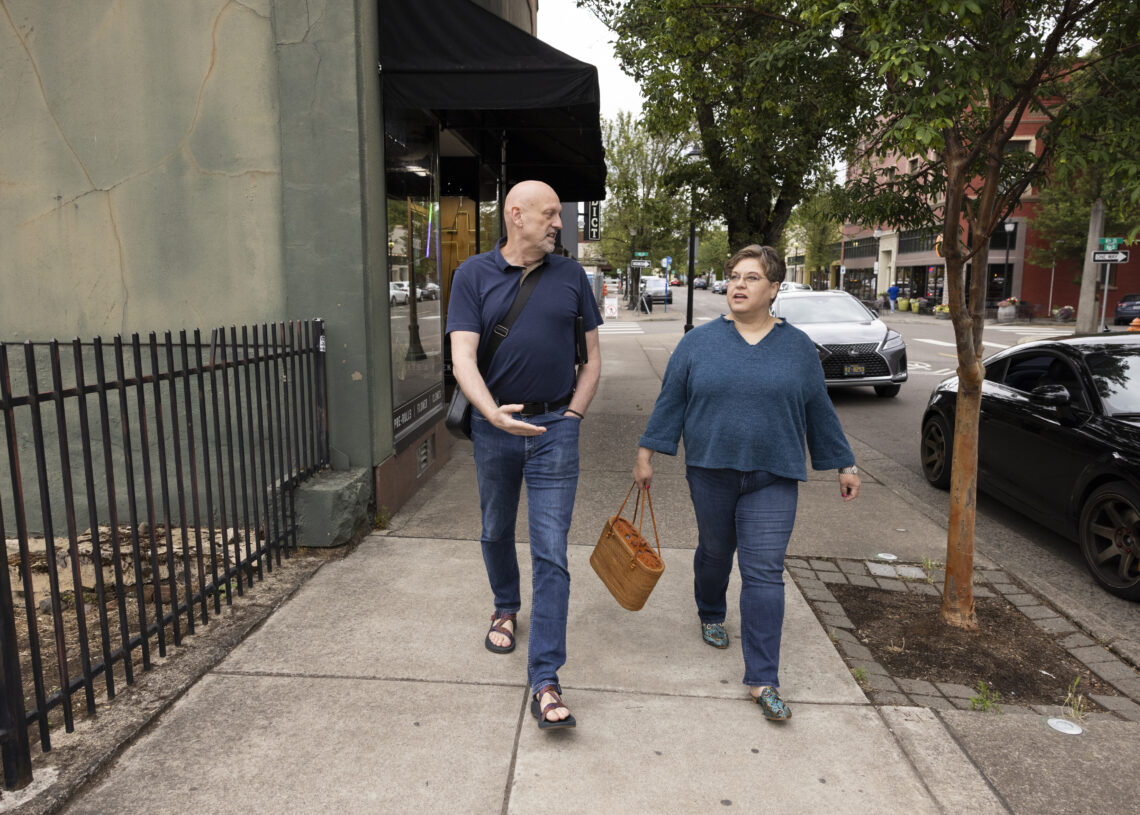
WEST LINN, Oregon — When John Dekalb was young, making friends was easy. He walked up to other kids on the playground or sat near them in class, and all of a sudden, with very little effort, he had real pals. Later, his wife introduced him to her friends’ husbands, and they hung out as couples. But now Dekalb was 58, divorced, and the father of a 16-year-old who’d just gotten her first car. He had entire weekends to spend however he liked, but like many American men, Dekalb had few friends to spend those hours with.
His daughter urged him to socialize. His therapist told him everyone needs connection. But making friends didn’t feel as easy as it once had. So, one evening at the end of spring, Dekalb drove through the suburbs, hoping that a speed-friending event might help him find a few buddies to paddle-board or play pickleball with.
Dekalb felt anxious as he parked outside the West Linn Public Library, but he liked the idea of a structured get-together. Cocktail parties were too open-ended. Tonight, he knew, he’d spend one minute talking to each attendee, and if he clicked with anyone, they could exchange contact information and try to form a friendship later.
Most of the two dozen people there that night were around Dekalb’s age, but they were a disparate group. A divorcee fresh from Florida announced she would not be speaking to any men. A 70-year-old who spends his free time at the theater sat next to a younger woman who said she loved hair metal bands. And in the back, a locksmith chatted with a retired heavy-machine worker who’d bailed the last time he signed up to speed-friend and almost bailed again because it felt safer to stay home with his dog.
The organizer, a woman named Jo Becker, told the group she had started the event because she, too, wanted friends.
“Everyone’s here for the same purpose,” she said. “It’s awkward meeting new people and making connections. We’re all busy. We’ve all got some midlife transition going on. The point of this is to have some positive social time and potentially spark a new friendship.”
This was Dekalb’s third try at speed-friending. The first time, he’d left without making a connection. He’d felt a little embarrassed and very disappointed, but his daughter told him she was proud of him, so he tried again. His second attempt went almost as badly as his first. He worried he was doing something wrong. He might have given up after that, but Becker invited a few participants to a dinner party, and when Dekalb attended, he made a handful of platonic connections with women.
Dekalb was grateful for those new friendships, but he wanted a male buddy, so he pushed himself to try again. This time, he decided, he would be braver. If he met anyone he had anything in common with, he’d give them his number, then see what happened.
The group did a few icebreakers to loosen up, and by the time Dekalb finished going around the room exchanging silly handshakes with everyone, he felt ready to open up. He turned to a woman named Jill and asked why she’d joined the event.
“I live alone,” Jill said. “I was working from home, and it was really isolating. It put me in a bad place. I lost contact with people. I drifted apart.”
Dekalb told Jill his daughter had spent middle school learning remotely because of the pandemic, and he’d realized watching her that building friendships is a skill.
“A lot of people don’t understand it’s something you have to practice,” he said.
Becker’s phone timer buzzed. The first minute was up. Usually, Becker arranged the tables in a square so people could rotate in a single direction, but so many people had shown up that night, she had to squeeze in extra tables wherever she could. She spent a few minutes moving people to other seats, and Dekalb found himself in front of a soft-spoken engineer named Evan Garich.
“Do you like complex math problems?” Garich asked.
“Did we just experience one?” Dekalb asked. He laughed and tried to outline the rotation pattern in the air. “I don’t love math, but I work in IT, so I do solve problems.”
Garich asked what kinds of problems he liked to solve, and Dekalb sat back, both impressed and stumped by the question. The work problems he liked best, he said, were puzzles that required real thought and research.
They chatted easily, even vulnerably. Garich said he and his wife were separated. His kids were younger than Dekalb’s, but still, he wanted to model healthy behaviors for them, and that meant being vulnerable and building relationships, however scary that felt. When the buzzer went off again, Dekalb slid his email address across the table.
“Oh!” Garich said. He fumbled through his pockets, then pulled out a card where he’d written his phone number. “Here’s mine.”
Surveys show that the average American had many more friends 30 years ago than they do now, but researchers aren’t exactly sure when adults became so lonely. Did it happen when the bowling leagues began to disappear? When the iPhone debuted? During the lockdown days of the covid pandemic?
In his 2023 report on the loneliness epidemic, Surgeon General Vivek H. Murthy said he didn’t consider disconnection a public health concern when he took office in 2014. But as he traveled the country and dug into scientific literature, he came to see it as one of the nation’s most pressing health concerns.
Social isolation increases a person’s risk for heart disease, stroke and even premature death by roughly 30 percent, Murthy found. It’s as bad for a person’s health as smoking 15 cigarettes a day. Yet 61 percent of Americans do not feel very connected to others. That dwarfs the number of people suffering from diabetes, obesity or smoking-related issues.
Men have been particularly affected, researchers have found, but they aren’t quite sure why. Fewer than 4 percent of the peer-reviewed articles in top psychology journals are about friendship. There are more college courses on Taylor Swift than there are on friendship.
After a few rotations, Dekalb found himself chatting with a lawn-care worker who said he’d signed up for the event because he used to be judgmental.
“It’s very hard to have empathy if you don’t leave your bubble,” the lawn-care worker said. “I’m trying to give people a chance.”
Dekalb’s energy began to flag as the event entered its second hour. Still, the night felt special. All around him, men were having the kinds of conversations that researchers say are key to curbing the loneliness epidemic.
Two men in their 70s sat next to each other and talked about the lives they used to have.
“When my wife was alive, we didn’t have a social network. We had each other,” a former registered nurse named Mitch Stanley said. “And that worked until it didn’t.”
On the other side of the room, one man told another he’d been lonely for 12 years. And Mike Swanson, the retired heavy-machine worker, stayed and met a few friends even though he thought every minute of the first 45 that he should go home to his dog.
“I’ve lived like this 60 of my 65 years,” he said. “It’s really a lifetime of perceived safety that I’m trying to give up.”
Dekalb shuffled over to another table and sat in front of a man wearing a T-shirt with “Dagger Dagger Dagger” written on it. His name was Mitchell Pennell. Dekalb asked what the shirt was about, and Pennell said it was a reference to a Dungeons & Dragons campaign.
“I’m a nerd,” Pennell said. “And I’m proud of it.”
Dekalb slid his contact information across the table.
“So back in the ’70s,” Dekalb said, “I played D&D a lot. My mom asked me, ‘Are you worshipping Satan?’”
Pennell picked up Dekalb’s contact information and added it to a pile of numbers he’d already collected.
“If my ex could see me now!” Pennell joked.
The buzzer sounded.
“Okay. Real fast,” Dekalb said. “Divorced. Daughter’s growing up. I have a lot of free time. I want to get back to things I used to love, and D&D is one of them.”
Pennell handed over his phone number, and soon the night was over. Dekalb had collected information from six people — three women and three men.
Dekalb sent a group email to the women and invited them to play board games at a coffee shop, but he couldn’t yet bring himself to contact Garich or Pennell. He wanted to hang out, but they’d both given him only their phone numbers, and that made him nervous. An email seemed like less pressure, he thought, and he worried how they’d respond to a one-on-one lunch request from a guy.
A few days went by, then two weeks, and Dekalb realized that as hard as going to the event had felt, it was nowhere near as stressful as building a real friendship. But he also knew hard things could be rewarding, so as the Pacific Northwest warmed and paddleboard season began, he told himself he’d text the guys.
The post Divorced and middle-aged, he needed to make a friend. But he’d forgotten how. appeared first on Washington Post.