By the time Martin Margiela, a man routinely listed among the most influential designers of the late 20th century, left fashion in 2009, he had changed how people thought about clothes. But most had no idea what he looked like. He had really given only one in-person interview — in 1983. He had never taken a bow at the end of a show. He had rarely been photographed.
He was happy, it seemed, letting his work and the myriad designers it inspired, including Demna, Raf Simons, Phoebe Philo and Ellen Hodakova Larsson, keep his name alive for him. Occasionally, however, he would resurface to remind people exactly who did deconstruction, frayed hems, street casting and upcycling first.
He popped up, for example, in 2018, as the behind-the-scenes artistic director for a retrospective of his work at the Palais Galliera in Paris, and in 2020, in the Reiner Holzemer documentary “Martin Margiela: In His Own Words” (though as a voice and pair of hands, not a face).
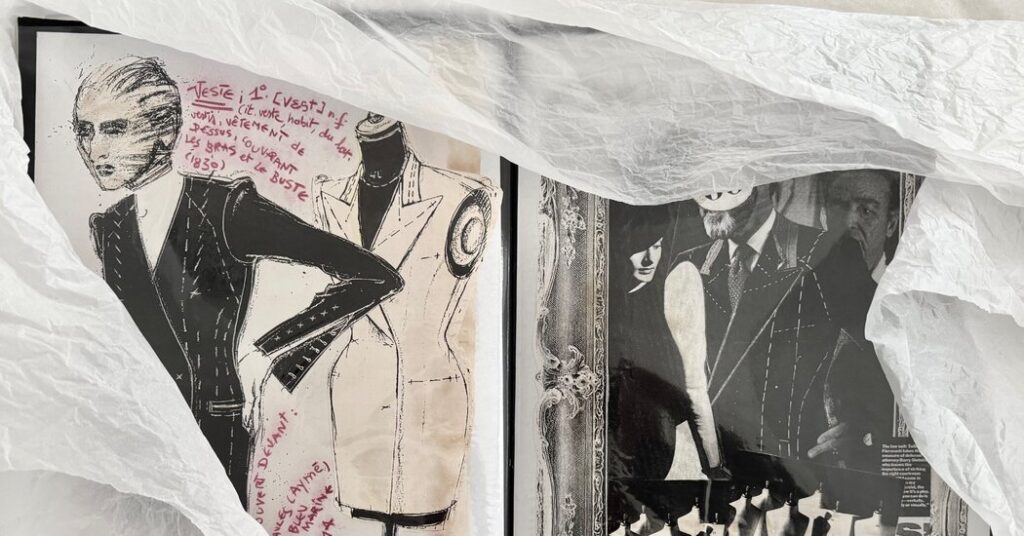
And this week, he is back once again — or back-ish, anyway — thanks to an auction being held on Thursday in Paris. Composed of almost 200 pieces from Margiela’s personal archive (currently on display in a special exhibition), the sale includes pieces ranging from his early ’80s sketches for the Golden Thimble competition in Belgium through his work as the first women’s wear creative director of Hermès. The result is as close to a living memoir as it is possible to get.
“It’s very rare that someone sells their personal effects,” said Salomé Pirson, one of the founders of Maurice Auction, which is organizing the event in collaboration with Kerry Taylor Auctions. At least while they are still alive. A collection of paintings or furniture, maybe. Items that were saved because of their private meaning, however? That’s something else.
Yet according to Pirson, Margiela not only selected each item for sale himself, including clothing, look books, invitations and photographs, he also documented them in his own words.
“I’m sure the O.G. fans will go mental,” said Glenn Martens, the creative director of Maison Margiela, now owned by Renzo Rosso’s OTB Group and not involved in the auction.
The excitement is likely to be shared by more than the committed fashion freaks. “Private collectors, museums and international buyers see these pieces as both cultural and historical objects,” said Kaat Debo, the director of MoMu, the Antwerp fashion museum, which has an extensive Margiela collection.
There is an allure both literal and almost talismanic about owning an object a pivotal figure has touched, as past auctions of the everyday effects of Joan Didion, Stephen Sondheim and Diane Keaton have demonstrated. That Margiela, unlike those artists, is still alive is not likely to lessen the draw of his belongings, especially since he is no longer making fashion. (In 2021, he pivoted to art.)
Indeed, according to Pirson, the auction was Margiela’s idea, after a 2025 sale of his work as amassed by sibling collectors. That earlier auction, “Martin Margiela: The Early Years, 1988-94,” brought in “10 times more than we expected,” Pirson said. Specifically, it brought in 1,889,000 euros (about $2.158 million, including fees).
“We had a two-hour line during the viewing to enter,” Pirson said. “It was crazy. We were expecting some excitement, but not that much.” At the time, she had contacted the designer to let him know the auction was happening — or at least tried to. “I don’t have his phone number, and he emails reluctantly,” Pirson said. But afterward, he got in touch. (An auction spokeswoman said the designer was, as per usual, not available for interviews about the sale.)
“I think he realized he had so many archives kept in secret in his office for years, and it was of important historical value, but also commercial value,” Pirson said. “If I am Martin Margiela, I see the interest getting crazier and crazier each year, and the amount of money people earning with selling the clothes he designed getting crazier and crazier. He doesn’t have any children, so this is a way to handle his legacy.”
Also, “he has a very good memory,” she said. “He remembers every detail of anything he has done from any period.”
The auction includes, for example, the white smock that was Margiela’s working uniform, with his name inked in permanent marker on the collar, which Pirson thinks will be one of the most popular items in the sale — not despite its assorted stains and paint splatters, but because of them. They prove that “he wore it,” Pirson said. “It’s also one of the most recognizable items of the brand.” What’s less known is its origin story.
“They are copies of the ‘blouses’ worn by models in haute couture houses between fittings,” Margiela wrote in the catalog notes. “Because our fashion house was rather controversial, the outside world nicknamed them laboratory coats, which had absolutely nothing to do with my intention. What interested me was the contrast between the traditional and the progressive.”
Similarly, what Pirson identifies as another hot item, the Tabi graffiti boots from 1991 — “they are in all the books about Martin, they are part of fashion history” — has its own back story.
“The unusual silhouette I had in mind in 1988 needed a very different style of shoe than everything that was around,” Margiela wrote. “I thought of bare feet and high massive heels. I suddenly remembered the street workers that I saw in Japan. They had intriguing outfits and wore soft Tabi boots. I was thrilled by the idea to construct them in leather on high, heavy, cylindrical heels. Nobody liked them, but I continued to present them season after season.”
The pair for sale is from an exhibition in which visitors were encouraged to write on the white walls and floor, “but they unexpectedly wrote even on the white-painted Tabi boots,” Margiela wrote. “I love this spontaneous result.”
Then there are the three Barbie dolls, as well as the three Kens Margiela created because “as a kid, they were my models; I loved to make dresses for them,” he wrote. “This joy never left me.” In 1989, he was invited to present Barbies in Martin Margiela outfits and replicated — in miniature — three outfits from his fall 1989 show. “The result was magic,” he wrote. “Unfortunately, they disappeared at the end of the exhibition. I was in shock. I think I never could cope with that loss. So back in Covid lockdown, I felt it was the moment to recreate them. I still had the patterns.”
If the first part of the sale offers a sort of window into Margiela’s work and mind, the second half, composed of numerous Hermès pieces from the wardrobe of his mother, Léa Bouchet, offers a different kind of insight.
“I think his mother was very important to him,” Pirson said. “She was not his muse, because I’m not sure this is the proper term for Martin, but she was a very strong woman, a bold woman, and it’s very touching to see that he built a wardrobe for his mother, basically, when he was working at Hermès.” You can see that in the perfect belted beige cotton trench, in the black leather keychain pendant, and in a sand-toned cashmere and silk tunic and trousers set, all of which reflect his approach to what is now called stealth wealth.
Both Martens, the Margiela designer, and Debo, the MoMu director, have their eyes on certain items from the sale, though neither has particularly high hopes of acquisition. “Maison Margiela always tries to participate in auctions in order to keep solidifying our own archive,” Martens said. “But we rarely win. Those items go for crazy money.”
As to whether the sale might inspire other designers to likewise divest themselves of their own relics of collections past, Pirson is optimistic. “I hope so,” she said. “I think Margiela has always been and will always be ahead of his time.” It’s possible, she added, “this may be the first of a long, new trend.”
The post The Fashion Insider’s Sale of the Century appeared first on New York Times.