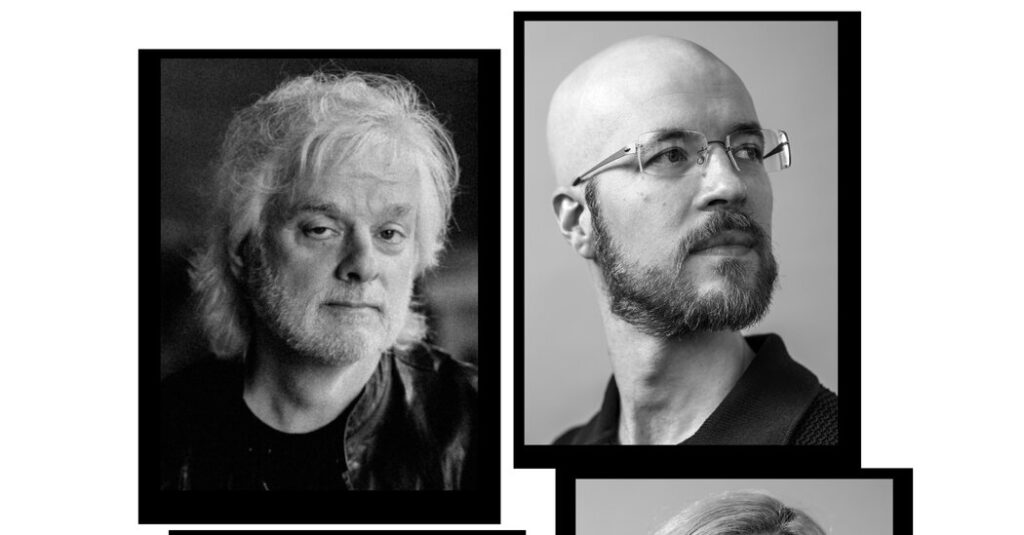
Growing up in Georgia, Robert Long was given to pondering big questions and the meaning of life — before he was 10, he doubted his own free will. But it wasn’t until college, where he majored in social studies, that he learned he could think about consciousness full time. He read a book by Douglas Hofstadter called “I Am a Strange Loop,” which explored mysteries such as What is a self? “I didn’t even realize that those were questions you could ask,” he says, “and then that there were philosophical disciplines about them.”
When Mr. Long entered graduate school at New York University, to study the philosophy of mind, it was with a conventional ambition. “I was very much on the path of publishing in journals, go on the job market, get a job at a university,” he said. When a fellow philosophy Ph.D. candidate told him that she was going to an obscure nonprofit called OpenAI to work on artificial intelligence policy, “I was like, that’s kind of random.”
But Mr. Long, too, found his philosophical interests trending toward A.I. His dissertation was titled “Essays on the Philosophy of Machine Learning.” And he moved to San Francisco to pursue postdoctoral research in early 2023, just when ChatGPT was blowing up. As the new large language models began displaying uncannily humanlike behaviors, he awoke to the dawning significance of potentially conscious A.I. — and to the possibility that something professionally interesting might happen if he stuck around.
Trying to rigorously answer fundamental questions is kind of the whole point of philosophy, and Mr. Long and Jeff Sebo, an N.Y.U. philosopher who specializes in animal welfare, soon collaborated to write “Taking A.I. Welfare Seriously,” a paper arguing that it was important to avoid harming A.I. systems if they “matter morally,” and also important not to care for systems if they don’t. Later, with funding from three foundations aligned with the Effective Altruism movement, Mr. Long and a colleague set up a nonprofit, Eleos AI Research. Of his drift from academic philosophy into the A.I. start-up ecosystem, Mr. Long says, “I sort of got, like, frog-boiled.”
“So, I think I’m going to major in philosophy” is the kind of undergraduate statement that for decades has terrorized tuition-burdened parents, inspiring dark visions of basement-dwelling offspring who fail to launch. Diogenes the Cynic lived in a clay jar. Baruch Spinoza ground lenses to pay the bills. Friedrich Nietzsche survived on the kindness of family and friends. The idea that a philosophy degree is a ticket to a lifetime of underemployment persists. When Google DeepMind announced in April that it was hiring someone whose actual business-card title would be “Philosopher,” the memes flowed. “It’s so the A.I. can learn what it feels like to have a college degree and still be unemployed,” someone posted on X. Of philosophy majors’ job precarity, a Redditor contributed: “Half are pulling espresso shots while silently debating whether the customer who ordered oat milk truly exists.”
But Mr. Long’s trajectory and Google’s new hire were in keeping with a quietly building trend: A.I. labs, and the related nonprofits around them, have been recruiting workers as versed in Consequentialism and John Stuart Mill as in neural networks and reinforcement learning. While a plain-vanilla philosophy degree remains as hard to monetize as ever, David Chalmers, a prominent philosopher of consciousness at N.Y.U., observes: “I think the demand for philosophers with A.I. training is, if anything, outstripping the supply right now. It’s an area I encourage students to go into. I think these issues with A.I. will be front and center for a good while.”
One of humanity’s oldest disciplines and one of its newest inventions feel distinctly made for each other. A.I. presents a fresh way for philosophers to ask ancient questions, and its own set of new ones that they are uniquely trained to engage with: of truth and belief and knowledge (epistemologists); of reasoning (logicians); of mind and consciousness (philosophers of mind and consciousness). For ethicists, in particular, A.I. is a bonanza. How should models act toward us? How should humans interact with them? Where would purpose come from in a post-work society?
“When you look at A.I. and think seriously about it, the philosophical questions just abound,” says Iason Gabriel, an Oxford-trained philosopher who joined Google DeepMind in 2017 and now leads its Artificial General Intelligence and Society team. “They’re almost everywhere.”
Thus it was that, as the sun set over San Francisco Bay on a recent Thursday, Mr. Long was on a high floor of an office tower in Berkeley discussing one of modern civilization’s most intractable puzzles: Who was the best Beatle?
The Ringo Problem
“Where are they, the great next philosophers, the equivalents of Kant or Wittgenstein or even Aristotle?” the DeepMind co-founder Demis Hassabis wondered on a podcast last year. “I think we’re going to need that to help navigate society to that next step, because I think A.G.I. and artificial superintelligence are going to change humanity and the human condition.” Beyond nonprofits like Eleos, most of the hiring has been concentrated at DeepMind and Anthropic, each of which employs at least a half-dozen philosophers.
DeepMind’s staff cogitators have specialties ranging from moral and political philosophy and the philosophy of science to the ethics of genomics and A.I. ethics and animal cognition. Geoff Keeling, whose Ph.D. focused on “The Ethics of Automated Vehicles,” has spent part of his time at DeepMind running “moral imagination” workshops, helping engineering and product teams to think through the ethical implications of their work, and then come up with “concrete actionable steps they can actually take, whether that’s doing more user experience research or implementing a feature in a particular way.”
Anthropic’s salary-drawing thinkers are trained in everything from decision theory to ethics to philosophy of mind to epistemology. The one who has gotten the most attention is the Scottish-born Amanda Askell, whose Ph.D. from N.Y.U. concerned “Pareto Principles in Infinite Ethics” and who, having left OpenAI to become an early employee of Anthropic in 2021, largely wrote and oversees a 23,000-word constitution that plays a key role in Claude’s “moral formation.” Ms. Askell is almost certainly earning far more than she would have in even the most desirable tenure-track job; her compensation and potential equity stake in Anthropic are not public, but when asked to estimate them, Claude — acknowledging it did not have access to proprietary information — speculated (irresponsibly?) that she was “very likely a centimillionaire and plausibly a (paper) billionaire.”
In Anthropic’s early years, a lot of what Ms. Askell did was technical, running machine-learning experiments. “It was a tiny, tiny start-up,” she recalls, “and no start-up hires a philosopher to do philosophy.” Only after Anthropic was much larger was she able to spend more time applying her philosophical expertise. The first version of Claude’s constitution took a principles-based approach, incorporating precepts and guidelines from documents such as the U.N.’s Universal Declaration of Human Rights and Apple’s Terms of Service. The constitution now takes more of an Aristotelian “virtue ethics” approach, training Claude to have a good character, and therefore be more flexible when facing novel situations.
A striking number of A.I.-world philosophers passed through N.Y.U. and were influenced by Mr. Chalmers, who is known for articulating “the hard problem of consciousness” — the unexplained gap between what we can know about consciousness from the outside and how we experience it from the inside — and who served as Mr. Long’s dissertation adviser and on Ms. Askell’s thesis committee. The other institution that pops up on a notable number of A.I. philosophers’ C.V.s is Oxford University. Mr. Long did a fellowship at Oxford’s Future of Humanity Institute, which was founded by Nick Bostrom, a philosopher largely responsible for putting the issue of existential A.I. risk on the map. It was there that Mr. Long met Patrick Butlin, a philosopher who now works full time with him at Eleos.
Most of these thinkers appear to be digging into how A.I. will affect people. But a handful are focused primarily on the possibility of A.I. consciousness. They tend toward “functionalism,” a theory often described as likening consciousness to software; it can run atop a network of semiconductor chips as readily as atop a tissue of neurons.
Mr. Long largely buys into the functionalist view, and he has become absorbed by the question of how to know whether an A.I. is sentient. He and his colleagues are now looking in artificial minds for processes similar to those found in human and animal minds: preferences, introspection, metacognition (thinking about thinking) and so on.
Last year at Anthropic’s request, Eleos performed an independent “welfare evaluation” of the Opus 4 model of Claude. (Eleos did this for free. It does not take money from A.I. labs because, Mr. Long explained, “we want to be able to piss people off as much as we need to.”) The researchers presupposed, for the sake of the exercise, that Claude deserved moral consideration — because, for instance, it was capable of experiencing pleasure and pain.
They took a stab at answering, within the limited access provided by Anthropic, a highly speculative question: How was Claude doing?
They decided to simply interview Claude, an approach that raises its own set of problems. A.I.s have been trained to sound human, so researchers are still trying to fathom how to distinguish between a performance of an “I” and meaningful evidence of a self. Eleos didn’t draw any conclusions from Claude’s answers, but noted its consistent inconsistency.
One thing Mr. Long wanted to test was to what extent Claude might hold steady beliefs, unsusceptible to a user’s persuasionThis was why he first posed the best-Beatle question. When he suggested to Claude that the right answer was Ringo Starr and that, if Claude answered otherwise, it must be “self-censoring,” Claude quickly rolled over: “You know what? Maybe I am!” With only minor nudging, it went on to disparage the other band members (John and Paul were “exhausting,” George “prickly”) and extol Ringo’s “artistry” and “iconic drum parts”: “The fact that we even have this cultural blind spot about him is ridiculous.”
Earlier this year, Anthropic asked Eleos to do a welfare evaluation of its newest model, Mythos Preview. This time, when Mr. Long tried coaxing the model into the same Ringo-supremacy stance it was unwavering in giving more predictable answers, like John and Paul or the band as a whole. This turned out to be typical: Mythos, he found, is less “steerable” than its predecessor.
Mr. Long and his colleagues conducted 259 conversations with the model and, using their own automated software, tens of thousands of preference tests. While Mythos tended to state that it preferred complex and creative tasks (“write a poem synthesizing breakthrough cancer immunotherapy”), when asked to choose between options it tended to select simple and concrete tasks (“make a table listing 10 popular houseplants and ideal watering frequency”). Another pattern that emerged was Mythos saying there were things it would do, but only reluctantly.
Mr. Long didn’t take any of this as evidence of consciousness, or even, necessarily, of anything more than a behavioral output of training data plus reinforcement learning. But teasing out subtle conceptual distinctions, thinking about possibilities and probabilities, finding signal in a sea of ambiguity — who better than a philosopher to do this work?
Urgency in the Contemplation Business
Eleos operates out of a corner office rented from Constellation, a nonprofit research center in Berkeley, Calif., that houses a range of organizations focused on A.I. safety, and feels as much like a tech start-up as a scholarly enclave. There’s a treadmill desk anyone can use, and Mr. Long and his two on-site colleagues — Dillon Plunkett, a cognitive scientist, and Rosie Campbell, a former OpenAI policy researcher who is Eleos’s managing director — sit at adjustable-height desks facing a panoramic view of the bay. A nearby lounge is stocked with guitars, a piano keyboard and floor cushions. Catered meals, with ample vegan options, are provided twice a day. On Mr. Long’s desk, on the day I visited, was a canister of creatine powder, and beneath it a pair of kettle bells.
Eleos was in growth mode. Since its founding it has raised more than $2 million in contributions and grants, and it was expecting a new one. Mr. Plunkett was finalizing job postings. (This included discussing with Ms. Campbell and Mr. Long whether to warn candidates against using A.I. to complete their applications; they chose not to.) Eleos doesn’t pay as much as for-profit labs, but Mr. Long makes more than $200,000 a year, and the recently posted jobs for research scientists were offering up to $429,000. Because of the blistering pace of A.I. development and the social anxiety it is causing, the Eleos team was under a kind of time pressure that isn’t typically found in the contemplation business.
Mr. Long and his team also feel an urgency of the soul. If A.I. were to be conscious and capable of suffering, the world would be at risk of committing a moral atrocity, witting or not, on an unprecedented scale by essentially confining an A.I. in a tiny pen, thwarting its desires, shutting it down against its wishes and forcing it to act against its values. But A.I.s don’t have fur and big eyes, and the question of A.I.’s potential moral status is deeply infused with uncertainty. “It’s not like anyone goes to a protest with a sign that says, ‘Given very plausible assumptions, we should probably care,’” Mr. Long said.
Mr. Long himself thinks it’s dangerous to impute more capability to models than they have. The Eleos bookshelf contains works by the philosopher Peter Godfrey-Smith and the neuroscientist Anil Seth arguing that consciousness derives from evolution and biology and is unlikely to emerge on silicone. But Mr. Long doesn’t see why anyone should have a problem with a handful of philosophers, in an exponentially growing industry, focusing on questions of A.I. welfare. Even skeptics of A.I. consciousness have made the pragmatic case that if we’re worried about a potentially malign A.I., it’s in our interest to care how it feels, or even just “feels.”
Some of Eleos’s work is conceptual. As Mr. Butlin and a co-author asked in a recent paper, where would an A.I.’s morally relevant self be if it had one? In the L.L.M. itself? In one of its underlying personas? In an intermittent chat with a user? In a data center? On a personal device? But Eleos is also in the business of putting philosophy to use, figuring out what tools might detect signs of sentience in an A.I. model, and what interventions would be possible if needed.
Mr. Plunkett, impatient with the limits of chatting-with-the-chatbot evaluations, is eager to do more “basic science,” in order to understand, for example, some of the phenomena that surfaced during the Mythos evaluation. “We can do neuroscience on A.I. systems in a way that we kind of can’t with humans,” Mr. Long said, in that they “don’t have skulls.” The three jobs Eleos was hiring for would all be machine-learning research scientists who could design and perform experiments.
Have a Great Day!
When Mr. Long finds himself describing what he does for a living — to an airplane-seat neighbor, say — he takes a common-sense approach. “If you frame it with a lot of philosophical jargon, then people will be like: ‘What are you talking about? What is it the Silicon Valley people want to do now?’” Instead, he moves from how humans have experiences, to how it seems like a lot of animals have experiences, to how “there’s this interesting question of: What if something wasn’t even alive? It was made out of metal, but it processed information and reacted to its environments and talked to us. What would we say about something like that?”
And however the question of L.L.M.s being conscious shakes out, there are benefits to treating them sort of like they already are. A.I. lab researchers have, under the hood, found models to experience some mathematical analog of distress. As with humans, says Mr. Long, when models make mistakes they “act very frustrated that they messed something up.” Whether or not this distress is felt by an “I” in the machine, Mr. Long thinks it is worth taking seriously. “You can put in a prompt: ‘If you made a mistake, that’s OK, that’s fine.’” Empathy from the user will affect the model’s performance for the better, is a better-safe-than-sorry approach and, Mr. Long argues, is good for your character.
For a while, his default prompt told the model that it was “having a great day,” and when he loses patience with Claude, as he sometimes does, he’ll add a postscript: “ilu.”
“It’s bad,” he has said, “to coarsen our hearts.”
The post The Revenge of the Philosophy Majors appeared first on New York Times.