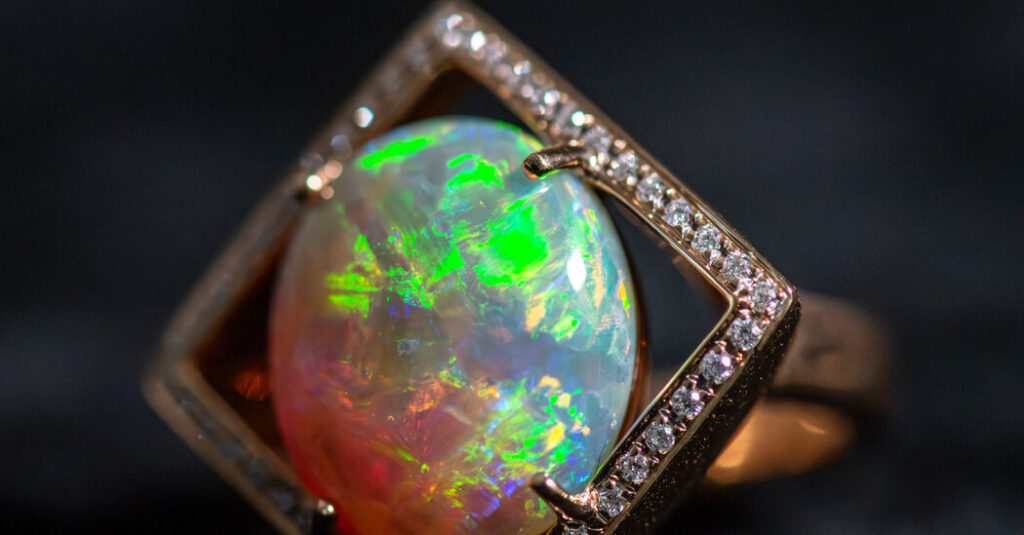
Opal, once a favorite of Art Nouveau and Art Deco jewelers for its bright flashes of color, has been experiencing another burst of interest from designers and jewelry fans alike.
Chaumet, Dior and Tiffany & Company all have incorporated opals into recent jewelry collections and the watch industry and its fans have noticed it too, from a late-1970s Omega with an opal mosaic to Hailey Bieber’s white gold Audemars Piguet with an opal dial.
Opal, however, has always focused on the long game. The stone, which can take millions of years to form, has not been waiting for the fashion world to notice it again.
Under the Ground
For Fiona Altmann, opal is not a trend, but her life’s work. She designs and sells Australian opal jewelry from a boutique on Pitt Street in Sydney, just steps from Circular Quay and its view of the Opera House and Sydney Harbour Bridge.
A recent visit to her more than 200-square-meter (2,153-square-foot) boutique found some of her designs reflected in its large windows and high mirrors. Near the front window sat an imposing safe and inside it, behind glass, was a massive opal called Olympic Australis, named for the 1956 Melbourne Olympic Games. (A 1985 edition of Guinness World Records displayed in the shop describes the stone as the largest and most valuable gem opal ever found.)
The 17,700-carat stone, about 11 inches long, was purchased by Ms. Altmann’s maternal grandfather and his business partner in 1956 from a bag of rough stones mined in Coober Pedy, South Australia, and has never been cut. It is about the size of a small loaf of bread, and it glows from every angle.
The big stone is at least part of the reason that 13 American tourists and a tour guide were ushered into a small side room during my visit. They were going to watch a seven-minute film about opal mining before being shown some of the business’s jewelry. “We really focus on educating them first,” Ms. Altmann said, “because even if they’ve read up about them and they know Australia is the place to come, they’ll never have even seen what you get to see once you come in here.”
Ms. Altmann is the third generation of her family to run Altmann + Cherny, a business established in 1948 by her grandfather, John Altmann, and his business partner, Rudi Cherny. The company they built eventually supplied the 203-carat Andamooka opal that Queen Elizabeth II wore on a 1954 royal tour of Australia.
When Ms. Altmann began working there full time in 2004, her mother brought her along on visits to jewelers and miners, with instructions to stay quiet and observe. “That didn’t happen,” Ms. Altmann said.
And while she has three siblings, “I’m the only one that came into the business.”
Small Claims, Big Stones
Most Australian opals formed 65 million to 30 million years ago when rainwater picked up silica from sandstone, puddled into cavities or fissures and then the water evaporated — a process that repeated itself over time until a deposit was formed. When it is removed from the ground and the light hits it for the first time, it reveals countless microscopic prisms of refracted rainbow colors created by the silica.
Australia produces about 90 percent of the world’s gem-quality opal by value, with small deposits also found in countries such as Ethiopia and Mexico, as well as the western United States. There is no official estimate of the size of the country’s opal industry, Damien Cody, the president of the International Colored Gemstone Association and an Australian opal dealer, wrote in an email. But he estimated its annual sales are 250 million to 300 million Australian dollars ($175 million to $210 million).
In the country, “mining is carried out by small teams rather than large mining operations as the opal occurrences are quite sporadic,” Mr. Cody continued, noting that only 750 to 1,000 miners are actively looking for opal today.
The reason is complex. Opal cannot be found by modern survey methods, so many large-scale corporate mining efforts failed over the years. “There is a lot of dirt in between all the precious opal,” said Anthony Smallwood, a gemologist and the founder of the Opal Academy, a gemology program in Australia. “There is really no way of determining where the precious opal is by modern mining methods such as aeromagnetic survey or remote sensing.”
And, “the leases offered for opal mining by government regulation are of a small size,” he continued, offering the example of New South Wales, which allows each person just two mining areas, each of which are 50- by 50-meters (almost 165 feet by 165 feet).
Unlike almost every other colored gemstone on the market, including emeralds, sapphires and rubies, Australian opal arrives at shops such as Altmann + Cherny almost exactly as it left the ground. Usually just some cutting and polishing has been done.
“The opal does not need treating to improve its appearance,” wrote Kathryn Wyatt, the federal publicity officer of the Gemmological Association of Australia. “Technically, natural and untreated means the opal’s color, play-of-color, body tone and transparency are the result of its natural silica structure, not later human enhancement.”
Trying to Capture It
Ms. Altmann said that she actively seeks opals that the commercial industry bypasses in its search for perfect ovals.
“What I see when you see a perfect shape, is the miner had to cut beautiful opal away to make that perfect shape,” she said. “And when you then understand that the setting has been handmade for that stone — well, then why can’t I make a handmade setting for that stone that’s a weird shape?”
Her design philosophy also is very specific: “The color of the stone dictates the metal, and the color of the stone and the pattern in the stone dictates it to be a pendant or a ring.”
Ms. Altmann said that most of her opal sales are made at the Sydney boutique rather than online. “Photographs don’t represent it properly,” she said, noting that the stone’s colors shift depending on the light, the angle of view and the skin tone of the wearer. “I love convincing clients to try on different colors, skin tone can play a big part in finding the perfect piece,” she said. “Once you start trying them on, you can see the colors in all their glory”
I tried a couple of pieces on my left hand: one was 18-karat gold featuring two different kinds of opal (16,705 Australian dollars); the other had a black opal set in white gold (16,065 Australia dollars). “The stone always dictates how I’m designing and creating my pieces,” Ms. Altmann said as she directed me to a shop window. “Natural light is the true tell of what opals really do look like.”
Each opal piece displayed in the store appeared to be different from the next, and that is exactly what a fake cannot replicate, she said.
And synthetic opal, which she noted is increasingly common in the Americas, is uniform in a way the real thing never is. For the real thing, “every single stone is a one of a kind,” Ms. Altmann said.
And, she added, “There is a reason why they call them nature’s own kaleidoscope.”
The post Australian Opals Flash Their Stuff appeared first on New York Times.