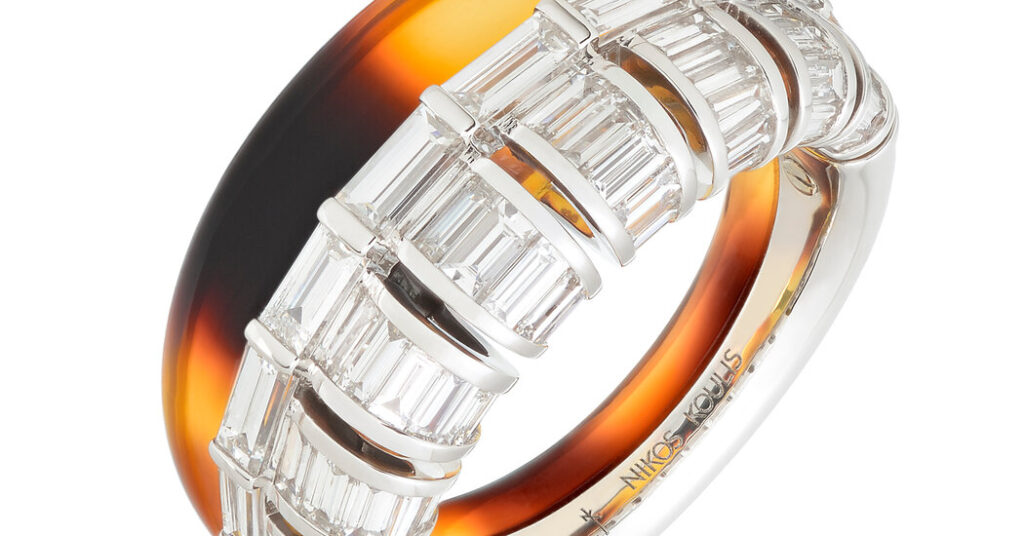
For those of a certain generation, tortoiseshell evokes the Riviera glamour of the 1970s: Jackie O. behind oversize tortoiseshell sunglasses as the Christina, the yacht owned by her Greek shipping magnate husband Aristotle Onassis, cruised the Mediterranean.
Nikos Koulis, a Greek jeweler who was born in 1977, did not belong to that jet-set world. But in a new collection inspired by his own sunglasses, he said he tried to capture something of the bold elegance and cosmopolitan spirit that defined the era.
“I fell in love with the light inside this material,” Mr. Koulis said in a phone interview from his home in Athens. “I had a pair of sunglasses sitting on my desk in the sunlight. Depending on how the light hit them, the color would change from deep brown to bright honey tones.”
Today such eyeglass frames are made of cellulose acetate, a plant-based material derived from wood pulp and cotton fibers. (In 1977, the hawksbill sea turtle, the principal source of genuine tortoiseshell, was added to the highest protection list by the Convention on International Trade in Endangered Species of Wild Fauna and Flora, known as CITES, effectively banning international trade in the material.)
Intrigued by the optical effect, Mr. Koulis decided to test the material. He commissioned a German factory to produce custom blocks of cellulose acetate thicker than those typically used for sunglasses so the material’s distinctive veining would be visible after it was carved into sculptural, three-dimensional jewelry forms.
“The material is lightweight and offers a lot of sculptural possibilities,” he said. “Also, the combination with gold and diamonds felt completely new.”
But testing in Mr. Koulis’s Athens workshop revealed that the acetate would require significant reinforcement before it could be used in fine jewelry.
“We had to find a way to make the material durable enough to use alongside gold and diamonds,” he said. “It took several layers of a special coating and a number of tries in the workshop, but in the end we were confident that we could create something truly special.”
Each of the 27 pieces in the collection, named 77 for the year of Mr. Koulis’s birth, was crafted from just three materials — cellulose acetate, diamonds and 18-karat white and yellow gold. The designs were distinguished by variations in the carved acetate, choice of metal and diamond cuts and settings.
“Nineteen seventy-seven was an important year in culture and aesthetics,” he said. “It brings to mind the spirit of disco, fashion freedom, the end of the hippie era and the glamour of Yves Saint Laurent. It’s Studio 54 meets Annie Hall.”
Among the designs were a pair of sculptural 18-karat white gold hoop earrings, set with 9.33 carats of brilliant-cut diamonds, 1.23 carats of emerald-cut diamonds and polished tortoiseshell-effect elements; a choker of polished tortoiseshell-effect links interwoven with 18-karat yellow gold elements and 8.03-carat cushion-cut diamonds; and an 18-karat white gold and tortoiseshell-effect ring, set with 2.38 carats of tapered baguette-cut diamonds. (All prices on demand.)
Also in the collection, a handful of one-of-a-kind pieces featuring black enamel — for what Mr. Koulis called “added drama” — were scheduled to debut this week at his Paris flagship, which opened in May in the Eighth Arrondissement.
“For me, what is precious and what is valuable are not the same thing,” he said. “It is the contrast of materials that adds value to creativity.”
“This collection places Koulis within a lineage of jewelers who have expanded the boundaries of preciousness,” said Corentin Quideau, an independent consultant and global jewelry brand strategist in Paris. “Think of JAR with bone and aluminum, René Boivin with wood, Wallace Chan with titanium and Hemmerle with bronze and aluminum. Like them, Koulis has the creativity and confidence to take a so-called ‘nonprecious’ material and elevate it through design, craftsmanship and artistic vision.”
In the end, Mr. Koulis said, 77 became more than experimenting with a material.
“This collection reflects a part of me more than any other,” he said. “There is a strong femininity and sensuality to it. I like to surprise my clients, and I hope they will appreciate this collection as much as I do.”
The post The Glamour of Faux Tortoiseshell appeared first on New York Times.