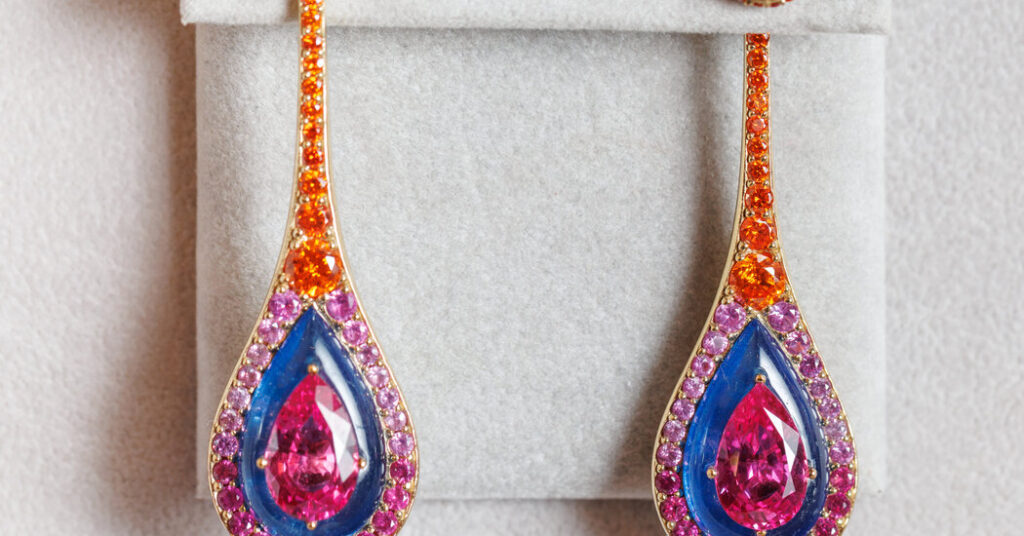
Imagine: the sapphire blue of summer blueberries, the ruby and amethyst of autumn beets, the sunlit topaz of a lemon and a sprinkling of emerald citrus leaf.
These are not the makings of a salad but the color of gems, formed from fruits and vegetables.
These Fruit Gems and the jewels made with them — glittering lotus earrings carved from a deep magenta stone made of beetroot and adorned with sapphires and emeralds, or a Paraiba tourmaline on a petunia ring derived from blueberries — are the creations of the London designer Anabela Chan.
“Some people might think, ‘Why would I want to wear a purple sweet potato?’” she said in a recent video interview, “but the way we cast it and set it with a sapphire and alexandrite with all the detailing and carving work, it looks like something that doesn’t look like anything else.”
Ms. Chan said the process was inspired by her drive to ensure Anabela Chan Joaillerie melded precious objects — sculptures, jewelry and more — with sustainability, all while making luxury available and affordable to a wide audience. (For instance, her Ruby Blue Spirulina Begonia Earrings have a total of more than 20 carats of lab-grown and simulated sapphires, yet sell for $2,535.)
In the trademarked process that Ms. Chan said took four years to develop, she and her team dry food waste and then grind it into a powder. That pigment then is combined with their version of a bio-resin made of avocado seeds and agave to create “gems” that can be carved or molded to resemble the glass and quartz wisteria and butterflies typical of Art Nouveau jewels. These are then hand set into pieces designed in 18-karat gold, gold vermeil or sculpted recycled aluminum.
The resulting gems, however, do require extra care: they are not as enduring as mined gemstones and are especially vulnerable to scratches and exposure to chemicals and other elements; but well cared for, they should last many years, according to a spokeswoman for Ms. Chan.
Food waste
The inspiration for the gems came during the pandemic, when Ms. Chan volunteered to bring fruits and vegetables nearing their sell-by dates to the needy.
“In the U.S. and U.K., about 40 percent of food goes to landfills, which translates to millions of tons of food going to waste,” she said. “I wanted to find a creative way to address this problem, to turn organic waste into jewelry.”
She began by scouring local farmers’ markets and supermarkets for items that were about to be sent to landfills. “They thought I was crazy when I first told them what I was doing, but that’s where it gets exciting and fun,” she said.
Experimentation proved that carrots, for instance, decomposed too fast to use. Spinach rendered a stronger yellow than did lemons. And she had tradition and history to guide her.
“Taking color from nature is the oldest way of using color,” she said. “It goes back to Paleolithic times.”
Fans of Ms. Chan’s creations said the unusual nature of the gems actually provides much of their appeal. Vivien Wong, a founder of Little Moons, a company that sells mochi-wrapped ice cream confections, and owner of several Fruit Gem pieces, said that people were always asking her about them. “Everyone has the Van Cleef or Cartier,” she noted by phone from her London home, “but no one knows what this is. There’s a story about it. What are you going to tell about your Cartier bracelet?”
Raising awareness
Tingfei Fan, a lawyer in Hong Kong, agreed. When she first purchased a Sweet Potato and Blueberry Garden cocktail ring ($2,235), with its petunia petals made of blueberry and sweet potato and set with multicolored lab-grown sapphires, she was especially drawn to the concept. “I had never seen anything like it before,” she said. “I thought it was noble.”
But now she sees the idea going even further. “I know that buying a ring doesn’t make me an environmentalist, but I think it raises people’s awareness in general, and I think if the fine jewelry industry goes in that direction, it would be a good thing.”
According to Ms. Chan, this approach partially explains the Fruit Gems’ popularity. “In the jewelry industry so much has been the same for so long, and it’s nice to be able to challenge the concept of what is fine jewelry by turning something so humble into something of value again,” she said. “I think that turning waste into things we need and want — that is the greatest luxury of all for me.”
Like her other collections, the Fruit Gems — produced in limited editions of five to 10 pieces per design — may be purchased from Ms. Chan’s flagship in the Knightsbridge area of London, her online site and such retail and online outlets as Fortnum & Mason in London, Farfetch and Moda Operandi. (Bespoke pieces also are available: Ms. Chan, for example, recently created a brooch and earrings from a bridal bouquet.)
“You can have fun with it, and really can wear them out — where I have other pieces that never see the light of day because they’re so precious,” Ms. Wong said. “It’s like costume jewelry, but it’s fine jewelry.”
That “having fun with it” has been, for the designer, the whole point. “Ultimately, I think jewelry should bring joy,” Ms. Chan said. “That’s why we wear it.”
The post Is That a Blueberry or a Beet on Your Finger? appeared first on New York Times.