BRUSSELS — For years, many other NATO allies treated Turkey with suspicion for buying a Russian air defense system, attacking Western-backed Kurdish forces in Syria and stalling Sweden’s bid to join the alliance.
That was then. Now, ahead of a NATO leaders summit in Ankara next week, the stars (and stripes) seem to have aligned for Turkish President Recep Tayyip Erdogan.
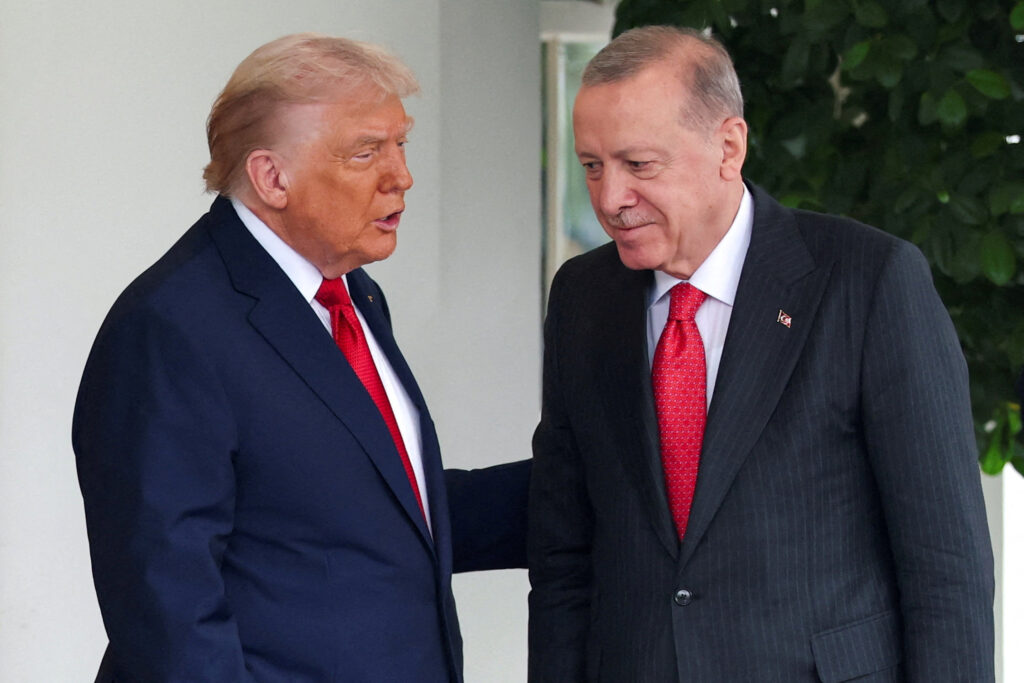
President Donald Trump, touting his friendship with his Turkish counterpart, says he’s only attending this year’s summit for Erdogan. It is the latest sign of rocky relations between Trump and his European peers.
Meanwhile, European officials, straining for a united front, have stayed largely mum about concerns of democratic erosion in Turkey. Instead, many have praised Turkey’s robust weapons industry as Europe rearms in the face of a U.S. military drawdown.
The meeting in the Turkish capital, gathering leaders of NATO’s 32 nations, will serve as a testament to this friendlier posture.
“Ankara’s international visibility will increase more than ever before, and our capital will make a name for itself as a center of global diplomacy,” Erdogan told a recent meeting of his AK Party.
Trump’s attendance alone amplifies Ankara’s message that it can help bridge divisions within NATO divide. Turkey, which boasts NATO’s second-largest military and strategic control over the Bosphorus Strait, will showcase its military prowess at a summit dominated by discussion of arms production.
Still, a drama-free gathering, let alone the display of solidarity that NATO is striving for, is far from guaranteed.
Officials from across the alliance are pulling out all the stops for the event on Tuesday and Wednesday.
Turkey has expanded the city’s airports and road network. NATO Secretary General Mark Rutte flew to Washington to sweet-talk Trump. And diplomats hope to flash billions of dollars in the president’s face with promises of weapons purchases and increased military spending.
Washington’s agreement with Tehran has helped defuse Trump’s dispute with European leaders who had hesitated to join the U.S.-Israeli war against Iran.
But the Iran deal is fragile, and the administration is still reproaching European allies over alleged stinginess. Questions also abound about U.S. plans to withdraw troops from Europe.
Trump does not shy away from the type of public argument that makes NATO officials squirm. He has engaged in a spat with Italian Prime Minister Giorgia Meloni, for example, over his assertion that she “begged” him to take a photo together at a recent Group of Seven meeting in France.
Diplomats have fretted for weeks about whether Trump would even attend the NATO summit. Turkish officials, however, seemed confident that Erdogan could persuade him. Turkey, which neighbors Iran and advocated against the war, had sought to facilitate talks between Washington and Tehran.
A fan of strongmen, Trump has given Erdogan a resounding endorsement in recent weeks, calling him “a friend of mine” and a “hell of a leader.”
“If not for the fact that it was being held in Turkey by President Erdogan, I don’t think I would’ve gone to it,” Trump told reporters at the White House last week, as Rutte sat next to him.
The NATO chief then quipped that Trump would also show up for him, and Trump agreed, but added: “I wouldn’t have gone for what we went through over the last two months with the various countries.”
Rutte, whose flattery of Trump has gained notoriety, brought a chart to the Oval Office titled “The Trump Trillion” to credit the U.S. president with pressing European nations to boost spending on their militaries.
America’s jilted allies now have years of experience navigating Trump, and leaders will rely on a familiar playbook: Keep it brief (the formal summit will be over in less than a day). Ramp up the pageantry. Avoid long joint statements that can highlight divisions or test Trump’s patience.
For Erdogan, Trump’s shout-out is “already a huge diplomatic win,” said Ozgur Unluhisarcikli, Turkey director for the German Marshall Fund, a U.S.-based policy institute. He said Erdogan “will want to capitalize on this during the summit and convert it into domestic popularity.”
Despite the friendliness with Trump, the Iran war has put Ankara on edge about U.S. volatility and about rising Israeli dominance in the region, spurring a search for new defense partnerships. Yet Turkish officials still describe Washington as an indispensable ally.
In another sweetener for Ankara, Trump has hinted at a breakthrough in a long-standing disagreement over American F-35 fighter jets. The United States blocked Turkey from buying the planes after its purchase of the S-400 Russian air defense system during the first Trump administration.
Asked about this and U.S. plans to sell Turkey jet engines for its own aircraft, Trump said last week that he was likely to make Erdogan “very happy.”
Ankara has maintained cordial relations with Moscow, all while selling Turkish drones to Ukraine in its battle against Russia.
Turkey’s homegrown weapons manufacturing has strengthened its hand as NATO contends with the U.S. withdrawing resources and European capitals vowing to take charge, but not yet equipped to do so.
That dynamic has kept European leaders quieter than before about rule-of-law concerns in Turkey, even as a crackdown on Erdogan’s main political opposition has fueled alarm in recent months, alongside a now-reversed decision to close an Istanbul university.
Turkish authorities detained more than 200 people on security grounds ahead of the summit. Rights groups said they include political activists, lawyers, an academic and an LGBTQ rights activist.
At a time of skepticism toward rhetoric about values, E.U. condemnation of Turkey’s rights record has taken a back seat, officials and analysts say.
Many officials are less inclined to stress such issues as they look to Turkey to sell Europe weapons or curb migration, and as Ankara accuses them of double standards over their limited criticism of Israeli aggression in the region.
Erdogan’s critics see Trump’s praise and Europe’s pivot as encouragement for the Turkish president.
Istanbul Mayor Ekrem Imamoglu, Erdogan’s chief political rival, has been imprisoned since 2025 on corruption charges he denies.
“Europeans don’t want tensions with Turkey anymore. … They don’t want to have that conversation,” said Asli Aydintasbas, a fellow at the Washington-based Brookings Institution.
“Sooner or later, I think Turkey and Europe would start re-crafting their relationship under different terms,” Aydintasbas added. “But neither side has openly stated that, so they’re doing this dance, and civil society rights have been the first thing thrown out of the window.”
As Turkey’s military role within the NATO alliance gains prominence, its relationship with the European Union seems increasingly awkward.
Despite improving ties with European nations such as Germany and Belgium, Turkey’s bid to join the 27-nation bloc is on ice, and a standoff over territorial waters has intensified with Greece, an E.U. and NATO member.
Instead, Turkey has focused on clinching bilateral weapons deals and other one-on-one partnerships with European countries, including Italy and Spain.
E.U. Commission President Ursula von der Leyen, who is also expected at the NATO summit, recently ruffled feathers when she grouped Turkey with Russia and China as rivals to be countered. E.U. officials quickly backtracked, describing Turkey as an “important partner.”
Yet the controversy reflected a reality that the E.U. has not clearly defined its relationship with Ankara to keep up with the times, while its member states are also divided.
The “dilemma at the E.U.,” said Unluhisarcikli, is seeing Turkey as “a partner, a competitor and at times a rival.”
Burhan Yüksekkaș in Istanbul contributed to this report.
The post Turkey sees its status in NATO rise, thanks to its weapons factories and Trump appeared first on Washington Post.