We are living in an upside-down world. Here is an example. When the U.N. Security Council endorsed President Trump’s so-called peace plan for Gaza, including what looks like indefinite U.S.-backed Israeli control in the territory, it contradicted decades of the U.N.’s own resolutions and the rulings of the International Court of Justice. The Palestinian human rights activist Shawan Jabarin wrote to the body, pleading for it to respect international law.
“To seek, as a matter of supposed political compromise, to sideline international law would be to render the U.N. complicit in Israel’s violations, to fundamentally break the promise of the U.N. Charter and to fuel only ever intensifying human carnage,” he wrote.
Jabarin got his start in activism 44 years ago as a member of a student group affiliated with the Popular Front for the Liberation of Palestine, a Marxist-Leninist, Soviet-backed militant group. In the 1980s and ’90s, he spent about eight years in Israeli prisons. At the same time, he made the long transition to leading Al-Haq, the oldest and probably most authoritative human rights organization in the occupied territories and one of the oldest in the Arab world.
But in 2021, Israel designated Al-Haq and five other Palestinian civil society organizations as terrorist groups. In September the U.S. State Department imposed sanctions on Al-Haq and two other Palestinian groups, explicitly for their work with the International Criminal Court, which has issued arrest warrants for Prime Minister Benjamin Netanyahu and his former defense minister Yoav Gallant in connection with accusations of war crimes in Gaza.
On the day the U.N. Security Council put its seal of approval on Trump’s plan, Israel was launching airstrikes on Gaza. The next day, Gaza health officials said 76 Palestinians had been killed. Altogether, since the U.S.-brokered deal went into effect, Gaza health officials say, more than 350 Palestinians have died, most of them at the hands of Israeli forces. Israeli authorities continue to restrict the movement of humanitarian aid, so that only a small fraction has been getting in. And yet world leaders and Western media refer to what is happening in Gaza as a cease-fire, and the activists — who are peacefully opposing the carnage — are facing sanctions. This is the upside-down state of our world.
For the second installment in my series on the state of international justice, I traveled to Israel and the occupied West Bank to talk to the activists who are documenting human rights violations committed in Gaza and the West Bank. (I could not visit the few researchers who continue to work in Gaza, which has been effectively closed to international journalists for more than two years.) I wanted to see how, having been designated as terrorists, placed under sanctions, harassed and threatened with prosecution, they are continuing their work. What I found is that they have expanded their idea of what that work is.
I visited Jabarin in his office in Ramallah in the West Bank. “One American organization was told by their lawyer that if they give us a cup of tea, that’s like giving a cup of tea to bin Laden,” Jabarin told me. We were having coffee and dates. Al-Haq’s headquarters, in a small office building set back from a busy commercial street, looks and sounds like an NGO office anywhere in the world: generic furniture, phones ringing dissonantly, a lot of sunlight and not quite enough air. But what’s outside the building is not like any other place I’ve been.
Over the past couple of years, many more people have become aware of the violent practices of the Israeli occupation — the continuing displacement of Palestinian villagers, the beatings and robberies committed by settlers, some of which take place under the direct protection of the military, and the detentions, torture and killings carried out by Israeli troops. The violence was frequent before Oct. 7, 2023, and has become a daily occurrence since.
But it’s the administrative, quotidian, usually nonviolent enforcement of the occupation that strikes me whenever I visit Ramallah. One day, as I was leaving my hotel for an interview, Israeli soldiers blocked off the street just outside. This had nothing to do with me, but what should have been a 10-minute drive took me two hours. “And this,” I thought in between attempting mostly useless side-street maneuvers, “is how the occupation works.”
Under the 1995 Oslo Accords, Ramallah is designated as Area A, which is fully governed by the Palestinian Authority. (Area B is, hypothetically, under Palestinian civil control but policed jointly with Israel, and Area C is governed entirely by Israel.) Nonetheless, Israeli troops can — and do — bring the city to a standstill anytime they want. The currency is Israeli. Residents use Israeli phone numbers, for which they pay Israeli companies, and consume food and other products made in Israel.
The day I was trying to drive in gridlock happened to be Yom Kippur, the holiest day of the Jewish religious calendar, when Hebrew-language television and radio in Israel go off the air. The radio in my rental car produced nothing but static, even though in this majority-Muslim, minority-Christian city it was — or should have been — an ordinary Thursday. Most residents of Ramallah cannot enter Israel; many of them have never been there, and yet they are at all times aware of the customs of the occupying power and the whims of its armed services.
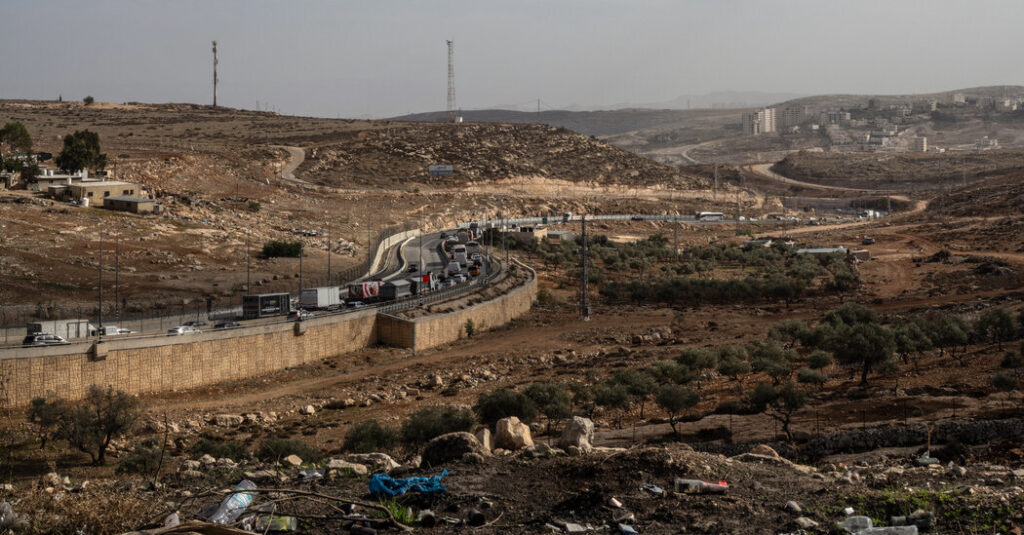
In the West Bank outside Ramallah, Israel has long exercised near-total control of the two most important resources: water and roads. The dwindling number of Palestinian farmers who still have access to their land often can’t get enough water to farm. As for roads, the new ones, built by Israel for the convenience of settlers, are almost completely off limits to Palestinians. Many of the roads on which Palestinians were once able to travel have been closed off by the Israeli authorities over the past two years. Palestinian villages have metal gates at the entrance, erected and operated by Israeli troops, and many of these gates stay shuttered for days, weeks or months.
Before Oct. 7, 2023, getting around the West Bank was hard and unpredictable: You never knew where a checkpoint might pop up or a gate might be shut. Now it’s quite predictable: You really can’t get from most places to most other places. Jabarin’s mother lives in a village outside Hebron. It used to take him an hour and a half to get there. Now it can take eight hours.
“This is illegal,” Jabarin said, spreading his arms as though to encompass all of his life and his people’s lives. “This is illegal. The occupation is illegal.” The International Court of Justice agrees, as has the United Nations, according to numerous resolutions passed starting in 1967. And yet now the Security Council has effectively given Israel’s occupation of Gaza the force of international law.
U.S. sanctions have caused Al-Haq to lose access to its bank accounts. All 45 Al-Haq employees now work without pay. “That’s 45 families,” Jabarin said.
Still, Al-Haq continues its work: documenting the genocide in Gaza and the constant violence in the West Bank, working with the International Criminal Court and the International Court of Justice and filing complaints in the courts of countries whose nationals are suspected of committing war crimes while serving in the Israeli Army. At this point Al-Haq has little left to lose. Some other Palestinian organizations, though, have become more cautious.
Defense for Children International-Palestine is another prominent human rights group. Its general director, Khaled Quzmar, also leads Defense for Children International, a Geneva-based coalition of dozens of groups worldwide. In 2023 the Palestinian organization sued the Biden administration in federal court, arguing that the 1948 Convention on the Prevention and Punishment of the Crime of Genocide obliges the United States to stop supporting Israel. The judge in that case concluded that he did not have the authority to rule on foreign policy matters.
This year, Quzmar told me, he decided against joining another lawsuit, in part because he did not want to invite U.S. sanctions. After being designated a terrorist organization by Israel in 2021, Defense for Children International-Palestine lost much of its European and American funding, but at least it still has access to its bank accounts and can continue its core work: documenting the effects of the genocide and the occupation on children and providing services to children and families. According to the organization, more than 350 Palestinian children are in Israeli custody; more than 50 have been killed in the West Bank this year.
But the threat of U.S. sanctions, which has loomed particularly large in the past few months, has made the group step away from some of the work Israel least wants it to do. The United States, in other words, continues to support Israel not only financially and militarily but also, in effect, legally, by helping ensure its continued impunity.
In Israel a bill pending in the Knesset — the Parliament — would make it a crime punishable by up to five years in prison to cooperate with the International Criminal Court, including supplying the court with information about allegations of war crimes. Even though this legislation is not yet law, almost every human rights defender I interviewed mentioned it.
One activist told me that he was limiting his work to putting all available information on the genocide and allegations of war crimes online. If someone then wants to take that information to The Hague — he trailed off so I could fill in the blank. A lawyer told me, with a similar figurative wink, that he was pursuing cases only in the domestic judicial system. If, by going all the way to the highest court, he happened to fulfill the international courts’ requirement that all domestic remedies be exhausted first, well ….
In most places I’ve reported from, the work that prepares the ground for pursuing international justice is the work of documenting — collecting testimony, organizing data, analyzing visual information. Israeli human rights defenders are certainly doing this kind of work, despite their government’s attempts at intimidating them, but their primary focus has been on something else: on naming the crime. In July two leading organizations, B’Tselem and Physicians for Human Rights-Israel, published reports that used the word “genocide” in their titles. The B’Tselem report was called “Our Genocide.”
“Genocide is not crime committed by a small group,” Yuli Novak, the executive director of B’Tselem, told me. “The whole society is recruited to it. Ours is a genocidal society.” She recounted the staff meeting in which, during a briefing from researchers working on the ground in Gaza, the scale of the catastrophe became clear to everyone present. It was also clear to them that the mass killings of civilians were not simply collateral and that starvation was not a side effect of the war. These acts were intentional. The intent was genocidal. They decided that the most important thing they could do was to tell the story of what they now felt was their genocide.
The 88-page report contains testimonies and statistics — more than 58,000 killed, almost a third of them children — but its focus is on the narrative. The report examines ideology and language as well as structures of the occupation, the displacement, violence and imprisonment that made the genocide possible. It doesn’t argue that the genocide was preordained but aims to show that by Oct. 7, 2023, the conditions that made it possible were in place and the Hamas attack became the “triggering event.”
This story about the genocide is also intended to serve as a warning. The B’Tselem report suggests that the practices documented in Gaza may spread to areas under direct Israeli control — not only the West Bank but also Israel, where about one in five residents is Palestinian.
Years before preparing the report, Novak spent two months in Rwanda because she “wanted to understand the moment before,” she said. “It’s very similar. The fact that there are weapons in the streets and they are in the hands of men and all of this is connected to one person,” in this case the former national security minister Itamar Ben-Gvir, whom the report identifies as a force behind spreading genocidal speech. Since Oct. 7, his office has been distributing guns to Israeli settlers. More recently, it armed self-appointed militias that harass antigovernment demonstrators in Tel Aviv.
We were talking in a quirky little house in Jaffa, which Novak shares with her partner, Yael Harari, and their 2-year-old son. A few weeks after the B’Tselem report was released, Harari graduated from medical school. What should have been a triumphant occasion felt unbearable. Harari couldn’t face the ceremony — the giant Israeli flags, the self-congratulatory speeches, all while people were starving and being killed in Gaza. In the end, she, too, decided to act by naming the genocide. She attended the ceremony. When her name was called, before walking across the stage, she opened her graduation gown to expose a white T-shirt with the words of an amended Hippocratic oath: “First do no harm,” with “harm” struck out and replaced by “genocide.” In a video of the graduation, you can hear the crowd go silent as she starts walking.
Something similar happened with the “Our Genocide” report. When B’Tselem released it, Novak and her staff braced for the reaction. They had been vilified before. Novak had been doxxed, threatened and at least twice forced to temporarily leave the country. But this time, there was no such reaction. Mainstream Israeli news outlets largely ignored the report in much the same way as they have been ignoring almost everything happening in Gaza. Since October 2023, their coverage has focused almost exclusively on the Hamas attack, the Israeli hostages, Israeli soldiers who have died in uniform and the outside world, which they say has been unfairly criticizing Israel.
Haaretz, a left-wing newspaper with a small audience, covered the report, but “when something happens only in Haaretz, it’s as if it hasn’t happened at all,” Novak said.
The work related to international justice, war crimes and, of course, genocide, refers to the Nuremberg trials, which began almost exactly 80 years ago. Defendants in those trials — German generals, judges, industrialists and others — often claimed not to have known about the nature of the crimes or the extent of the crimes committed by their compatriots. The B’Tselem report explicitly aims to prevent this justification. The title alone does the job.
Over the years of interviewing Israeli dissidents, I’ve noticed that the origin stories of their activism usually date to one or another of Israel’s wars or crises. It is as though these explosions of violence open the opportunity for seeing — or foreclose, for some, the opportunity to not see. Ruchama Marton, the founder of Physicians for Human Rights-Israel, told me her story when I visited her in Tel Aviv. She is 88, five feet tall and has just published a memoir whose title can be translated as “A Tough Woman” or “A Difficult Woman.”
With her cat lying on the dark wood dining table between us, Marton told me that in 1987, when the first intifada began, she knew that Israeli television was lying to her. She didn’t know what specifically it was lying about, but she is, she told me, “very sensitive to lies.” She gathered 11 colleagues, as many as would fit in a van, and they went on a fact-finding mission to Gaza.
Defense Minister Yitzhak Rabin had acknowledged that the Israeli forces’ strategy for suppressing the uprising was to beat the protesters. Even so, what she saw at Al-Shifa Hospital shocked her. “Every bed — these were young people with broken limbs, many of them unconscious because of being hit with clubs to the head. They were intubated.”
After leaving Gaza, the doctors pulled over at a gas station, discussed what they had seen and decided to form an organization. Physicians for Human Rights-Israel provides medical services in the occupied territories, and in Israel it has published many meticulously documented reports on such topics as access to health care, torture in Israeli prisons and, now, genocide.
In July the group issued a 65-page report to coincide with B’Tselem’s. It’s called “Destruction of Conditions of Life: A Health Analysis of the Gaza Genocide.” Marton told me she started using the term two years ago. Having done this work for more than 35 years, she had witnessed the long, systematic creation of “conditions of life calculated to bring about its physical destruction in whole or in part,” as the Genocide Convention puts it.
On Oct. 7, 2023, the Hebrew University historian Lee Mordechai was in the United States, in the second month of an academic year he was spending at Princeton working on a book about the year 536. Like many Israelis abroad, he struggled to locate his role and his relationship to what was happening in Israel and Gaza. He was watching and reading all he could, in Hebrew and English. “If this is being done in my name, then I need to know what it is,” he recalled thinking. The more media he consumed, the more he noticed a gap between information readily available to Israelis and to people outside Israel.
In December 2023, when South Africa filed a genocide case against Israel at the International Court of Justice, Mordechai read the documents. The case, he realized, was an attempt to organize all available verifiable information into a coherent narrative. He could do this, too, he thought. And he could add more recent information.
Mordechai started assembling publicly available facts about what was happening in Gaza into a report, which he saved as a PDF file and posted on X and on Academia.edu. He kept publishing revised and updated versions. He studied the relevant law and classified the actions of Israeli forces as crimes against humanity. After a few months, he started using the term “genocide.” “I read the Genocide Convention, and what I could see fit the definition,” he told me. “I am not a legal expert, but I know how to read, and this is what I do in my day job.”
Few seemed to notice Mordechai’s report until one day, in March 2024, his 28-post thread on X went viral. Overnight, the audience for that version of the report went from a couple of hundred to five million.
Mordechai returned to Jerusalem in August 2024. His project now involves over 100 volunteers — Jews and Palestinians, many of them academics. They maintain an online archive that includes media and expert reports, published testimonies and witnesses’ accounts posted on social media. He continues to update the main report, which is now more than 200 pages long and cites about 4,000 sources. Plans include an encyclopedia, a collection of statements made by Israeli officials that appear to show intent to commit crimes against humanity or genocide, and content that “an interested person can take as a PowerPoint to their family.”
Each of these activists — Jabarin and Novak, who are professional human rights defenders; Marton, whose primary work was in psychiatry but who accumulated decades of human rights experience; and Mordechai, with his volunteer researchers — is working to preserve the record and to name the crime that Israel is committing.
One way to think about this work is as a bare minimum. Israeli activists are reluctant to talk about international justice not only because their government may criminalize such talk but also because the possibility of such justice for Gaza seems so remote.
Another way to think about it is as work for the future. The International Criminal Court may yet succeed in prosecuting cases related to Gaza. The International Court of Justice, where the South African case against Israel is pending, will perhaps eventually consider it. Novak, who spent years learning from South African anti-apartheid activists, told me that she hopes a reckoning with “our genocide” will become the foundation for a society in which Palestinians and Jews live together as equals. Mordechai, too, envisions truth and reconciliation commissions and a museum of the Gaza genocide — “like Yad Vashem,” the Jerusalem complex dedicated to the history of the Holocaust. Someday, when the world has a chance to turn right side up again.
The Times is committed to publishing a diversity of letters to the editor. We’d like to hear what you think about this or any of our articles. Here are some tips. And here’s our email: [email protected].
Follow the New York Times Opinion section on Facebook, Instagram, TikTok, Bluesky, WhatsApp and Threads.
The post ‘This Is Illegal,’ He Said, Spreading His Arms. ‘This Is Illegal.’ appeared first on New York Times.