President Trump is set to mark the 250th anniversary of the United States today with an elaborate celebration in Washington, D.C., featuring military flyovers and a fireworks display that organizers say will break world records. America’s other global leader, however, has chosen to spend Independence Day quite differently.
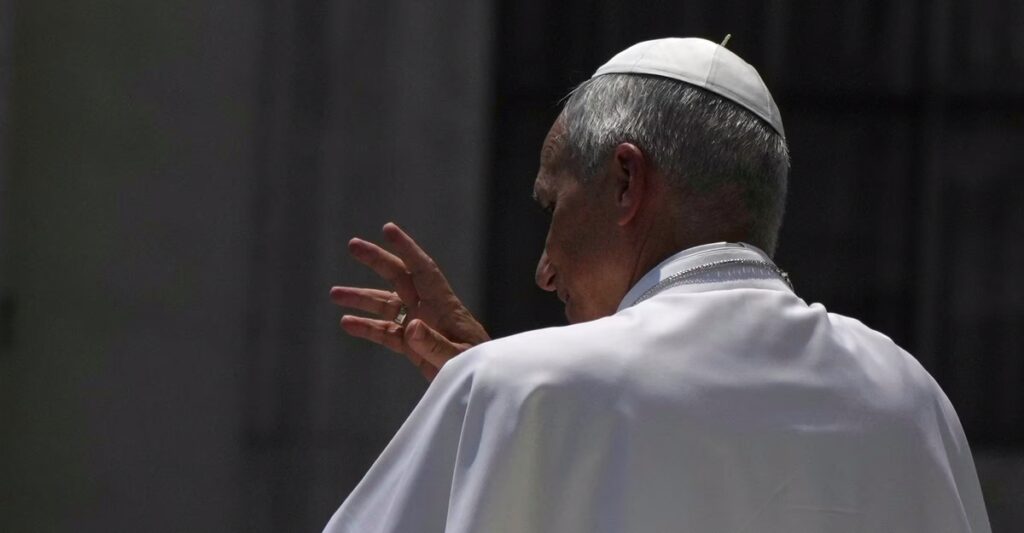
This morning, Pope Leo XIV visited the southern Mediterranean island of Lampedusa, where he laid flowers at the graves of migrants who had died trying to reach Europe. Leo compared them to the man who fell among thieves in the Gospel parable of the Good Samaritan. “Here you have seen not just one but thousands of human beings fallen into the hands of robbers who have taken everything from them, beat them brutally, and walked away, leaving them half-dead,” the pope said. He called on his listeners to act like the biblical benefactor: “We become neighbors by acting as neighbors.”
The first U.S.-born pope did not mention his native land in his remarks. But given the significance of the date, and his repeated criticisms of Trump’s immigration policies, Leo’s message to America was impossible to miss.
Yesterday, the pope released a letter marking the semiquincentennial in which he implored the U.S. to live up to its founding ideals, particularly in its treatment of immigrants. He called on the country to safeguard “human life from its beginning at conception until natural death,” which must include “welcoming, protecting and assisting immigrants, whose hopes, sacrifices and contribution have formed part of the history of this country from its very beginning.”
In a speech livestreamed from the Vatican, Leo also addressed the U.S. yesterday as he accepted the Liberty Medal from the National Constitutional Center in Philadelphia. He praised America’s long history of opening “its doors to successive waves of immigrants, enabling them and their children to play their part in shaping the future of the nation.”
Judging by his rebukes of the Trump administration, Leo plainly believes that America is failing to live up to this standard today. The pope has made clear his opposition to Trump’s immigration policies, which he condemned last year as “inhuman” and “extremely disrespectful.” In November, he backed the U.S. bishops when they denounced the government’s campaign of “indiscriminate mass deportation.”
Trump has not personally pushed back on Leo’s criticisms; his remarkable attacks on the pope earlier this year focused on the pope’s opposition to the Iran war. Instead, the administration’s most prominent voice in the immigration debate with the Church has been that of Vice President Vance.
[Read: The Iran war showed a new side of Pope Leo]
In a new memoir about his conversion to Catholicism, Vance dismissed some of the Vatican’s statements on immigration as “generic” and “trite platitudes.” Earlier this week, the vice president told Fox News that he hoped Catholic leaders had learned from the Trump administration that “it’s not just about the dignity of the immigrant; it’s also about the dignity of the native-born factory worker who has their wages destroyed. It’s about the dignity of the child who can be sex trafficked by a cartel member when you have open borders.”
Leo’s visit to Lampedusa seems to confirm that defending the dignity of immigrants will continue to be a priority, just as it was for his predecessor Pope Francis. In 2013, the recently elected Francis chose to make his first trip outside Rome to the then-little-known Lampedusa after hearing about migrants who had died when their boat sank off its shores. There, Francis deplored the “globalization of indifference” epitomized by the migrants’ plight.
Francis went on to produce hundreds of pages of writings and speeches on the issue. Indeed, in one of his final official acts—less than three months before his death last year—he sent an open letter to U.S. bishops encouraging them to oppose the Trump administration’s mass-deportation policies.
Leo’s own trip to Lampedusa, in keeping with his more restrained and traditional style, was less dramatic than Francis’s. Whereas the Argentine pope arrived at the island’s main port on an Italian Coast Guard vessel, accompanied by a flotilla of fishing boats, Leo arrived by car. Francis celebrated Mass using an altar made out of a small fishing boat, but Leo opted for a conventional setting.
During his visit, Leo said that the deceased migrants were victims of economic inequality, political corruption, an “indifference to the common good,” and the failure by countries in the region to coordinate their immigration policies. Although Leo’s principal focus on Lampedusa was defending migrants—a left-coded cause in the American political context—his messages to the U.S. highlighted two right-coded concerns: protecting religious freedom and the right to life. He described both as founding ideals grounded in a biblical understanding of the human person.
This political balancing is characteristic of Leo, who has sought to reassure conservatives and progressives in the Catholic Church that he listens to both sides. The strategy reflects the importance he places on unity, as summed up in his papal motto, In Illo uno unum: “In the One”—that is, Christ—”we are one.”
In his speech yesterday, Leo made clear that he sees polarization in America and the wider world as a grave problem. Citing the U.S. motto E pluribus unum, Leo told the gathering in Philadelphia: “In order for a nation to flourish, it must be truly united; united not by goals bound to momentary endeavors, but by ideals that do not fade with the passing of time.” As unlikely as the Founders might have deemed it, one of the most ardent defenders of those ideals today is an American in the Vatican.
The post Pope Leo’s Challenge to America on July 4 appeared first on The Atlantic.