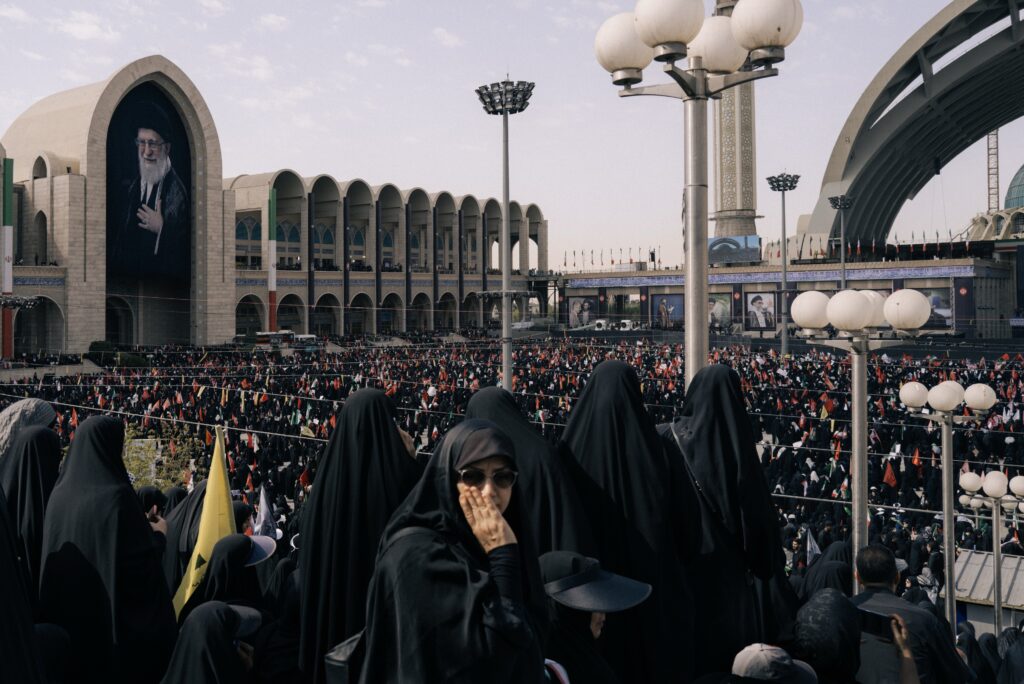
TEHRAN ― Tens of thousands of mourners streamed on foot to the Grand Mosalla religious complex in Tehran on Saturday as Iran mourned its supreme leader, Ayatollah Ali Khamenei, who was assassinated in an airstrike on the first day of the U.S.-Israeli war.
The huge outpouring to view the caskets of the slain leader and some of his family members, positioned at the front of a prayer hall, is part of five days of somber funeral rites that will stretch across five cities and into Iraq, before Khamenei is buried in Mashhad, his hometown.
The public display of lamentation and bereavement was an opportunity for collective closure after some of the most perilous months in the Islamic republic’s history, but also a forceful show of defiance from a system badly battered but very much still standing.
“We are mourning,” read a black banner across one of the streets leading into Mosalla, “but we do not bow.”
Inside the massive, open-air complex, crowds chanted, “We are avenging the blood of our leader,” during breaks in religious recitations. Smaller groups led sporadic calls of “Down, down, America!” Some people cried; others stood in silence. One sign declared “Kill Trump” in white lettering against a red backdrop.
Amin Haghighat, 40, a member of the clergy from Isfahan, said that the funeral was a critical show of unity for Iran but that the most important message being delivered was one of revenge.
“We are here to take our revenge, to show that we will stay until our enemies are evaporated,” Haghighat said.
After months of war, he said, he feared Iran’s enemies “are attempting to sow discord, and our most important tool is that of unity.”
For Iran’s surviving regime, Khamenei’s funeral is a test of the state’s competence and capabilities just months out from a brutal war with two of the world’s most powerful militaries. But crowd size could also be interpreted as an informal indicator of the government’s support.
Millions turned out for the funeral of Khamenei’s predecessor, Ayatollah Ruhollah Khomeini, in 1989. Nearly 40 years later, the regime is hoping to make an even stronger display of unity, though dissent in Iran is often met with brutal, even deadly, repression.
Faezeh, 46, a homemaker who runs a side business as a makeup artist and asked to be identified by only her first name because of her distrust of Western media, said she thought the crowds Saturday morning were already an indication of widespread support for Iran’s new leadership.
“We have aspirations, big goals, like freedom, dignity and independence,” Faezeh said, adding that she believes Iran is closer to achieving those goals now than it was just a few months ago. “We do not welcome war, but it has made us stronger,” she said.
Many people brought their children with them Saturday, despite temperatures exceeding 90 degrees by midday.
Saeed Arabian, 37, an elementary school math teacher from Shuhada in southern Tehran, sat with his three sons in the shade beneath a staircase on Mosalla’s edge.
“From early childhood, children should learn that it’s the rules of the jungle, that the weak are killed,” Arabian said, explaining why he brought his children, age 4, 5 and 8, to a funeral viewing.
Arabian said he used to think the world was governed by laws, but after U.S. actions against Iran, he said he changed his mind. “We see that human beings are just treated like animals,” he said.
From the religious complex to the surrounding streets, images of Khamenei were everywhere: on buildings, on flags, pins, posters and billboards. In many instances, Khamenei is being pictured alongside his son and successor, Mojtaba, who has not appeared in public.
“He was like a father, and now he is like a father,” said Seyed Mohammad Amin, pointing at images of one leader then the other. Amin, 28, a filmmaker, came to the viewing from Yaftabad, a neighborhood in southern Tehran.
It is still unclear whether Mojtaba Khamenei will appear at any of the funeral events. He was reportedly injured in the strike that killed his father and has not been seen in public since the start of the war.
However, several senior Iranian officials who had not been seen since the war have reappeared this week.
Ahmad Vahidi, the commander of the Islamic Revolutionary Guard Corps, attended a private mourning ceremony in Tehran on Thursday. And on Friday, the head of Iran’s aerospace command, Majid Mousavi, attended a commemoration at Mosalla ahead of the public viewing.
The post In Tehran, huge throngs mourn assassinated supreme leader Ali Khamenei appeared first on Washington Post.