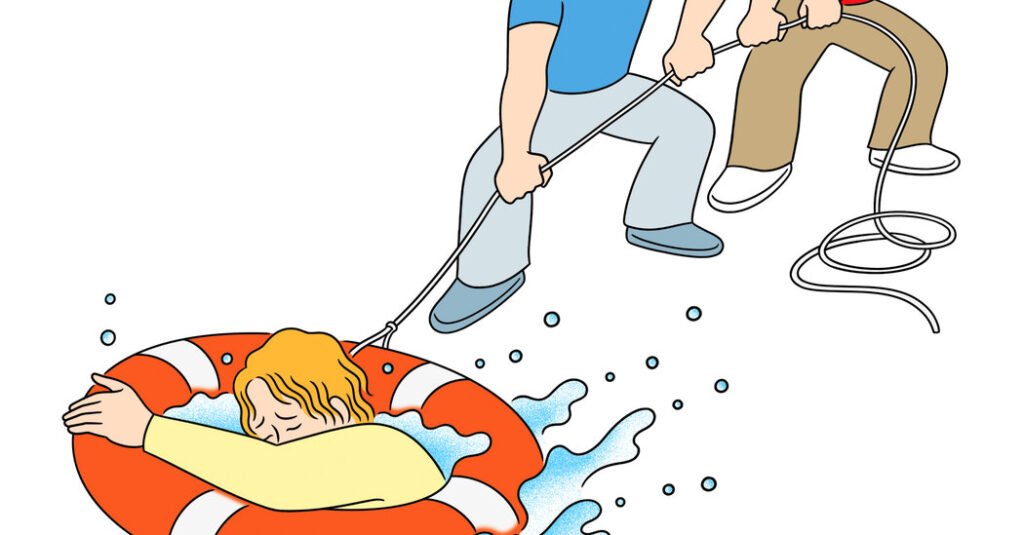
My older sister is nearing the end of a brutal divorce and is struggling financially and emotionally. During the divorce, we learned that she had misrepresented her employment for more than a decade to her spouse and to our family. She has not worked for years and is now thousands of dollars in debt from legal fees and years without income.
She says she cannot work because of health problems, a series of diagnoses and self-diagnoses. We do not want to dismiss her health concerns, but every conversation seems to bring a new reason she cannot look for work.
My younger sibling and I want to help. Our mother is not in the picture, and our sister’s relationship with our father is strained. But we worry that financial support may enable her rather than help her. She says she does not know what to do, cannot trust her own judgment because she may have “brain damage” and believes she has ruined her life. Yet when people offer guidance, she sometimes blames them or grows resentful if things do not turn out as she hoped.
My younger sibling and I are early in our careers and are building our own lives and families. We cannot take responsibility for her expenses. Still, as she runs out of time to find a new place to live, we feel trapped between two bad choices: watching her sink further into debt and despair, or offering support that could draw us into a long-term obligation while allowing her to avoid taking responsibility for her life.
Is there a responsible middle ground? Should we pay for an apartment for a fixed number of months, on the condition that she look for work and begin covering rent afterward? Or should we avoid giving money and offer only emotional support, even if that means watching her struggle? The smart, warm, lovely older sister we know is hurting and stuck. We want to help her without enabling her, and we are overwhelmed by how to do that responsibly.
— Name Withheld
From the Ethicist:
You’ve identified the two main ethical issues involved here. First, your sister should be encouraged to take responsibility for her own life. Simply taking on her problems interferes with that: The short-term solution impedes the long-term solution. Second, you and your younger sibling have your own lives, which come with their own sets of responsibilities.
Whatever financial assistance you offer, then, should be limited in amount and duration. It should also be conditioned on your sister’s taking specific steps that can improve her chances of stability. This might mean applying for benefits, consulting a debt counselor and working with you on a realistic housing plan. It’s equally important, in view of her reported incapacities, that she receive a proper evaluation, involving a doctor or a mental-health professional.
If she resists those steps? It won’t do to fund the consequences of habitual avoidance while leaving the underlying problems unaddressed. She may indeed require more structure and outside support. Until you and your other sibling have a clearer understanding of her actual capacities and limitations, though, it will be hard to know what conditions are fair. The key is to help her become more fully in charge of her life and to keep yourselves from being drawn into an open-ended role that ultimately helps no one.
Readers Respond
The previous question was from a reader who wondered what she owed her previously abusive mother who has Alzheimer’s. She wrote:
Our parents divorced when we were young, and both were neglectful and emotionally abusive. … Now in her 80s, my mother is showing signs of Alzheimer’s. Her husband recently told me that if he dies first, I will be responsible for her care. I don’t think I can do it. The thought of having her live with me makes me physically sick. My siblings are unlikely to help. Since that conversation, almost a year ago, I have thought about this every day. What, if anything, do I owe my mother? — Name Withheld
In his response, the Ethicist noted:
Nobody has the right to ask this of you. We may owe something to those who raised us, but we have no duty to abandon our own lives to look after them, especially when they failed in their parental duties. Tell her husband that you’re not going to take on her care and that he needs to make the necessary preparations. He should consult with an elder-care lawyer, identify the local Area Agency on Aging and arrange advance directives and other long-term plans while your mother still has the capacity to participate in those decisions. A trustee to manage her affairs once he’s gone should be appointed. These are things you can suggest to him, anyway. They are not things you need to do.
(Reread the full question and answer here.)
⬥
If your mom were drinking herself to death, that would be one thing. But she is merely aging. And she will soon be helpless. Your mom took care of you when you were helpless. You can count yourself lucky to have a chance to help her. — Walter
⬥
I had a very similar situation with an abusive mother. Her personality changed completely when the dementia got to the moderate stage. She became a nice person, full of supportive comments, compliments and loving messages. All the things that would have been nice to experience when growing up and throughout my early adulthood. She was in assisted-living and eventually a nursing home, but I was responsible for most of her care and saw her almost every day. I could not have done that had her personality not changed. I’m told this is really common. Nice people become difficult at these stages. Nasty, critical people become nice. Certainly do not have her live with you, but you might find some relief in those later stages when your mother might actually become loving and motherlike. — Heidi
⬥
There may be no ethical duty, but many states have filial responsibility laws. The child might seek advice to establish a written denial of relationship in case the mother is hospitalized, or do everyone a favor and suggest the mother participate in her own care planning, including an advance directive. — Heather
⬥
Don’t let her victimize you again. Once you make that decision, you’ll feel like a great weight has been lifted. Even if you had a loving parent, no one can force you to take on such a responsibility, but with an abusive one? No way. Don’t think of it as “she made her bed, let her lie on it.” Think of it as you being free. — James
⬥
Compassion does not require sacrificing your own mental health. There is a difference between ensuring someone is safe and becoming their full-time caregiver. One of the Ten Commandments is to “honor” your mother and father. Not “love” your mother and father. Adult children who survived abusive childhoods should not be judged for setting boundaries, even at the end of a parent’s life. Sometimes the most loving thing you can do — for both yourself and your parent — is to help arrange appropriate care for them without reliving decades of trauma. — Alicia
The post My Sister Insists That She Can’t Work. Should I Pay Her Bills? appeared first on New York Times.