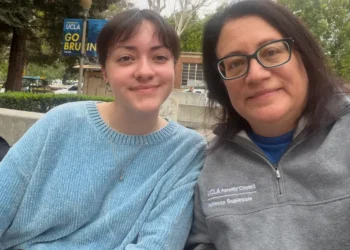
Mia Taylor looked down at her Los Angeles County election ballot a few weeks ago and felt a familiar mix of duty and dread. How could she possibly know the best choices in the dozens of local contests she was asked to vote in? Partly on a lark, she turned to a newly ubiquitous tool: Claude.
Ms. Taylor snapped a picture of her ballot and asked: “So, who do I vote for here?”
Claude, an A.I. chatbot developed by Anthropic to analyze data and hold natural conversations, initially declined to answer. Like OpenAI’s ChatGPT and Google’s Gemini, other widely used tools, Claude is trained to avoid answering political questions that could expose biases.
So Ms. Taylor, a self-described liberal Democrat, sharpened her question, asking it to find links to well-regarded progressive groups and help her come up with strategic voting options.
“Here are some sources you can look at,” it replied, linking to voter guides and describing each race in detail. Ms. Taylor was especially torn about her vote for mayor, wondering how she could help stop Spencer Pratt, the Republican who momentarily looked likely to win one of the top two spots in the open primary. Claude’s advice: Vote for the incumbent, Karen Bass, not Nithya Raman, a member of the City Council. (Mr. Pratt later lost the race, while Ms. Bass and Ms. Raman advanced to the general election.)
It was probably only a matter of time before voters began to use artificial intelligence to help guide their choices. The 2026 midterms may be the first American elections in which voters are using A.I. in meaningful numbers.
Voters are turning to new A.I. tools to serve as nonpartisan researchers, viewing them as a viable alternative to traditional news coverage, voter guides or social media. They provide an appealing and seemingly efficient way to learn about campaigns and ballot measures, allowing users to bypass the sometimes dizzying array of political literature, advertising and commentary coming their way. But some experts warn that the tools are far from foolproof: The results they produce can be marred by factual errors or shaped by flawed assumptions.
Chris Johnson, a 58-year-old resident of Atlanta, appreciates both the allure of relying on A.I. to choose candidates and the worry about its accuracy.
Mr. Johnson, a registered Republican who considers himself a libertarian, has voted in every Georgia election for the past 40 years. When he prepared to vote in the state primary in May, he asked ChatGPT to tell him which of the candidates was the most libertarian. Initially, the system resisted answering directly, so Mr. Johnson asked it to rely on the candidates’ voting history. The chatbot suggested Brad Raffensperger, the Georgia secretary of state who was running for governor in the Republican primary but ultimately lost the race.
Mr. Johnson felt chagrined by how easy it was. He recalled that for years he read the print edition of the local newspaper to come up with his own sense of which candidates most closely matched his values.
“I felt a bit lazy for not doing more,” he said. “It felt easier, but I am not sure that everything was correct.”
The appeal of artificial intelligence tools, also referred to as large language models, lies in their simplicity: Users often find the information they produce more straightforward and understandable than data from a more traditional internet search. And many welcome the interaction. Researchers and A.I. companies are already envisioning a time when political campaigns create their own chatbots, enabling voters to question them directly.
“There is a reason these models are persuasive: They come up with facts or factual claims and are just good clear explainers,” said David G. Rand, a professor of information science, marketing and psychology at Cornell University who has done extensive research on the effectiveness of artificial intelligence in political persuasion.
Earlier this year, before voting in a local school board election, Mr. Rand turned to artificial intelligence for help. He uploaded an hourlong video of a campaign forum and then asked which of the candidates most closely matched his values. He used this research to make his choices. And when he ran his picks by friends who were more involved in local politics, they endorsed his reasoning.
Still, Mr. Rand noted, the output is only as good as the input: A.I. tends to reaffirm and mirror users’ biases, framing candidates’ views through the voters’ lens, rather than objective facts.
Anthropic, the parent company of Claude, has said users asking about political topics “should get comprehensive, accurate, and balanced responses — responses that help them reach their own conclusions rather than steer them toward a particular viewpoint.” In a lengthy statement earlier this year, the company said Claude is trained to “treat different political viewpoints with equal depth, engagement, and analytical rigor.”
Jeremiah Hain, a 42-year-old psychotherapist in Los Angeles who has used ChatGPT routinely for other small tasks, recently employed it to help him choose candidates in races for mayor and various other offices.
“I don’t have the time, nor did I want to do the same kind of research I have done in the past,” he said. “This was very intuitive, and I actually respect its intelligence, I guess.”
He was so enamored by the process that he posted a video on TikTok encouraging other voters to do the same. (And because he knows his videos get more engagement when he is shirtless, Mr. Hain filmed himself bare-chested. “I wanted to do this as a thirst trap on purpose,” he said.)
But that sense of efficiency may mask the risks of turning over the democratic process to technology, some experts warn. Because most chatbots produce answers that sound confident and authoritative, users may not make the time to check the underlying claims.
Ideally, A.I. tools for election help would rely on a curated and verified database of political information and policy platforms to help voters, rather than pulling data from across the internet, as the existing tools do, said Yamil Velez, a political science professor at Columbia University who has researched the effectiveness of A.I. in convincing voters. But he was reluctant to completely dismiss the usefulness of A.I. in election decisions. “It is important to think about what is the alternative,” he said. After all, he added, most voters are unlikely to spend hours in the county clerk’s office researching their election options.
A year ago, Mr. Velez added, he would have said that voters would be better off relying on an internet search, but the A.I. tools are becoming increasingly accurate.
Nonetheless, he cautioned, the current tools likely benefit candidates who are more vocal in the local press and on social media, making their views easier to find. Campaign strategists are keenly aware that voters are using these tools and have begun looking for ways to get more favorable results by publishing more material online in formats that chatbots prefer, such as using bullet points.
Still, in interviews, people who had used A.I. to research election choices said it allowed them to vote with more confidence.
Robert Siebelink, a 54-year-old Democrat who lives in Corona, Calif., turned to Claude after feeling overwhelmed by the prospect of researching the 61 candidates running for governor in his state, not to mention the candidates in less high-profile races. He uploaded his ballot and asked Claude to suggest candidates who most aligned with his values.
Eventually, he had narrowed down his choice for governor to two Democrats, Xavier Becerra and Tom Steyer, and asked Claude how to strategize.
In less than half an hour, he had filled out his ballot and chosen Mr. Becerra.
“I just felt so refreshed,” Mr. Siebelink said. “That’s the most informed voting that I have ever done.”
“It felt like some political expert that knew all of the research and we just sat down over coffee and chatted and they took notes,” he said.
Similarly, Rikki Powers, a 31-year-old Democrat who lives in Baltimore, took a photograph of his ballot before the recent Maryland primary and asked Claude to provide bullet points for each candidate. He said he was looking for a broader perspective than what he could get from candidate campaign websites. After checking some of the links for accuracy and to “make sure that I truly like the candidates I am voting for,” he used the summary to fill out his ballot on the spot.
“The last time I voted, I spent probably 20 hours researching,” he said. “This time was an hour.”
Still, Mr. Powers said, there are limits: While he had no hesitation uploading a blank ballot, he would never tell A.I. how he voted.
Jackeline Luna and Sean Keenan contributed reporting.
The post ‘Who Should I Vote for?’ Voters Turn to A.I. Before Casting Their Ballots appeared first on New York Times.