Just before dawn on a Saturday morning last month, a 76-year-old congresswoman arrived outside the John F. Kennedy Center for the Performing Arts and got close enough to peek behind a white tarp with blue stripes covering its marble facade.
Representative Joyce Beatty, Democrat of Ohio, was there to admire her own handiwork: the stripping of President Trump’s name from the building. A couple of weeks earlier, a judge had ordered the removal of the letters in response to a lawsuit Ms. Beatty filed contesting Mr. Trump’s move to stamp his own name on Washington’s premier performing arts center, named by Congress in honor of one of the nation’s most popular former presidents.
That gave Ms. Beatty, a Kennedy Center board member who is in her seventh term representing part of Columbus, Ohio, in Congress, the distinction of being one of the few people to have prevailed in a legal challenge to Mr. Trump’s efforts to remake Washington in his own image.
The president has never attacked Ms. Beatty by name. But a Justice Department lawyer wrote in a legal filing appealing the move that Ms. Beatty had been nothing more than a “troublemaking appointment” to the board since “the beginning of her tenure!”
It was music to the ears of a congresswoman who said she had been inspired to wage the legal battle out of a desire to protect the civil rights legacy of President John F. Kennedy.
“‘Go get in good trouble,’” Ms. Beatty said in an interview, quoting Representative John Lewis of Georgia, the civil rights leader who died in 2020. “This was good trouble.”
Ms. Beatty, who has served in the House since 2013, has not been a stranger to such resistance. In 2021, she was arrested in the atrium of a Senate office building along with eight activists demonstrating for voting rights.
The Kennedy Center is one of several iconic Washington edifices Mr. Trump has sought to overhaul since returning to office. From his tear-down of the East Wing of the White House to his renovation of the Lincoln Memorial Reflecting Pool, the president has endeavored to leave his mark on the nation’s capital despite evidence that such efforts are unpopular among voters and have presented political problems for his own party.
Ms. Beatty’s lawsuit was just one of many court cases challenging the president’s power to take a construction tool to a storied Washington site, but hers has been one of the few to succeed.
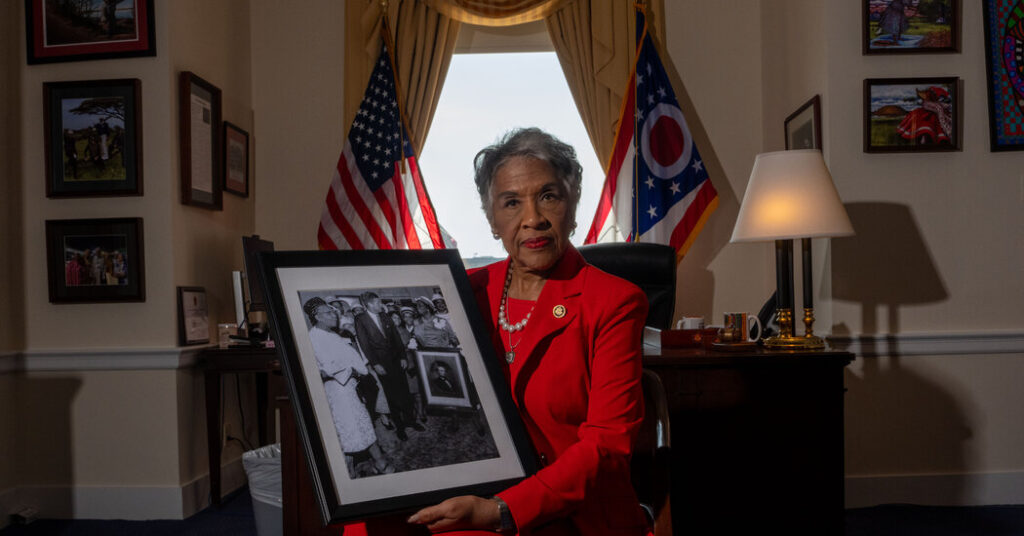
In the interview, Ms. Beatty said she took on the fight because her ties to the venue — and to the Kennedy family — run deep. A picture of her late husband’s grandmother, Mayme Moore, standing next to Kennedy hangs in her office on Capitol Hill. In the 1962 photo, Moore and members of the National Association of Colored Women’s Clubs were presenting Kennedy a framed portrait of President Abraham Lincoln.
Former Speaker Nancy Pelosi appointed her to the board in 2019 as an ex officio member, a trustee who already holds public office. Ms. Beatty said she has been serving ever since, joining a group designated by law to oversee “a living memorial to John Fitzgerald Kennedy.”
She was shocked during a board meeting in December when, with no warning, Sergio Gor, a board officer who has since become the U.S. ambassador to India, proposed adding Mr. Trump’s name to the center’s title and making it the Donald J. Trump and John F. Kennedy Center for the Performing Arts, or the Trump-Kennedy Center.
“I tried to push my button to say: ‘I have a question. I want to object to this. How are we doing this?’” recalled Ms. Beatty, who called in to the meeting. “I was muted. I thought it was a technical error at first, so, I tried it again.”
But she was muted for a second time, and before she knew it, the board voted in favor of the name change. Karoline Leavitt, Mr. Trump’s press secretary, said on social media that the vote had been unanimous. The next day, Mr. Trump’s name was affixed to the center’s front portico.
“It was not surprising, but that didn’t make it any less harmful or devastating,” Ms. Beatty said.
In the hours that followed, she said the meeting continued to bother her. On social media, members of the administration were celebrating a change that she thought would be particularly ruinous for the center, which had already been struggling financially partly because of boycotts from artists and audiences opposed to Mr. Trump.
Ms. Beatty was also outraged that the president’s allies on the board had silenced her during the meeting. So she sued her fellow trustees, including the board chair, Mr. Trump.
“I think because there has been a history of this president doing things and getting away with it, that there were folks out there who thought we were not going to prevail,” Ms. Beatty said. “There were people out there who thought it might not be worth it. For me, it was important.”
In her filing to the United States District Court for the District of Columbia, Ms. Beatty cited the law enacted in 1964 that named the institution in honor of Mr. Kennedy and argued that only Congress had the power change it. She also said ex officio trustees like her “possess the same rights and responsibilities” as other board members appointed by the president.
The Trump administration disagreed, arguing that ex officio trustees had no right to vote at board meetings. Further, the government said that a name change was necessary to revitalize the center, which “would go into financial and structural collapse” otherwise.
The monthslong legal battle came with twists and turns. At one point, Ms. Beatty accused the center of unlawfully excluding her from a different board meeting, only to learn that an emailed invitation had landed in her spam folder. She ended up attending that March meeting, and expressed her frustration with the Trump administration’s actions at the center after a judge said the board must allow her to speak.
Then in May, Judge Christopher R. Cooper ruled that Mr. Trump’s name must be taken down within two weeks from promotional materials, the center’s website and the building. In his opinion, Judge Cooper sided with Ms. Beatty, writing that the Kennedy Center was named to “honor President Kennedy and President Kennedy alone.” He gave the administration two weeks to comply and temporarily blocked the center from closing, thwarting Mr. Trump’s plan to shutter it for renovations after July 4.
The center is appealing the ruling on the name.
Mr. Trump was irate, raging in a social media post that Democrats cared more about “opposing your favorite President, ME, than saving a dying Performing Arts Center.”
Ms. Beatty, on the other hand, was elated.
“It was emotional, it was rewarding, it was a celebration in many ways,” she said of the ruling.
But the real moment of triumph came two weeks later on the eve of Judge Cooper’s deadline, when she arrived at the Kennedy Center to watch the removal of the president’s name.
A jubilant crowd had gathered as workers set up scaffolding and a tarp to cover the building’s portico, and people shared stories about what the center meant to them. A double rainbow came over the horizon, and Ms. Beatty indulged in a miniature dance party, mimicking Mr. Trump’s “Y.M.C.A.” move.
Ms. Beatty went home early the next morning — the crowd dwindled, and the president’s name was still up. Almost as soon as she left, Ms. Beatty got word that the workers were taking the name “Donald J. Trump” down. She came straight back, and after checking that the letters were gone, she thought of one word: justice. And later: history.
“I think about history and what this will say when history is written,” Ms. Beatty said. She said she hopes her grandchildren will learn about her fight and say, “‘That was my Grammy that won that lawsuit.’”
The post This Representative Fought Trump Over the Kennedy Center and Won appeared first on New York Times.