When the British jewelry designer Hannah Martin was a student at Central Saint Martins in London, she was taught the importance of clasps.
“I always say Saint Martins students have this thing about clasps because we were, like, drilled — we’d basically get thrown out of the room if we put a bought finding onto a piece of jewelry,” Ms. Martin said, referring to the mass-produced generic clasps often used to finish jewelry. Instead, she said, students were encouraged to conceal clasps beneath a gemstone or decorative motif, or integrate them into a design.
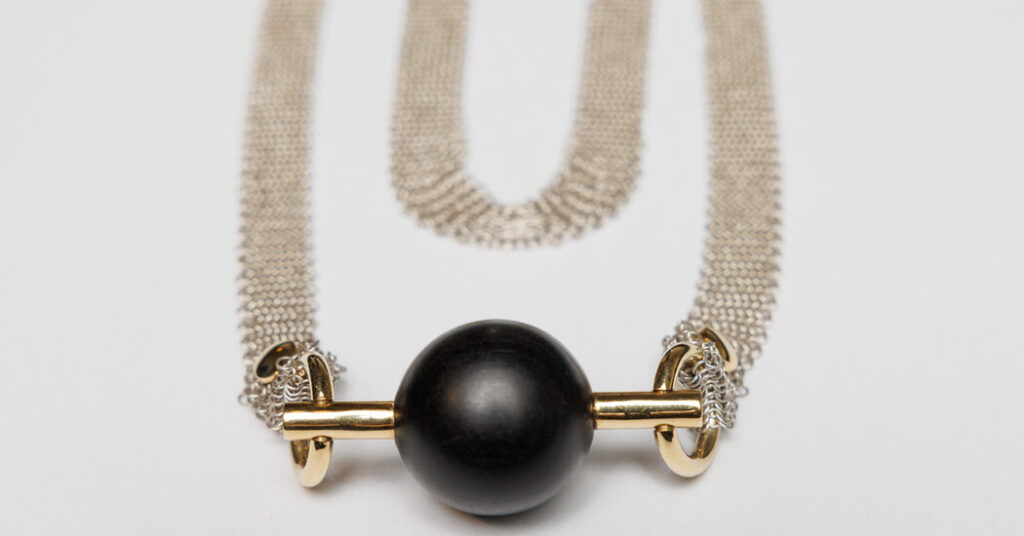
Ms. Martin chose to make fastenings the focal point of her creations. Her most recent collection, The Perfect Drug (02), made a feature of functional 18-karat gold clips and snaps in designs inspired by the belts and straps in the erotic art by Tom of Finland and the photography of Robert Mapplethorpe. And in her All Access necklace and bracelet, strips of gold or silver chain mail were fastened by gold clasps that resemble the plastic snaps used to secure music festival wristbands. “I love the fact that there’s this kind of chunk of gold that actually has to be there because it’s got a purpose,” Ms. Martin said.
Ms. Martin is not alone in her focus though. Clasps that combine form and function have also appeared in other contemporary jewelry designs.
“Clasps Were an Afterthought”
In 2003, the New York designer Marla Aaron began making functional gold carabiner clips based on the spring-loaded steel shackles used by climbers. The locks, as she called them, were designed to fasten chains at the hollow of the throat or the upper chest, rather than be hidden at the back of the neck. “It was like the clasps were an afterthought and we made them the main event,” she said.
The term “lock” — with its symbolic link to love and commitment — made the pieces more meaningful for customers who appreciate sentimental design, said Ruby Beales, the jewelry buying manager at Liberty department store in London. “A lock is a symbol of love and connection so it appeals to that customer.”
Ms. Aaron has also created locks based on the mechanisms of everyday objects. Her Pushmipullyu design was inspired by a piece of French sailing hardware, and the Trundle Locks rings and bracelets were derived from the functionality of a toilet paper holder. “There’s no mechanism that’s too mundane to be applied to our precious pieces,” she said.
Distinctive clasps are a way to elevate and differentiate classic designs, said Archana Thani, a jewelry trend forecaster and consultant in London. She said two brands — FoundRae in New York and Robinson Pelham in London — both have used clasps to elevate gold chains. FoundRae’s Sister Hook design features two interconnecting clips inspired by Victorian watch fobs, while Robinson Pelham’s Identity necklace is fastened at the front with links or heart-shape clips.
“It’s just that extra level of design when someone thinks about, ‘How do I incorporate the clasp into the design?’ That’s when I think you’ve created magic,” Ms. Thani said. She added that the Clic Clac H design by Hermès, with a clasp in the shape of an H, is an example of great functional design.
At the Milan jewelry brand Pomellato, clasps have been a focal point since the 1970s. In archival designs, chunky gold chains were fastened by oversize lobster clips, spring rings and carabiners: a look echoed this year in its Collezione 1967 high jewelry collection, which had similar styles with pavé diamonds. “Our mantra is: The clasp must be an important protagonist of the jewel or be invisible without capturing attention,” said the brand’s creative director, Vincenzo Castaldo.
He added that giving prominence to a mechanical element was what he called a “nonconformist approach” that reflected Pomellato’s less traditional, less conservative aesthetic.
Although many centerpiece clasps have an industrial aesthetic, others are more whimsical. New additions to Dior’s Bois de Rose collection, for example, include a pearl necklace fastened by a rose gold and diamond clip designed to resemble a rose thorn.
At Renato Cipullo in New York, the gold and diamond fastenings of its aquatic-theme necklaces and bracelets were shaped to resemble sea horses and dolphins. And Yvonne Léon in Paris created a gold python necklace that fastens like a belt, with a red enamel prong representing the snake’s tongue.
Vintage Inspiration
For some designers, antique jewelry has provided inspiration for interesting and distinctive fastenings.
The Lola collection by the New York jeweler Jade Trau was inspired by the fishhook-shape clasp of a vintage bracelet that she bought in 2016 at a trade show in Palm Beach, Fla. “I realized that it could be a stand-alone piece and it could also kind of function as a charm holder,” she said, so she recreated the clasp as the focal point of necklaces, bracelets and lariats.
In 2018, she created the Betty clasp, inspired by the padlock closure of a watch fob from the early 1900s, and this year she introduced the Georgie, based on an antique jewelry fastening. And in London, the designer Lucy Delius has also created functional yet decorative clasps based on the closure mechanisms of antique jewelry.
Ms. Trau said that locks and clasps had an irreverence that appealed to her customers and were a way to add what she called “a cool edge” to a gold chain. She also noted that making the clasp a focal point ended the need to reposition a twisted necklace, and that her clasps were easier to fasten than most as they were larger than normal.
But creating clasps that combine form and function does present challenges.
As Ms. Aaron, who has developed proprietary engineering techniques for her locks, said: “It’s much more difficult to make something work than it is to just make a pendant.”
The post Clasps Take a Starring Role in Some Jewelry Designs appeared first on New York Times.