The oppressive heat wave that has enveloped much of the United States upended plans for the nation’s 250th birthday that were years in the making.
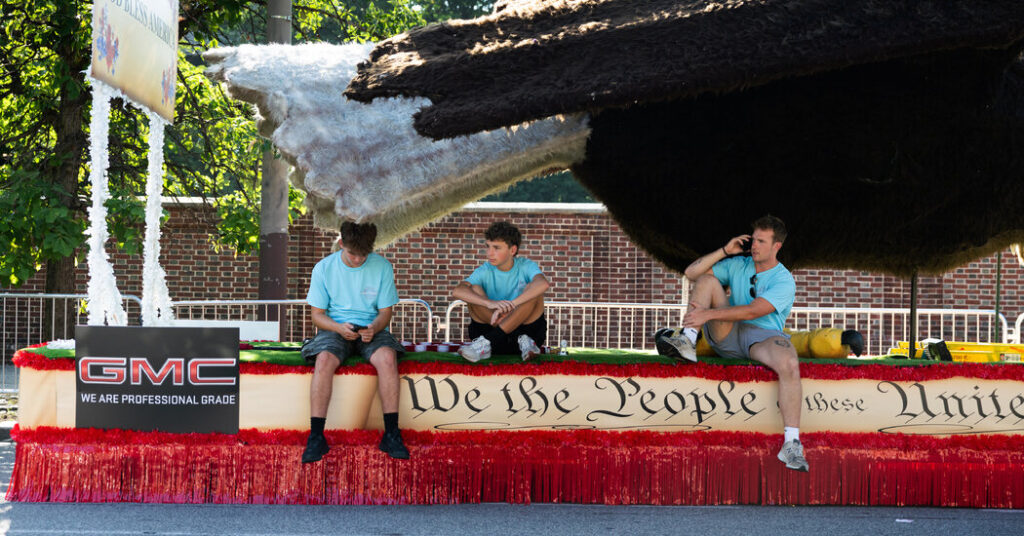
In Philadelphia, where the Declaration of Independence was signed, the extreme heat pushed organizers to scrap a parade on Friday that was shaping up to be one of the biggest in the city’s history. More than 50 marching bands and about 20 floats were to participate in the event, which had been set to begin at noon.
Organizers canceled the parade, which had already been delayed, as the afternoon high in Philadelphia was expected to reach 104. It could feel like 112 with the heat index, a measure of how hot the air feels based on temperature and humidity.
In Washington, organizers of the Great American State Fair on the National Mall, one of President Trump’s marquee events celebrating the country’s 250th birthday, temporarily closed the grounds to the public, citing the extreme heat. Daytime programming that was set to begin at 10 a.m. was postponed to 5 p.m.
As of 3 p.m., Washington had hit 100 degrees with a heat index of 112. By 5 p.m., when the fair grounds are scheduled to reopen, the temperature is still expected to be above 100, with the heat index even higher.
“The safety and well-being of our guests, volunteers, performers, vendors, and staff is our highest priority,” the fair’s organizers said on social media. “Conditions are expected to improve later.”
The blistering heat that settled over much of the eastern half of the country in recent days put a damper on efforts to bring people together to celebrate a milestone birthday for the nation, which finds itself embroiled in a deeply unpopular war with Iran at a time of extreme political polarization.
The long-lasting heat wave has brought dangerously high temperatures across the central and eastern United States. On Friday, the sticky, hot weather was focused in an area stretching from Ohio to New York and south into Georgia. As temperatures soared into the mid-90s to low 100s, around 180 million people were under extreme heat warnings or heat advisories on Friday, with forecasters warning people to avoid going outdoors during the hottest part of the day.
On Saturday, the Fourth of July, when celebrations were expected to continue, millions will still be under warnings for the most extreme heat, with temperatures in New York, Washington and Philadelphia expected to climb near 100 degrees yet again.
In Boston, where the temperature was hovering just below 100 degrees at midafternoon on Friday, organizers of the Boston Pops Fireworks Spectacular said the gates would open at 4 p.m. instead of noon on Saturday for the concert, which begins at 7 p.m. “We encourage guests not to arrive at the Esplanade early,” organizers said.
Parades, which usually step off in the afternoon, were the biggest casualties of cancellations, while fireworks displays and evening concerts were expected to go on as scheduled. Among the towns scrapping plans for a July 4 parade was Norristown, Pa.
“The parade is one of our community’s most beloved traditions, and we share in the disappointment of its cancellation, especially as we celebrate America’s 250th birthday,” said Jayne Musonye, the borough’s interim municipal administrator. “With dangerous heat in the forecast, the safety of our families, our marchers, and our first-responders must come first.”
Officials in Monmouth County, N.J., rescheduled an outdoor concert in Freehold featuring Steven Van Zandt of Bruce Springsteen’s E Street Band from Friday to July 17.
Among the other cities and towns that canceled parades on Friday were Bethany Beach, Del. and Lovettsville, Va.
Out West, continuing wildfires forced communities in Colorado outside of the metro Denver area to cancel their fireworks displays.
Events at Gettysburg National Military Park in Pennsylvania observing the anniversary of the battle, which took place from July 1 to July 3 in 1863, were moved from indoors because of the heat.
“General Longstreet is famously quoted to have said, ‘Not retreat, sir. Re-deploy,’” the park said on social media. “We too shall re-deploy when it comes to the Extreme Heat Warning that Mother Nature has thrown our way during the upcoming 163rd Anniversary of the Battle of Gettysburg.”
Organizers who elected to postpone July 4 events scheduled for Friday and Saturday were hoping to avoid a replay of a scene that played out in Reading, Pa., on Thursday afternoon. More than 100 people who had gathered at a train station there to catch the arrival of a Union Pacific steam locomotive were treated at the scene for “heat-related illnesses and medical emergencies,” the Muhlenberg Township police said in a statement. Those affected ranged from infants to older adults, the police said.
Thousands had gathered at the station to view the arrival of the locomotive, known as Big Boy No. 4014, which is making stops across the country in celebration of the 250th anniversary. Reading reached 103 degrees on Thursday afternoon, according to the Weather Service.
Local emergency medical services were quickly overwhelmed, Chief Randall Hoover of the Muhlenberg police said in an email on Friday, forcing E.M.S. personnel to declare a “mass casualty incident,” allowing the authorities to request additional medical assistance from surrounding counties.
Dozens of people, including one person who went into cardiac arrest, were taken to hospitals for treatment and additional evaluation, the police said. There have been no reports of fatalities resulting from the event, Chief Hoover said.
Joseph Goldstein contributed reporting.
The post How the Heat Is Upending Plans for America’s 250th Birthday appeared first on New York Times.