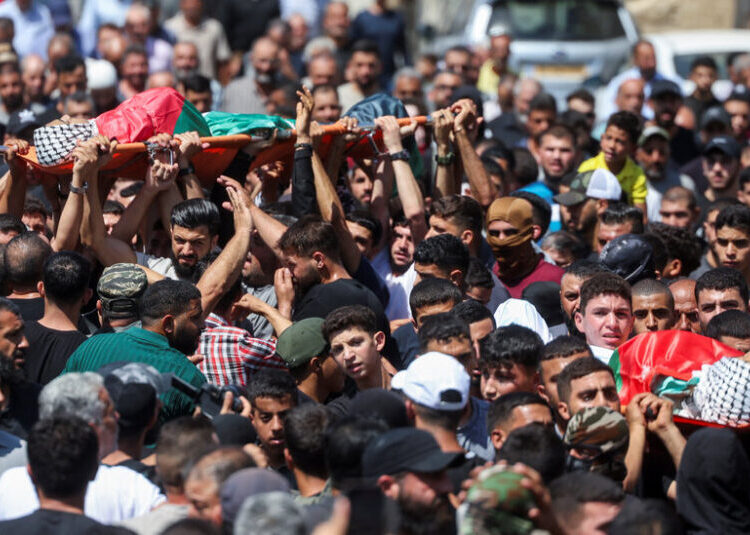
Four months after its supreme leader was killed in U.S.-Israeli airstrikes, Iran’s government began a week of elaborate events to mourn and bury Ayatollah Ali Khamenei, sending a message of stability and unity to the world — and to its enemies.
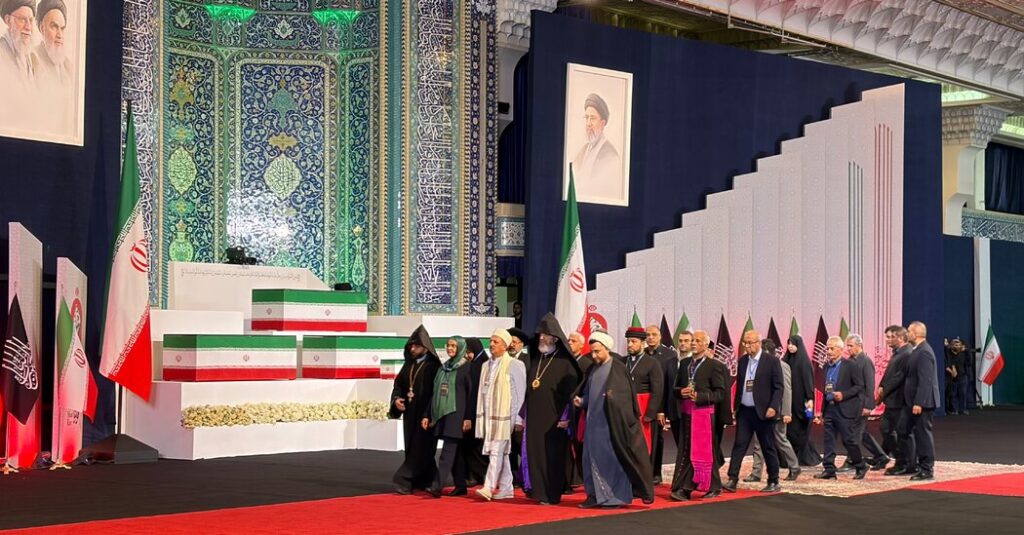
Images published on Friday by Iranian state media showed Iranian and foreign officials, militia members and religious leaders walking to and standing before the casket of Ayatollah Khamenei, who was killed on Feb. 28. Some visitors bowed solemnly, prayed or cried.
It sets the stage for a series of ceremonies, which will continue on Saturday with a public viewing of Ayatollah Khamenei’s casket. After a procession in Tehran on Monday, his body will be taken to holy Shiite cities in Iraq before he is buried in his hometown, Mashhad, in Iran.
The casket, decorated with the Iranian flag, was topped by a black turban and a black-and-white checked scarf like one he often wore, which in Iran is associated with the country’s Basij militia force. The black turban signifies that he was a cleric descended from the Prophet Muhammad.
Friday’s ceremony took place in Tehran’s Grand Mosalla, a large prayer complex where Ayatollah Khamenei gave many important addresses during his reign. State news reports said his casket was surrounded by those of family members who were killed along with him.
By Friday morning, symbols of mourning had spread across Tehran. Giant black banners hung from overpasses and buildings, while billboards bearing Ayatollah Khamenei’s portrait appeared along major roads and intersections.
Some showed him alone, gazing outward in the familiar official imagery that long dominated the country’s political landscape. Others paired him with his son and successor, Mojtaba Khamenei, visually linking the end of one era to the beginning of another.
While Iran’s government is seeking to portray Ayatollah Khamenei as a beloved and respected leader of global stature, many Iranians may view the expensive, dayslong funeral with discontent or anger.
Over 37 years of authoritarian rule, Ayatollah Khamenei harshly repressed dissent and allowed economic mismanagement and corruption to fester in Iran.
The long delays to his burial, more than four months after his killing, reflect the extraordinary circumstances Iran has faced this year: bombardment by the United States and Israel, with uncertainty over whether the government could ensure a secure event.
Ayatollah Khamenei was a constant presence in Iran’s political life for decades. Some of his supporters said that his killing remained difficult for them to process, and the days of mourning planned across the country have become an occasion to grieve and mark the end of a political era.
His successor, his son Ayatollah Mojtaba Khamenei, has not been seen in public since he was chosen as supreme leader in March. It is still unclear whether he will appear publicly at any of the funeral events.
The funeral comes at a particularly turbulent moment for Iran. The past six months have left deep fissures in the country, with protests, regional conflict, security tensions and internet shutdowns disrupting daily life and contributing to broader uncertainty and instability. For many Iranians, the death of a leader who had dominated for decades was yet another turning point in a period defined by upheaval.
“I still cannot believe he’s gone,” said Dunya Mohamadi, 24, who was in central Tehran on Friday with her 10-month-old son, Ali. She said she had traveled with her family from Malard, about 24 miles west of the capital, to attend the ceremonies. “My heart wants to mourn as best as I can,” she said.
The New York Times was granted access to the funeral ceremonies of Ayatollah Khamenei by Iran’s government, which determined the ceremonies our reporters could attend, accompanied by a government-provided translator and a guide. The views expressed by people interviewed at these events may not be representative of many Iranians, while others may have felt unable to speak freely.
More than 50 official foreign delegations participated in the viewing ceremony on Friday, a spokesman for the funeral organizers told Iranian state media.
Dmitri A. Medvedev, a former president of Russia and the deputy chairman of its Security Council, is expected to attend Friday’s ceremony, the Kremlin spokesman, Dmitri S. Peskov, said Thursday. Russia has given support to Iran during its war with Israel and the United States, and Iran has supplied drones to Russia that it has used to attack Ukraine.
China is sending a senior Chinese lawmaker, He Wei, who is a vice chairman of its top legislature. Iran is increasingly looking to China as a critical economic partner, and the country has been the primary purchaser of Iranian oil over the last several years.
Leaders of Shiite communities abroad were also in attendance, including from Pakistan. During the six days of public ceremonies that are expected to follow, Iran’s government is seeking to emphasize Ayatollah Khamenei’s role as a Shiite spiritual leader with devoted followings throughout the Muslim world.
Members of several Iranian-aligned militias in Iraq also attended on Friday, including Kataib Hezbollah, according to images published by Iranian state media. The group has attacked U.S. targets in Iraq in recent months. The images also showed family members of slain leaders of the Lebanese militant group Hezbollah, which is backed by Iran.
Iraq’s president, Nizar Amedi, and the country’s speaker of Parliament, Haibat al-Halbousi, were also in attendance for the funeral ceremonies. The arrival of Iraqi officials comes at an awkward moment for Iraq’s new government, as it is under increasing pressure to loosen its ties to Iran.
Ayatollah Khamenei’s funeral has also brought together adversaries, if not outright enemies, who are otherwise engaged in deadly conflicts in the region.
The president of Iraq’s Kurdistan Region, Nechirvan Barzani, met with Iranian officials on Friday, according to Iranian state media. His region hosts Iran’s exiled Kurdish militias, who remain in an undeclared shadow war with Iran’s Islamic Revolutionary Guards Corps. There have been reports by local news outlets in recent days of clashes.
From Afghanistan, one of the Taliban’s most senior figures, Mullah Abdul Ghani Baradar, and its foreign minister, Amir Khan Muttaqi, were set to attend the funeral.
And on Friday, Ahmad Massoud, the son of Ahmad Shah Massoud, a commander who fought the Taliban in the 1990s, could be seen paying his respects. Mr. Massoud now leads one of the main opposition groups to Taliban rule from abroad.
Also scheduled to attend the funeral were Prime Minister Shehbaz Sharif of Pakistan and the country’s army chief, Field Marshal Syed Asim Munir. Their country has been embroiled in a conflict with Afghanistan that has left hundreds dead since late February as Pakistani officials accuse the Taliban of supporting militant groups that have killed thousands of security personnel in Pakistan in recent years.
Pakistan and Iran’s relations have been marred by tensions in recent years, but the war with the United States and Israel, and Pakistan’s role as a mediator to end the conflict, has brought their leaderships closer.
The killing of Ayatollah Khamenei rattled many among Pakistan’s estimated 35 million Shiites, a minority often targeted by militant violence.
The city of Tehran had already begun reorganizing itself on Friday for the large public elements of the funeral in the days ahead.
Officials announced traffic restrictions and heightened security measures before the procession, with police officers and security personnel visible across central Tehran. Many shops in the city center were closed, leaving the typically crowded streets unusually quiet. Roads were closed as the authorities prepared for what they said would be one of the largest public gatherings in the history of the Islamic Republic.
Across the capital, volunteers prepared stations to feed and support the large crowds expected to arrive before public ceremonies were to begin early Saturday. At one such station, Hamid Reza, 54, directed men unloading boxes of food, fruit and supplies from a truck. He said organizers at that location alone expected to distribute some 300,000 bottles of water and had stocked eggs, lentils, watermelons and snacks for mourners.
He described the work as his contribution to honoring a leader he admired.
“We miss him,” he said. “I wish I had sacrificed myself for our leader.”
Elian Peltier, Erika Solomon, Paul Sonne and Li You contributed reporting.
The post It’s Day 1 of the Supreme Leader’s Funeral, and Allies Gather in Iran appeared first on New York Times.