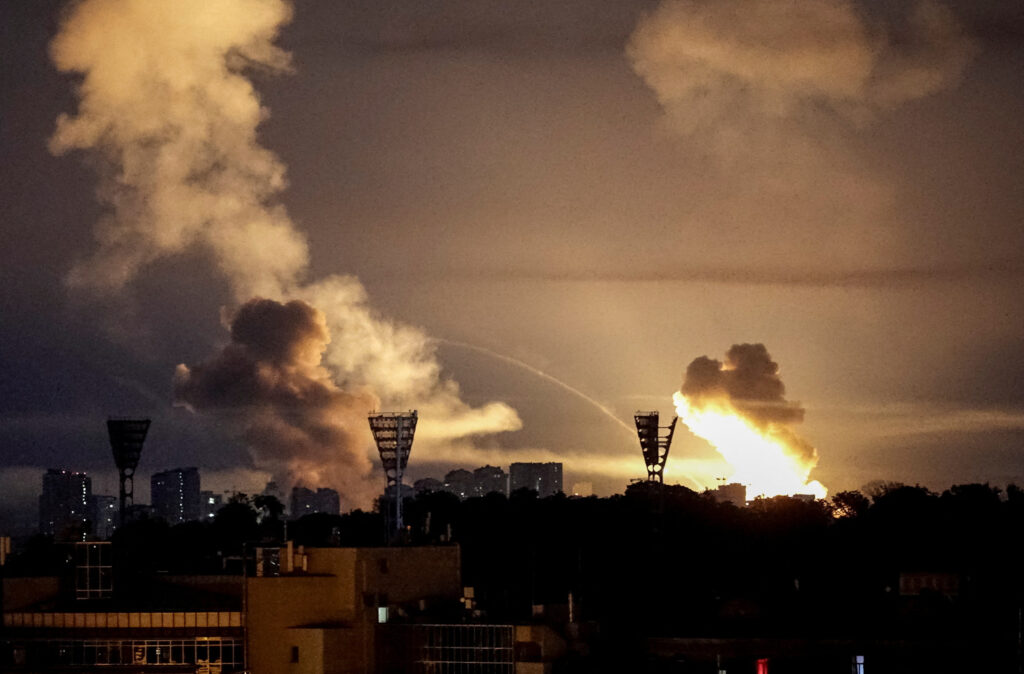
KYIV — Russia pounded the Ukrainian capital with airstrikes overnight, killing at least 25 people, injuring more than 90 others and causing fires throughout the city, officials said Thursday.
It was the latest major attack on the Ukrainian capital — part of a strategy, analysts said, to target areas beyond the frontline — as Moscow finds its war stalling and as casualties mount, with little prospect of renewed ceasefire or peace negotiations.
Moscow launched missiles and self-destructing drones, as well as a large number of drones powered by jet engines, in an attack that lasted through the night. Explosions could be heard repeatedly throughout the city.
“It was a terrible night for Kyiv,” Mayor Vitali Klitschko said.
Every district in the capital suffered damage, Klitschko said, with the worst in the east, where “part of a building was literally blown away.”
“A search and rescue operation is underway,” he wrote on social media. “People are being searched for under the rubble. Among them — a 15-year-old girl and her family.”
Russia’s attack also hit locations in the Kharkiv, Sumy, Dnipro, Zaporizhzhia and Cherkasy regions, Ukrainian President Volodymyr Zelensky posted on social media. In Kyiv, “an ambulance station, a research institute, a hotel, and businesses” were damaged, Zelensky said.
Russia launched 74 missiles and 496 drones, of which 25 missiles and 12 drones struck targets, Ukraine’s Air Force said on Telegram. Most of the attack focused on Kyiv, it added.
Ukrainian and Russian forces have traded air attacks over the past weeks, with Kyiv inflicting considerable damage on military and energy infrastructure deep inside Russia, which has led to acute gasoline shortages throughout the country.
Kyiv and Moscow are aiming to increase the pressure on each other and eventually exhaust each other’s resources, in hope of potentially forcing political change, said Tatiana Stanovaya, a senior fellow at the Carnegie Russia Eurasia Center.
“For Kyiv, the aim is to create by winter more acceptable conditions for talks,” Stanovaya said. “And for Moscow, they are also counting on some kind of political changes happening in Ukraine itself and in the West, which will create the conditions to force Kyiv into discussing Russia’s demands.”
Last week, officials in occupied Crimea, which Russia illegally annexed from Ukraine in 2014, declared a state of emergency after weeks of punishing drone strikes that have disrupted water, fuel and electrical supplies on the peninsula.
Russia’s Defense Ministry, in a statement on social media, said Thursday’s attack targeted “military-industrial enterprises and fuel and energy facilities in the city of Kyiv and the Kyiv region, as well as military airfield infrastructure in the Dnepropetrovsk, Poltava, Cherkasy, Chernihiv, and Kyiv regions.”
Moscow has targeted Kyiv and other Ukrainian cities since the beginning of its full-scale invasion, more than four years ago, largely with major air campaigns during the winters focused on damaging the country’s heating and electricity grid.
But the bombardments of recent weeks are a departure in the sheer number of airborne weapons that Russian forces have hurled at the Ukrainian capital, and come as Ukraine ramps up long range strikes on Russia.
Recent Russian attacks have involved hundreds of drones and dozens of missiles — with large number of ballistic missiles, which are difficult to intercept. Zelensky and other top Ukrainian officials have pleaded with their Western counterpart to provide more Patriot missiles and missile systems, which are the only weapon that can effectively counter ballistic missiles.
Thursday’s deadly strike on Kyiv was a show of force and a further sign Putin was digging in — escalating further against Ukraine in response to Kyiv’s increasingly punishing drone campaign, analysts said.
Russia’s message was that Ukraine’s air campaign would not lead to political destabilization within Russia or a softening of its negotiating position, but “instead it will lead to escalation and we will strike harder,” Stanovaya said, adding that she would not be surprised if Russian strikes expanded still further in the coming weeks.
Sergei Markov, a pro-Kremlin political analyst, said one of the aims of Thursday’s overnight attack was to undermine what he called “propaganda” in the West that the tide was turning in Ukraine’s favor in the war.
“Ukraine is not winning. There has been no turning point. Your leaders are going to be eternally spending the population’s money on the Ukraine war,” Markov said. “There will be more and more strikes. We will continue to escalate.”
Other analysts see the air campaign more as evidence that Moscow is left with few good options.
“As Russia’s offensive efforts flounder, the Russian leadership is increasingly switching to a bombardment campaign,” said Michael Kofman, a military analyst at the Carnegie Endowment for International Peace in Washington. “So it’s not unexpected, and it’s one of the few remaining means of increasing pressure on Kyiv.”
Although Kyiv is targeting key production facilities in Russia’s military industry, Moscow still appears to be able to manufacture large numbers of ballistic missiles and Geran drones, which are based on the design of the Iranian Shahed.
The goal of the Russian air campaign was twofold, said Franz-Stefan Gady, an analyst in Vienna with the Center for a New American Security. On one hand, Moscow hoped “to degrade and destroy Ukraine’s defense industrial base.”
At the same time, the large-scale attacks aimed to overwhelm and massively degrade the Ukrainian air defense systems in an effort to demoralize the Ukrainian public. However, this would not work, Gady said.
“It’s certainly going to drive up civilian casualties and it’s going to create a lot of damage, a lot of destruction,” he said. “But ultimately it’s unlikely that it’s going to break Ukraine’s will to resist or Ukraine’s air defense system, because they have shown to be able to adapt consistently.”
Natalia Abbakumova in Riga, Latvia, contributed to this report.
The post Russia rocks Ukrainian capital with massive assault, killing at least 25 appeared first on Washington Post.