Fireworks won’t be the only thing lighting up the sky Saturday evening across the United States. As the heat dome in the East will be losing strength, Mother Nature will be lighting some fireworks of her own — in the form of thunderstorms.
Around the periphery of this powerful area of high pressure will be a corridor dubbed the “ring of fire” — a meteorological pattern that describes stormy weather tracking along the edges of a heat dome.
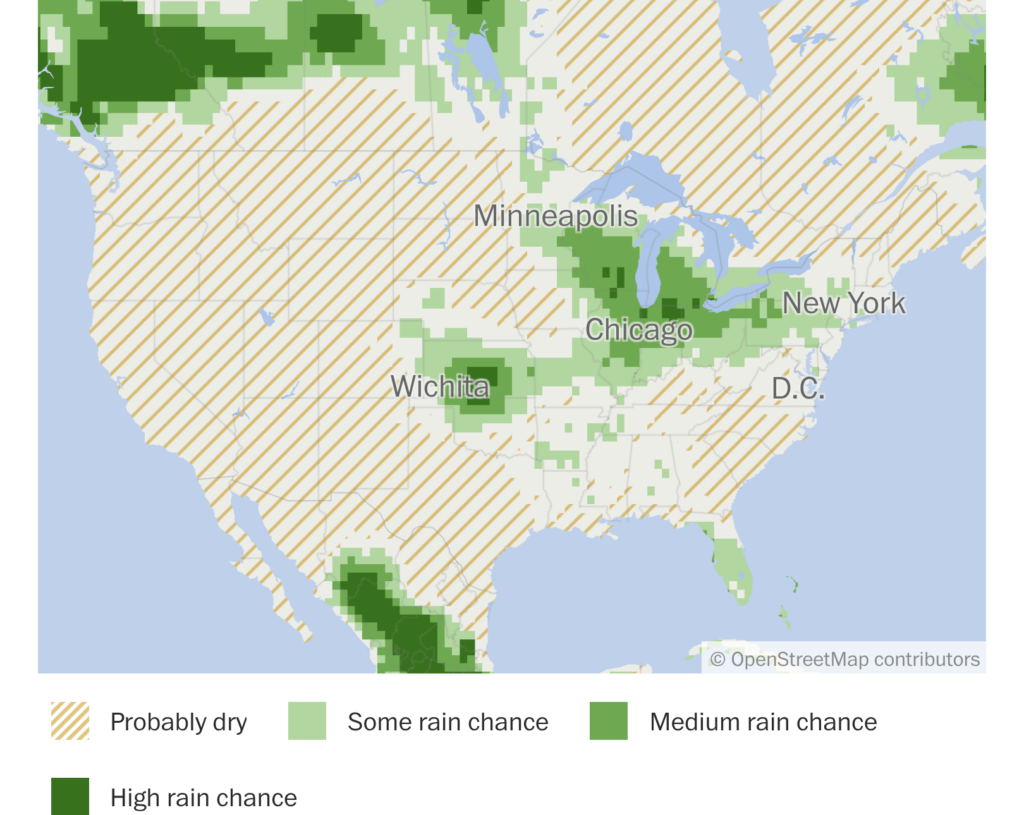
On the Fourth of July, the ring of fire will extend from the Plains to the Midwest, Northeast and Mid-Atlantic, with the potential for some gusty thunderstorms across that stretch.
NOAA’s Storm Prediction Center highlighted a slight risk (Level 2 out of 5) for severe thunderstorms in an area that includes New York, Philadelphia, Baltimore and the nation’s capital.
The weather pattern could “support strong to severe downburst winds that could produce wind damage,” the agency wrote.
These storms could disrupt the setup period for fireworks displays and send people headed for cover early in the evening — but the risk for stormy conditions, at least in the East, should gradually fade after sunset.
Pockets of the Midwest and Plains will probably face storms that last later into the night, putting some fireworks displays at risk of delay or postponement.
At least in the D.C. area, even if storms dissipate, there may be other issues. There’s elevated potential for fireworks smoke to accumulate and linger in the skies, causing concerns for very unhealthy air quality, as a record-breaking 850,000 fireworks are planned.
That’s because sinking air and light winds beneath the heat dome could create a temperature inversion — a layer of warm air over cooler air near the ground — that traps fireworks smoke in the lowest levels of the atmosphere, reducing air quality and visibility.
Here are some cities where the weather may threaten viewing conditions during the evening of July Fourth:
New York
Scattered strong storms during the evening could affect July Fourth festivities in the city, but by the time fireworks start after 9 p.m., the storm risk will probably be easing.
Philadelphia
After early evening strong thunderstorm chances, the weather should clear well before the expected 11:45 p.m. fireworks start time.
D.C.
Isolated but strong storms early in the evening should dissipate by the time fireworks start, but smoke may hover in the skies as they are set off, reducing visibility.
Chicago
Showers and storms will probably be pulsing around into the night, with a medium chance that fireworks displays could be affected.
Minneapolis
Potential for wet weather during the evening will probably diminish overnight, but whether it clears in time for the 10 p.m. fireworks currently looks like a close call.
Wichita
There’s a chance that showers and storms lingering into the night put a damper on festivities.
Denver
Although the thunderstorm risk should fade after sunset, patchy wildfire smoke could create hazy viewing conditions.
On the other hand, here are some places where the weather should cooperate on the evening of July Fourth:
- Los Angeles
- San Francisco
- Seattle
- Las Vegas
- Phoenix
- Albuquerque
- Dallas
- Norfolk
- Raleigh, North Carolina
- Charleston, South Carolina
The post Will it be stormy or dry for July Fourth fireworks where you live? appeared first on Washington Post.