Chloe Chapin is a costume designer, portrait painter, fashion historian and the author of “Suitable: The Sartorial Revolution and the Fashioning of Modern Men.”
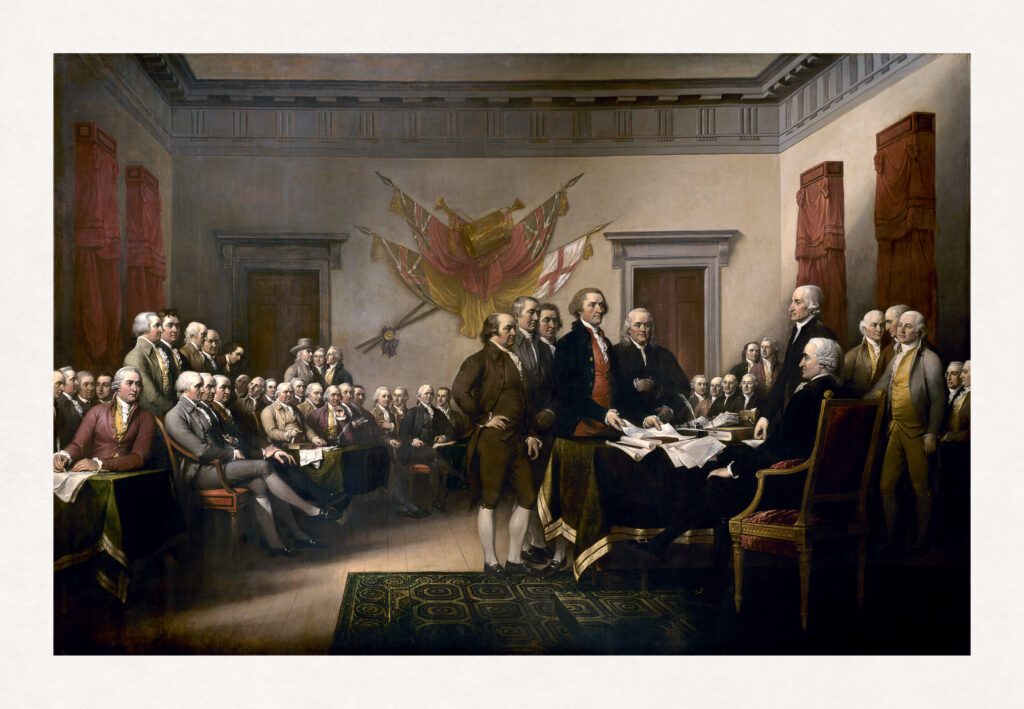
John Trumbull’s iconic 1819 painting “Declaration of Independence” is frequently used as visual shorthand for the American Revolution. It turns out that painting is more “Bridgerton” than Ken Burns.
Given its important subjects and location in the Capitol Rotunda, Trumbull’s painting has shaped ideas of Americanness and men’s fashion as inherently plain and practical. It has also spent more than 200 years acting as nationalist propaganda. In reality, one of the most familiar pictures of the Founding Fathers is less historical record than costume drama. This image has taught the public to see American men as morally superior in part because they weren’t “fashionable” — except that they were!
On June 28, 1776, Thomas Jefferson and the “committee of five” presented the final draft of the Declaration of Independence to John Hancock, president of the Continental Congress. The men Trumbull depicted for his painting commemorating this event were the epitome of the American experiment in new government: just ordinary men in simple, everyday dress.
In fact, their clothing is too simple.
The most significant story of menswear between the end of the 18th century and the beginning of the next is the “Great Masculine Renunciation,” the process in which men across the Western world went from dressing like aristocratic peacocks to plain penguins. The term “Great Masculine Renunciation” was coined by British psychologist John Carl Flügel in 1930, when he was researching the negative effects of drab, modern dress on the masculine psyche. Flügel traced the origins of this shift in style to the French Revolution around 1789. He argued that the subsequent reduction of male decorativeness was “one of the most remarkable events in the whole history of dress.”
Therefore, according to Flügel, 1776 was before this “Great Masculine Renunciation” took place. The Founding Fathers should still have been peacocks, not plain men in plain suits. Were the signers of the Declaration of Independence not just politically revolutionary but also … fashion forecasters?
Contemporary observers noted that Americans quickly adopted the latest London styles. Hancock — whom Trumbull dressed in plain black in his “Declaration” — wore crimson velvet and sumptuous embroidery. Portraits painted closer to the revolution show many of the signers embracing loud fashion choices. They wear bright colors, luxurious fabrics, decorative waistcoats and expensive trimming — hardly the plain, muted crew Trumbull later imagined.
By the 1790s, however, portraits of the signers of the Declaration of Independence show their dress shifting to the plain, dark, uniform suits that would dominate masculine style for the next two centuries. The signers were not indifferent to fashion; they were following it.
The question remains: Was it an accident, or did Trumbull intentionally refashion the Founding Fathers?
Trumbull was born in Connecticut to a well-connected family and served as a second aide-de-camp to George Washington during the Revolutionary War. He didn’t sign the Declaration, but he was pretty close to the rooms where it happened.
After the war, Trumbull studied with the American-born painter Benjamin West in London. In Paris in 1786, Jefferson encouraged Trumbull to commemorate the already historic event. Trumbull tracked down as many of the signers as he could, carefully capturing their likenesses.
In creating the painting many years after the event, Trumbull served as staging director, production designer and costume designer, making choices about clothing that he thought would suit the nation’s character.
Historian James Laver once suggested that fashion and taste follow a predictable cycle. According to “Laver’s Law,” fashions from 20 years ago appear “ridiculous,” and 10-year-old fashions seem “hideous.” When Trumbull was sketching the signers, no one wanted to be immortalized as “hideous” or “ridiculous.” Updating their suits was both an act of flattery and nation-building.
For Trumbull, character development and storytelling were more important than documenting historical truth. Sometimes updating a period look is necessary to connect with an audience, much like costuming a contemporary movie star with sexy hair in a period film.
To be a good costume designer, Trumbull had to be a bad fashion historian.
He exaggerated the plainness of the Founding Fathers by using clothing as an artistic metaphor to turn them into masculine icons of republican virtue. He borrowed elements from later (French) revolutionary fashions, such as muted colors and high collars, crafting a kind of style mash-up that created the revolutionaries his audience wanted to see.
Trumbull’s “Declaration” is not the only American history painting that updated men’s clothing styles to better reflect contemporary values. West’s 1771 painting “Penn’s Treaty With the Indians,” for instance, invented the dress of both English settlers and members of the Lenni Lenape tribe. Sir Amédée Forestier’s 1914 “The Signing of the Treaty of Ghent” costumed Americans as plain republicans in contrast to the aristocratic formality of the British delegation — even though in real life, the Americans had been wearing nearly identical diplomatic dress uniforms.
At a moment when we are rethinking national monuments and myths, it matters that we also reconsider the costumes that taught us what American respectability is supposed to look like. When Trumbull collapsed the fashions of two distinct periods into one made-up style, he made it seem like men in the early American republic weren’t following fashion trends, but had already decided on the sartorial values of America. The plain style they adopted later came to be understood as merely the condition of modern masculinity.
But plain dress was not the natural state of American men. Plainness was a fashion trend.
As the country is flooded with images of the revolution around the 250th anniversary of independence, Americans might wonder why historians — including artists — have chosen to see the Founding Fathers as intentionally unfashionable, rather than as fashion icons of their own time.
The post This iconic painting went full ‘Bridgerton’ on the Founding Fathers appeared first on Washington Post.