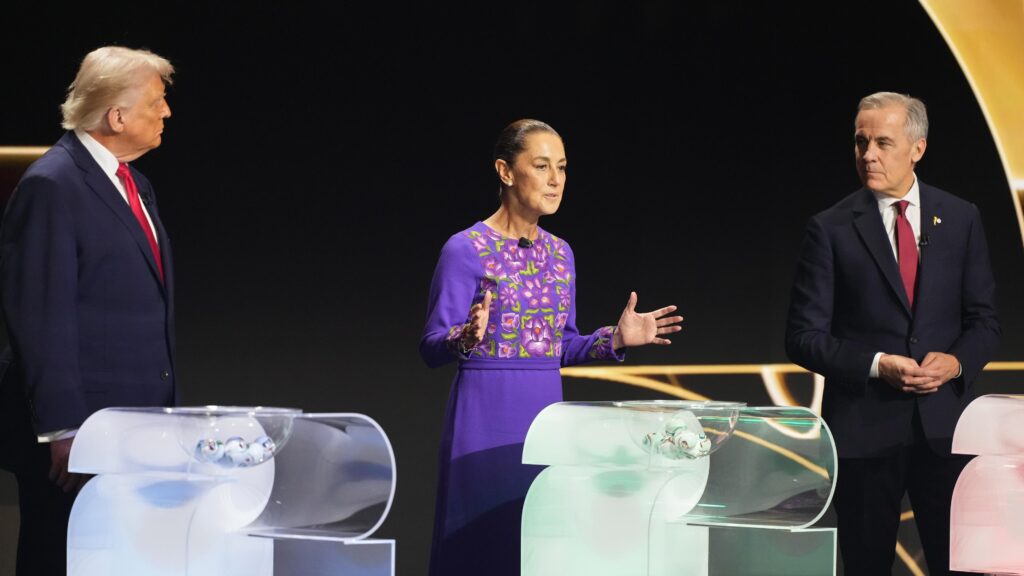
Six years ago, President Donald Trump stood at the White House and celebrated the U.S.-Mexico-Canada Agreement he signed as the “largest, fairest, most balanced, and modern trade agreement ever achieved.” On Wednesday, his Administration declined to renew the pact in its current form, opening a decade-long review process that threatens to inject fresh uncertainty into one of the world’s most deeply integrated economic relationships.
The decision, announced by U.S. Trade Representative Jamieson Greer, does not terminate the agreement that governs nearly $2 trillion in annual trade among the three countries. Goods will continue to move across borders largely as before, and negotiators are expected to keep working on revisions in the months ahead.
But the move marks a striking reversal for a President who once made the agreement a centerpiece of his economic agenda, and it raises new questions about the future of a trading bloc that supports millions of jobs and underpins industries ranging from automobiles to agriculture.
Trade experts tell TIME that the move could carry profound long-term consequences, creating the kind of uncertainty that discourages investment, complicates supply chains and, over time, raises costs for consumers whose cars, groceries, and household goods depend on tightly interconnected North American production networks.
“The practical impact immediately is very little,” says Josh Lipsky, chair of international economics at the Atlantic Council. “The truth, however, is that it creates uncertainty over the long-term viability of USMCA.”
Under the agreement’s terms, the three countries had until July 1 to agree to extend the pact for another 16 years. Canada and Mexico favored doing so, but the United States did not. A senior U.S. official says that Washington wants to address what it views as shortcomings in the deal, particularly America’s trade deficits with its neighbors and market access opportunities in areas like dairy and corn.
“Our trade deficits with both Mexico and Canada shot up during the Biden Administration,” the official says. “We’ve started to get it under control, thankfully, but we believe that the USMCA does not operate to control the deficit like the President intended.”
The agreement, which replaced the North American Free Trade Agreement, or NAFTA, has made the economies of the three countries more integrated than at any point in their history. Last year, U.S. exports to Canada and Mexico exceeded $670 billion, compared with about $106 billion in exports to China, according to U.S. government statistics.
Trade policy experts say the biggest risk is not an immediate economic shock, but a prolonged period of ambiguity. Companies typically approach investment decisions with a long-term forecast, especially in manufacturing industries where factories and supply chains can take years to build. Annual reviews and the possibility of additional tariffs, they say, could cause businesses to postpone expansion plans, slow hiring and reconsider where they invest.
“The longer it goes on, the more uncertainty there will be, so the less incentives there will be to invest,” says Diego Marroquín Bitar, a trade expert at the Center for Strategic and International Studies. Companies with operations across North America, he says, may delay expansions or hiring as questions about the agreement’s future linger.
Alfredo Carrillo Obregón, a trade policy analyst at the Cato Institute, says that while the failure to renew the pact is “not a doomsday scenario,” uncertainty itself carries costs for economies that have spent three decades building integrated supply chains under first NAFTA and then USMCA. “These are America’s neighbors, their largest and closest trading partners,” he says. If negotiations prolong, or the U.S. threatens to withdraw from the agreement or impose tariffs on Mexico and Canada, “it would send a pretty negative message on the reliability of the U.S. as a trading partner.”
Millions of jobs across the three countries depend on trade within North America.
Marroquín Bitar estimates that somewhere between 8-13 million American jobs are supported by trade with Mexico and Canada. The three countries, he argues, function not only as trading partners but as a single production platform and food system, with affordable products relying on Mexican labor, Canadian oil, and American manufacturing.
The Trump Administration says it wants to modernize the agreement to address challenges that have emerged since its creation, particularly China’s growing role in global supply chains. Officials have proposed stricter rules requiring more American-made content in automobiles and new measures limiting Chinese inputs and investment in North America.
Lipsky says those concerns reflect how dramatically the global economy has evolved since both NAFTA and USMCA were negotiated. “What they’re trying to deal with now is how you address the fact that the global economy has changed so much,” he says, citing concerns that Chinese companies could use Mexico as a gateway into the American market.
The agreement has also become increasingly important in shielding North American trade from Trump’s broader tariff agenda, as USMCA imports were largely exempted from tariffs. According to the Tax Foundation, compliance with USMCA rules rose from 44% of eligible imports in 2024 to 67% in 2025 and has remained above 80% this year, allowing a large share of trade to avoid higher tariffs. The organization estimates that eliminating those exemptions entirely would raise taxes by $466 billion between 2027 and 2036, amounting to roughly $300 per U.S. household in 2027, while reducing economic output and costing the equivalent of 95,000 full-time jobs.
For now, few experts expect such an outcome. But if the agreement were ever to unravel completely, consumers would likely feel the consequences quickly through higher prices on cars, food, and other everyday products that currently move freely across North American borders.
“You’d feel it in car prices, you’d feel it in agricultural products,” Lipsky says. “But that’s not imminent, and it’s not the most likely scenario.”
Still, economists warn that uncertainty itself can reshape the global balance of power. A less integrated North American market could encourage Canada and Mexico to diversify their trading relationships elsewhere, including with Europe, Brazil and, potentially, China. “Who is the winner of a less integrated, less competitive North American market? China,” Marroquín Bitar states.
Here is what the Trump Administration’s decision means for the United States, Canada, and Mexico—and why economists say uncertainty itself could prove to be the most consequential outcome:
United States
For the United States, the Administration’s decision reflects Trump’s broader effort to rebuild domestic manufacturing and reduce dependence on foreign supply chains. The White House wants new rules that would require half of a vehicle’s components to come specifically from the United States, while raising overall North American content requirements beyond the current 75% threshold, according to the Wall Street Journal. Officials are also pushing Canada and Mexico to restrict Chinese imports and investment.
The Administration argues that this “America first” agenda would bring jobs back to U.S. factories and strengthen economic security. Yet American businesses have warned that the transition could be difficult. Automakers including General Motors and Ford Motor Company operate supply chains that stretch across all three countries, with parts frequently crossing borders multiple times before final assembly.
“The way that we keep autos affordable is because they get access to Mexican labor, to Canadian aluminum, to Canadian oil,” Marroquín Bitar says.
A prolonged period of uncertainty could undermine the very investment needed to expand domestic manufacturing capacity, according to trade experts. If negotiations ultimately produce more barriers within North America, consumers could eventually face higher prices on everything from vehicles to household goods. And politically, affordability has become a central concern for American voters. “Creating more frictions between the three countries is going to make things more expensive in the U.S.,” Marroquín Bitar says. “That’s the ultimate consequence.”
Canada
Canada, whose economy depends heavily on exports to the United States, may face some of the greatest challenges from prolonged negotiations. Lipsky says Canada enters the talks in a weaker position than Mexico after a year of tensions that included tariffs, retaliatory measures, and Trump’s repeated suggestions that Canada could become the “51st state.”
The two countries continue to dispute issues ranging from Canadian dairy protections to U.S. tariffs on steel, aluminum, and softwood lumber. At the same time, Canadian officials worry that Washington and Mexico could strike agreements on key issues before it has fully entered negotiations, leaving Canada with fewer options.
Trade experts say that even if USMCA survives, Canada is likely to continue seeking other economic partners. More than 75% of Canadian exports go to the United States. But recent volatility, Lipsky says, has convinced many policymakers that such dependence may no longer be sustainable in the long run.
In January, with U.S.-Canada relations at their lowest point in modern history, Canadian Prime Minister Mark Carney met with China’s President Xi Jinping to forge what he called a “new strategic partnership” to end Canada’s economic reliance on the American market. While meeting with Canada’s second-largest export market, Carney agreed to cut his country’s 100% tariff on Chinese electric cars in return for lower tariffs on Canadian farm products, including canola seeds, a major Canadian export.
“No matter what, Canada and Mexico will look at other countries right now,” he says. “Canada’s already signaled some of this, because they feel that no matter what happens, even if USMCA is renewed, there’s been so much volatility and uncertainty and antagonism in the trading relationship, they don’t feel like they can be overly dependent on the U.S. in the long term, which they are.”
Some industries are particularly exposed. Canada’s heavy crude oil sector, for example, depends on American refineries that have spent decades building infrastructure designed specifically to process Canadian supplies. Finding alternative markets would be far more difficult than in other sectors.
Mexico
Mexico has made preserving USMCA a top priority. The United States is both Mexico’s largest export destination and one of its most important suppliers, supporting industries from automobiles to electronics and agriculture.
Mexican officials have sought to maintain tariff-free access wherever possible while proposing ways to deepen North American manufacturing and reduce dependence on Asia. Mexico has also already increased tariffs on some Chinese imports, reflecting Washington’s growing emphasis on limiting China’s role in regional supply chains.
“Part of what is being sought in this renegotiation is precisely to limit access for products made outside the North American region,” Carrillo Obregón says.
Yet Mexico also faces significant risks if uncertainty persists. Its manufacturing sector relies heavily on long-term investment decisions by multinational companies, and its economy remains more dependent on American demand than the United States is on Mexican markets.
At the same time, Mexico has pursued deeper trade relationships with the European Union and Brazil, creating alternatives should North American ties weaken.
Still, economists argue that no bilateral arrangement or outside partnership could fully replicate the advantages of a unified continental market. The reason USMCA exists, Lipsky says, is that the economies have become too interconnected to function through simple one-on-one agreements.
Yet the prolonged uncertainty is already prompting Canada and Mexico to consider how much they can afford to depend on a single market. Both countries have explored new trade relationships elsewhere, even as their economic futures remain deeply tied to the United States.
“All this uncertainty and everything that happened last year with the tariffs doesn’t really make the case that the U.S. is a particularly reliable trading partner at this point,” says Carrillo Obregón. “But both countries are still pretty vested in this relationship.”
The post U.S. Declines to Renew Trade Pact With Mexico And Canada. Here’s What It Means for Each Country appeared first on TIME.