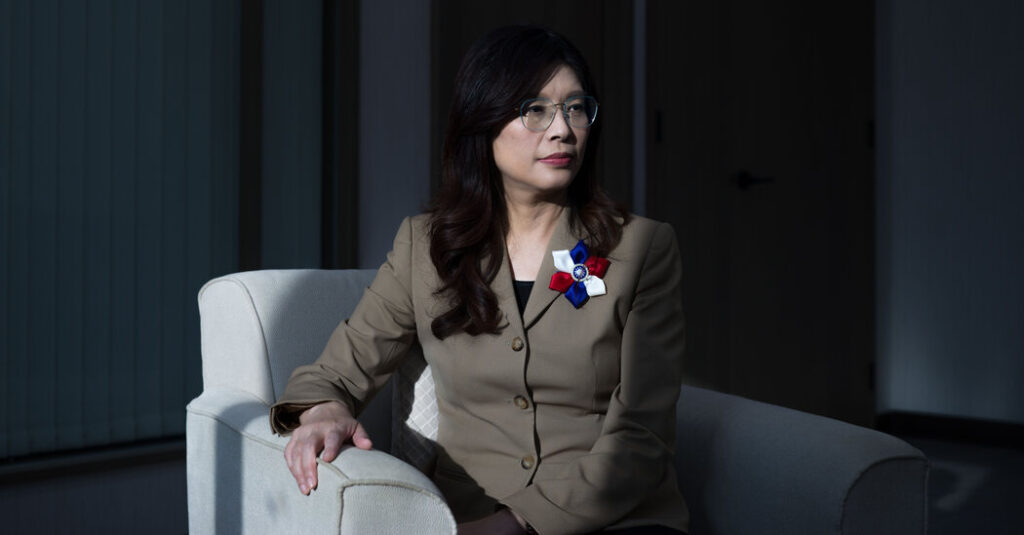
Back in her days as a Taiwanese student activist, Cheng Li-wun gave fiery speeches urging the island to sever its Chinese bonds and declare independence. She lashed out at the Nationalist Party, which had ruled over Taiwan for decades after fleeing defeat in China, casting it as the latest colonizer to oppress the island.
Now Ms. Cheng is, to the astonishment of many, the leader of the very Nationalist Party that she once despised, after winning the party’s leadership election in October. She recently bowed in respect at the grave of Chiang Kai-shek, the draconian Nationalist Party leader whom she once reviled. These days, she says that Taiwan’s people should proudly declare that they are also Chinese.
Ms. Cheng’s abrupt rise to power in the Nationalist Party and her urgent calls for rapprochement with Beijing have made her the most polarizing and potentially disruptive opposition leader that Taiwan has seen in years.
Her views could also prompt disquiet in Washington, a key supporter of Taiwan’s defenses, especially as Taiwanese lawmakers prepare to debate President Lai Ching-te’s proposal to increase military spending by $40 billion over the next eight years.
The plan, intended largely to buy weapons from the United States, will be one of Ms. Cheng’s first major political tests. Ms. Cheng has not said outright whether she opposes the increase, but she has questioned whether Taiwan can afford it, and whether the arms orders would help secure peace or make tensions worse. She said that Mr. Lai was recklessly turning the Taiwan Strait into a “powder keg.”
Ms. Cheng, 56, turned her back on hopes of Taiwanese independence more than 20 years ago, driven, she says, by a deepening belief that the cause was unrealistic and perilous. She now says that Taiwan must accept that it is historically part of China or risk a devastating war with Beijing, which claims the island as its lost territory.
“I don’t believe that time is on Taiwan’s side,” Ms. Cheng said at the Nationalist Party’s headquarters in Taipei, the capital of Taiwan, in an interview with The New York Times. “The rapid rise of mainland China means that its national strength is incomparable to what it was just four years ago, let alone 10 years ago.”
For the Nationalist Party, Ms. Cheng is a bold bet. The party, officially, the Chinese Nationalist Party, has lost Taiwan’s past three presidential elections to the Democratic Progressive Party, the party of President Lai, who has argued that Taiwan is a separate country that should keep China at arm’s length.
She won the Nationalist Party’s leadership after members, eager for a fighter, rallied behind her message that the party had become too timid. At events, she often delivers impassioned speeches without a script, a skill that she said she sharpened as a student politician. But some in the party worry that her embrace of China could unsettle middle-of-the-road voters. In surveys, only about a third of Taiwanese people also identity partly as Chinese.
“She’s an outlier leader who’s trying to disrupt the stagnation of the party,” said Jason Hsu, a senior fellow at Hudson Institute who was formerly a Nationalist Party lawmaker in Taiwan’s legislature. “She’s ideologically coherent, rhetorically sharp, but she could be politically risky for Taiwan that faces an increasingly coercive Beijing.”
Taiwanese security officials have said that evidence indicates that the Chinese Communist Party gave her campaign a lift, including by promoting her on social media in apparently coordinated messages from accounts that appeared linked to China. Ms. Cheng dismissed the allegations as sour grapes. After her victory, China’s leader, Xi Jinping, sent her a congratulatory message, an indication of Beijing’s approval.
She is now trying to prepare the Nationalists to take on the Democratic Progressives in local elections next year and a presidential contest in 2028. She may not be the party’s next presidential candidate — other politicians are favored — but she could have a powerful say in the party’s policy platform for the next election.
Ms. Cheng says that if Mr. Lai were to win another term, Mr. Xi could decide that peaceful unification is a lost cause and that China “would have no choice but to deal with the Taiwan issue through their own means,” she said, implying war.
She believes that her arguments will gain ground among Taiwanese voters. She said that Taiwan needed strong ties with the United States, but she argued that President Trump’s 20 percent tariffs on Taiwan and his pressure to move semiconductor production, the crown jewel of the island’s economy, to the United States, had fueled doubts about Washington’s intentions.
“Could it be that the United States is treating Taiwan as a chess piece, a pawn, to strategically provoke the Chinese Communist Party at opportune times?” she said of those public views, which echo Beijing’s rhetoric portraying Washington as manipulating Taiwan to constrain China.
Earlier Nationalist Party leaders often spent years studying in the United States and adopted a deep reverence for it, said Lee De-wei, a Nationalist Party politician who helped in Ms. Cheng’s campaign to lead the party. Ms. Cheng, who studied there for a year, does not share that attitude, Mr. Lee said.
“In her view, America is no longer the center of the world,” Mr. Lee said.
Even before taking up the leadership post, she was stirring controversy. She said in an October interview with DW, a German news outlet, that Vladimir V. Putin of Russia had won his latest term as president through a democratic election, despite evidence that there was no real competition.
Her critics said Ms. Cheng’s comments showed that she had been swayed by Beijing’s views of Russia as a victim of Western bullying. They say that she is similarly naïve about China’s intentions toward Taiwan. Wu Cheng, a spokesman for the Democratic Progressives, said she was “turning a blind eye to China’s clear aggression against Taiwan and instead blaming the victim, Taiwan.”
Such comments show how far Ms. Cheng has traveled politically. That journey began in a very different place. She was born to a Nationalist soldier from China and a Taiwanese mother and grew up in southern Taiwan. As a law student at Taiwan National University in the 1980s, she rebelled against her background as the daughter of a soldier, throwing herself into the island’s growing movement for Taiwanese identity and self rule.
“For generation after generation, these rulers have come and gone, only to squeeze and oppress the Taiwanese people more and more,” she said in a speech in 1988. “Today, the Nationalists are the most despicable rulers.”
In the years that followed, Ms. Cheng joined the Democratic Progressive Party. She left in 2002 because of anger over what she saw as its problems with corruption and an intolerance of internal dissent under Chen Shui-bian, Taiwan’s first president from the party, said Yin Nai-chin, a journalist who has known Ms. Cheng for many years.
Her detractors say she left the Democratic Progressive Party after she was disciplined for making unfounded criticisms of a party official.
In 2005, she joined the Nationalist Party, deciding that it offered the only realistic path for defusing tensions with Beijing. She accompanied the then-party chairman, Lien Chan, on an ice-breaking trip to China in 2005, the first visit there by a party leader since 1949.
Now, as head of her party, Ms. Cheng has said she is willing to meet China’s leaders. She says that because they will not talk to Taiwan’s government, the Nationalist Party must step in as Taiwan’s channel for dialogue. It’s an argument she thinks Mr. Trump would agree with, she said.
He “believes everything can be best solved through negotiation,” she said.
Chris Buckley, the chief China correspondent for The Times, reports on China and Taiwan from Taipei, focused on politics, social change and security and military issues.
The post Taiwan’s Opposition Leader, Once for Independence, Turns Toward China appeared first on New York Times.