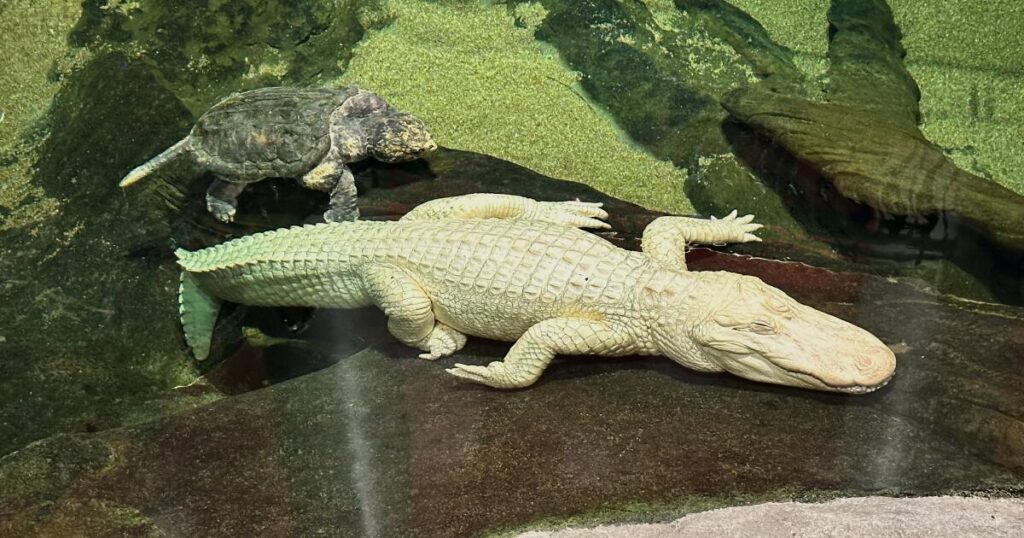
Claude, a rare albino alligator whose ghostly white scales and statue-like stillness earned him a cult-like following around the world, died Tuesday, according to the California Academy of Sciences in San Francisco. He was 30.
The cause was end-stage liver cancer, Bart Shepherd, director of the museum’s Steinhart Aquarium, said in an interview Wednesday night.
A connoisseur of fish heads (preferably trout) and just-unfrozen rats dubbed ‘ratsicles,’ Claude had been closely monitored in recent weeks because of a waning appetite. He was moved out of his publicly-viewable swamp habitat to be treated for a suspected infection and had seemed to be responding well to antibiotics before he was found dead early Tuesday morning, Shepherd said.
A necropsy was conducted at the UC Davis School of Veterinary Medicine on Tuesday, revealing that “almost the entire liver” was overtaken with cancerous tumors, Shepherd said.
Hatched at a Louisiana alligator farm on Sept. 15, 1995, Claude rose to fame in San Francisco, where he spent the last 17 years living in a swamp habitat at the Academy of Sciences aquarium in Golden Gate Park.
Claude became an unofficial mascot for the City by the Bay, where he appeared on billboards and advertisements at bus and light-rail stations. He was the subject of two children’s books. And his every move was tracked by a recently-launched 24/7 livestream called Claude Cam, underwritten by a San Francisco-based tech company called Anthropic, which developed an artificial intelligence chatbot called, you guessed it, Claude.
In a post on X, Rep. Nancy Pelosi (D-San Francisco), called the gator the museum’s “cold-blooded icon” and wrote that “San Francisco is heartbroken by the loss of Claude — our city’s distinguished albino alligator who was taken from us in his prime at just 30.”
Museum staffers dubbed Claude their “iconic swamp king.” And thousands turned out for his 30th birthday bash in September, during which he was presented a “cake” made of fish and ice and a proclamation from Mayor Daniel Lurie, declaring Sept. 15 to be “Claude the Alligator Hatch Day.”
“Claude represented that core San Francisco value of seeing the beauty & value in everyone, including those who are a bit different from the norm. Rest in peace, buddy,” State Sen. Scott Wiener (D-San Francisco) tweeted Tuesday.
Measuring 10 feet long and weighing 300 lbs, Claude was one of fewer than 200 alligators in the world with albinism, a genetic mutation that caused an inability to produce melanin, making his translucent skin appear white.
The condition resulted in poor eyesight, which, along with his inability to camouflage himself, made him vulnerable to predators in the wild, according to the museum. American alligators without albinism can live around 50 years in their natural habitats, according to the Smithsonian’s National Zoo & Conservation Biology Institute, but they can live up to 70 in captivity.
As a “banana-sized” baby, Claude was moved from the Louisiana alligator farm where he hatched to the St. Augustine Alligator Farm Zoological Park in Florida, where he lived in an enclosure alone for 13 years.
In 2008, Claude was loaded into a wooden crate and trucked across the country to San Francisco.
He made the four-day trip — albeit in a separate crate — with Bonnie, a female alligator with typical pigmentation. Biologists hoped they would get along and placed them in the museum’s swamp exhibit together.
But Bonnie did not like Claude, whose limited vision caused him to bump into his surroundings — and into her. She bit his right front pinky toe, which became infected and had to be surgically removed.
Bonnie was sent back to Florida. Claude’s toe remains in the museum’s veterinary hospital in a jar.
He lived peacefully with three female alligator snapping turtles named Donatello, Raphael and Morla, each of whom was believed to be at least 50 years old.
Claude’s enclosure had no doors for human access. Biologists had to use a ladder to climb down into the space for his weekly feedings.
Claude once swallowed a child’s ballet slipper that fell into his enclosure — he was placed under anesthesia to have it removed — but spent much of his time in the near-total stillness typical of an ambush predator.
“He didn’t move much. That was the joke with Claude — if you see him move, it’s an amazing day,” said Emma Bland Smith, who wrote a nonfiction children’s book about him called “Claude: The True Story of a White Alligator.”
Smith, who interviewed biologists who cared for Claude, said children are enthralled by the gator’s “rags-to-riches” story.
“Claude had been through a lot in his life,” Smith said. “We tend to anthropomorphize animals, but there is just something about Claude that is so appealing and charming. Claude was able to find a place for himself in the world even though he was different from others.”
Smith said she had done a reading at the museum about two weeks before Claude’s death and, as she did during frequent visits, peered down at him, smiled, and said, “Hey, Claude.”
“He doesn’t do anything,” she said, “but you feel this connection with him.”
The California Academy of Sciences said it will host a public memorial for Claude “in the near future.”
Shepherd said Claude’s care team at the museum has been heartened by an enormous outpouring of support — text messages, emails and voicemails from around the world; flowers placed outside the facility; even an edible fruit arrangement for staffers.
“It’s nice to see people care about the folks that care about these animals,” he said. “It’s also been a reminder to me about … the reach that even one animal can have. It really was global.”
The post Here’s why San Francisco’s legendary albino alligator ‘Claude’ died at age 30 appeared first on Los Angeles Times.