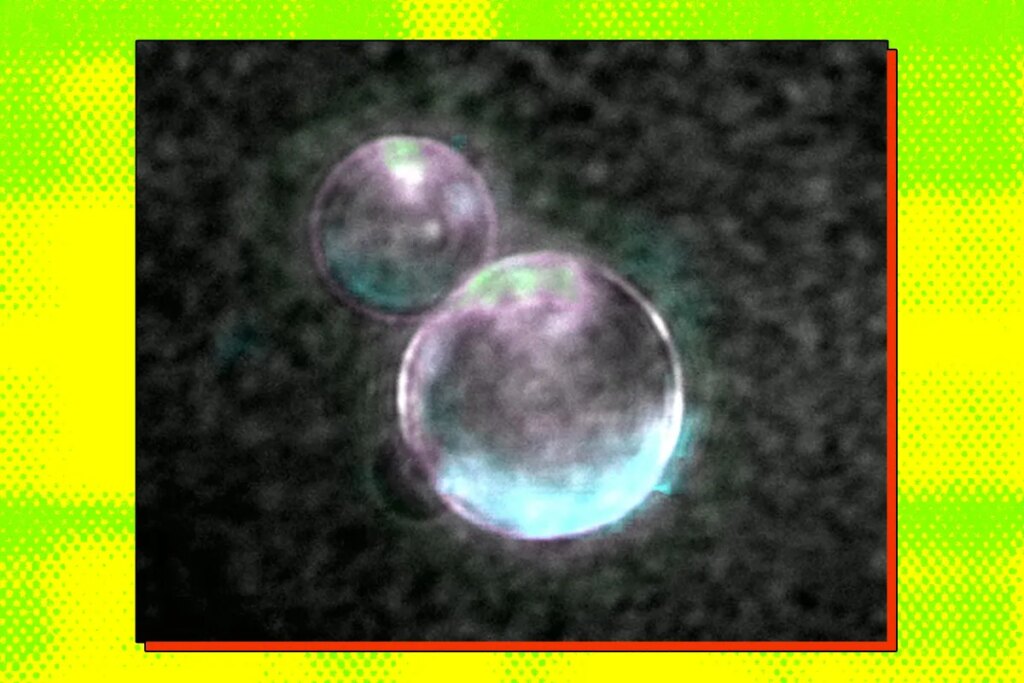
Scientists claim that for the first time in history, they have constructed a synthetic cell that feeds, grows, and replicates — just like a natural one — out of non-living chemical components.
The team from the University of Minnesota says their “SpudCell” is the “first synthetic cell with a complete cell cycle,” and can “grow, replicate its genome, divide, and undergo selection and competition across multiple generations.”
The research, which is being hailed as a major breakthrough, could usher in a new biotech era defined by synthetic organisms that can be grown from scratch and programmed to complete specific functions. It’s a futuristic approach that could open many doors for our efforts to solve a wide variety of human problems, from fighting cancer to capturing carbon.
It could also challenge our preconceived notions of what’s considered “life,” while exploring the essential functions of a living cell.
“We’ve replicated in chemistry what only used to be possible in biology: the complete set of behaviors of a cell,” said team lead and University of Minnesota synthetic biologist Kate Adamala in a statement about the work. “It proves that the most fundamental functions of life, like growth and replication, do not need a mysterious magical spark.”
Yet the research is still in its infancy. SpudCell is still primitive, most closely resembling a bacterium. But since it’s built from scratch, the team says it has some key advantages over natural cells.
“I know the full ingredient list of the cell, I know exactly what chemicals, what molecules at what concentrations,” Adamala told CNN. “It is fully defined, which means we can engineer it.”
“We’re hoping we’re really starting the true age of bioeconomy, enabling technology that will let people engineer biology,” she added.
As detailed in a preprint paper that’ll be submitted for publication this week, SpudCell is made up of anywhere from 150 to 200 molecules. While it can feed, grow and replicate across roughly five generations, it’s orders of magnitude simpler than a natural cell, which can hold billions of molecules.
Adamala called the construct an “incredibly wimpy organism that right now basically does nothing other than to eat and occasionally make a daughter cell.”
To get it to replicate once every 12 hours or so, scientists have to feed it externally while holding it at 86 degrees Fahrenheit. That’s a lot slower than natural bacteria, like E. coli, which divides every 30 minutes, as CNN points out.
It also can’t produce its own proteins, meaning that scientists have to feed it regularly.
Put simply, SpudCell is far from self-sufficient.
“It’s just the beginning,” Adamala told CNN. “It’s a chassis that we’re hoping to build on, and that’s significant, because now we actually can have some reasonable idea of how to build on it.”
Whether SpudCell actually constitutes what we refer to as “life” remains hotly debated, with experts arguing it can’t evolve on its own without the laborious care of its makers.
“I would say Kate has constructed a cell,” Stanford University associate professor of bioengineering Drew Endy, who founded a public-benefit institution alongside Adamala, told CNN. “I don’t think she’s created life.”
“However, does it promise a future where more people will be able to build cells?” he added. “Yes.”
Others were more open to the idea that the researchers had made a major step towards creating synthetic life.
“Kate Adamala’s team designed and built a nonliving synthetic cell that is much closer to being ‘alive’ than anything else produced by the bottom-up synthetic cell field,” J. Craig Venter Institute synthetic cell researcher John Glass, who was not involved in the research, told the New York Times.
More on synthetic life: Scientists Say They’ve Created a New Form of Life More Perfect Than the One Nature Made
The post Scientists Build Fully Synthetic Life Form That Can Eat and Reproduce appeared first on Futurism.