As he reached the end of his acceptance speech at the Republican National Convention in 2024, J. D. Vance’s tone became more intimate. He began to speak of a cemetery in Kentucky where five generations of his family are buried, and where he hopes he and his children will be buried too. The cemetery matters to him because the bones in that graveyard—some belonging, he said, to people born “around the time of the Civil War”—represent a concrete reality, a homeland, a place that he will defend. “People will not fight for abstractions,” Vance said, “but they will fight for their home.” Not “all men are created equal,” in other words, and not “Life, Liberty and the pursuit of Happiness,” but tombstones. Vance believes that blood and soil, not ideas and principles, are what make him American.
As it happens, I can compete with the vice president in a race to lay claim to old bones. There is a cemetery in Galveston, Texas, where multiple members of my family are buried, too, actually going back more than five generations. I own a photograph of the great-great-grandmother whose tombstone is there; she is wearing a hat and coat, standing on a chilly beach. Her parents are buried nearby—that is, my great-great-great grandparents, who were born well before the Civil War—plus aunts, uncles, and cousins, some of whom might well have arrived on the Gulf Coast before members of Vance’s family got to Appalachia.
But here is where Vance and I differ: I do not think that the presence of my ancestors in a Galveston cemetery makes me American. On the contrary, all of us—me and Vance; Vance’s in-laws, born in India; my great-great-great grandparents, born in Alsace; our respective children and eventual grandchildren—are, were, or will be Americans because we live in the community created by the abstractions that he dismissed in his speech. More important, I am convinced that these abstractions, all of those words vowing to “establish Justice” and “secure the Blessings of Liberty,” are much stronger, much more powerful than the pull of our respective clans and graveyards. Why? Because they can unite and inspire a nation that contains people with origins and ancestors as radically different as those belonging to me and Vance.
[From the July 2026 issue: How America gave up on its own history]
The lawyers, farmers, plantation owners, and rabble-rousers who wrote our founding documents were well aware that they needed a set of unifying ideas. By the time they got around to composing the Constitution, more than a decade after the independence declaration that we are celebrating this week, they were no longer primarily concerned with liberty and the pursuit of happiness, but with the need to keep 13 separate colonies and people of many divergent views and religions inside a single nation. Unlike the Declaration of Independence, the Constitution does not begin with a universal claim, that “all men are created equal.” It begins with the specific need to “form a more perfect union.” That need became more urgent over subsequent centuries, as that union came to include an ever-wider selection of people, among them former slaves and immigrants from Asia, Eastern Europe, Latin America.
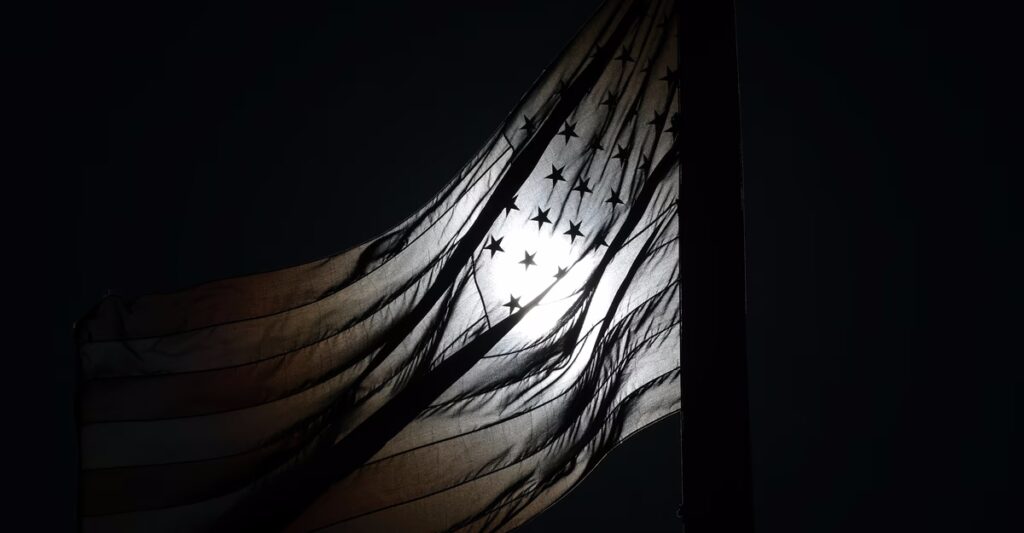
To hold the country together, we still require functioning institutions. But we also need symbols: a flag, a national anthem, shared ceremonies that remind us of our founding ideas. Thanksgiving. The Fourth of July. Presidential inaugurations. The State of the Union address. Indeed, convention speeches are traditionally used to invoke unity and “abstract” American values too.
Since Donald Trump and J. D. Vance took office last year, they have set out to destroy both the institutions and the symbols. Vance did not choose to speak about graveyards by accident: Because they believe that only their clan represents America, that only people like them deserve to be considered “real” Americans, and that the American government exists to serve them alone, they need to undermine anything that tells a more unifying story.
With that goal in mind, Trump has deliberately and methodically defaced the White House, a structure originally designed to evoke the classical virtues—simplicity, modesty, symmetry—that were widely admired at the time of America’s founding. He desecrated the Rose Garden, cultivated by a series of first ladies as a gift to the nation, replacing its grass court with a patio copied from his Florida resort as a gift to himself. He dug up the East Wing to build an even bigger monument to himself, accepting hundreds of millions of dollars from private donors to do so, while secretly demanding hundreds of millions more from taxpayers as well. He defaced the South Lawn with a spectacle of half-naked men beating each other into a bloody pulp, acting out performances of dominance and submission.
Even his destruction of the Reflecting Pool on the National Mall has real significance. He had it redone by people he claimed to know, in a color he preferred, without consulting anyone or going through any formal process. When the renovation proved incompetent, fostering algae, he forced police and the National Guard to pretend that the pool had been vandalized, even to investigate and arrest people who touch the water. This seems a trivial matter, but it is not. Representatives of the American state now have to comply with the president’s personal fictions, however ludicrous, because he and his tribe believe that federal employees work exclusively for them, not for all of us.
Inevitably, the Trump administration has destroyed the nation’s 250th-anniversary celebrations. I was 11 in 1976, during the bicentennial, and that July 4 I was at a summer camp in North Carolina. I remember celebratory flag-raising and patriotic songs, as well as sparklers in the evening. At the time, we didn’t think there was a permanent cultural divide between red states and blue states. In retrospect, I’m sure some of my fellow campers came from families with views different from mine.
[Simon Sebag Montefiore: The Democracies can still triumph]
It didn’t matter to our celebration of the bicentennial, mostly because we were 11. But it also wouldn’t have mattered even if we were adults, because everyone knew that the bicentennial was for all of us. The tall ships, the fireworks, the Freedom Train that carried a moon rock around the country—all of these were symbols we shared, no matter which part of America we came from. President Gerald Ford didn’t try to make the events of that year about himself or his base, or his tribe, or his bank account.
This year is different, because the White House is inhabited by people who don’t believe in the “abstractions” that we usually celebrate on the Fourth of July. And this affects the rest of us, whether we want it to or not. Congress’s celebration, planned for a decade, has been usurped by the president’s celebration, funded by private donors and featuring a political speech by himself. Other institutions in and around Washington postponed or reduced their 250th celebrations, so as not to get in the way of the president. Many people who might have participated will not attend, pay attention, or care.
I don’t know whether the United States of America will ever reach its tricentennial, but if it does, it will be because the narrow tribe that Trump and Vance represent has been defeated and removed, and because the country is once again governed by people who believe in an American union. This is not a partisan statement: Democrats and Republicans will together have to wrest the state away from people who believe they rule by right of inheritance, and give it back to a nation that still believes that all men are created equal, that they are endowed by their creator with certain unalienable rights, and that the purpose of government is to serve the nation—not to enrich an oligarchic clan.
The post Blood and Soil Aren’t What Binds America Together appeared first on The Atlantic.