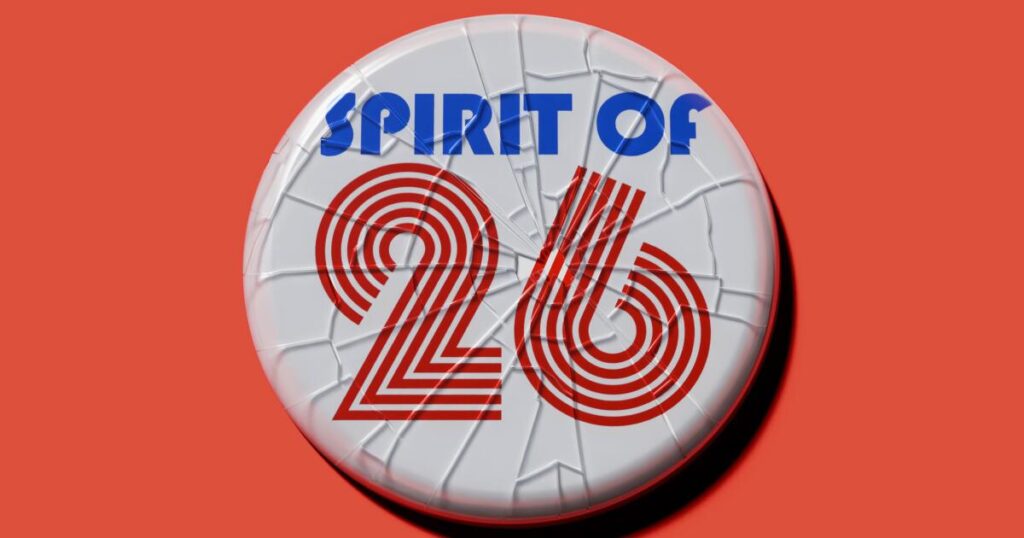

America 250” is no “Spirit of ‘76.”
For those of us who remember the bicentennial, the semiquincentennial is a complete and utter dud. Many fine festivities will take place on and around July 4, but compared with the years-long nationwide celebration that marked this country’s 200th anniversary, 250 feels like a nonevent.
Perhaps it was inevitable. Semiquincentennial (meaning half of a 500-year anniversary) certainly doesn’t roll off the tongue as easily as bicentennial and our current president isn’t making it any catchier. Mostly because he seems to think 250 is the new 80 (the birthday President Trump recently marked with his UFC Freedom 250 cage match on the White House lawn).
As many have noted, Trump’s method of honoring this country’s birthday involves making it all about him by demolishing parts of the White House (to install a new bunker-like ballroom), attempting to set up a $1.8-billion slush fund for pardoned Jan. 6 rioters, seeking to build a triumphal arch that a majority of Americans oppose and trying to slap his name and/or image on any surface he can think of (including a proposed $250 bill). No wonder so many artists have dropped out of the concert series planned for the Great American State Fair in Washington, D.C.
To be fair, the federal government’s involvement in bicentennial planning also got bogged down with political and personal hubris. The national commission, originally created by President Lyndon B. Johnson, was reformed under President Richard Nixon. Plagued by criticism and scandal, it was eventually dissolved by Congress and replaced by a new commission that decided to mostly fund community celebrations.
There was much hand-wringing over missed opportunities at the time, but for more than a year, state and local governments staged reenactments, parades and patriotic events all over the country while the commercial sector star-spangled the crap out of everything: T-shirts, bell-bottoms and bathing suits; curtains, bedspreads and throw rugs; dishware, glassware and Tupperware.
The Declaration of Independence appeared on highball glasses, tea towels and collectible plates. Beginning in 1974, CBS ran mini-history lessons called “Bicentennial Minutes,” which were then sent up on shows as diverse as “Hee Haw” and “Maude.” George Washington and other Founding Fathers graced Pez dispensers, coasters and the cover of Mad Magazine. There was a bicentennial Barbie and a colonial Campbell’s Soup doll. McDonald’s sold red, white and blue milkshakes, Burger King offered a flag-bedecked series of glass tumblers, Disney characters wore tricorn hats for a line of park merchandise.
Some called it the “buy-centennial” but for a kid who daily rocked Stars and Stripes sneakers, and, thanks to a year’s worth of American-history-themed “Schoolhouse Rock!,” could, and would, sing the preamble to the Constitution or the anthem “No More Kings” at the drop of a hat, it was great fun.
Now, of course, “No More Kings” is an anti-Trump protest theme, and the right has so co-opted patriotism that wearing a flag-emblazoned T-shirt can feel somehow partisan. American history itself has become a bone of contention, with the left accusing the right of whitewashing this country’s inarguable sins — Native American displacement, slavery, gender inequality and racist policies — while the right insists that the left is obsessed with undermining our nation’s power and legacy by “woke”-shaming it.
The only thing each end of our divided political spectrum can agree on is that democracy is under mortal threat from the other.
That’s one good reason to feel less than festive, and there are plenty of others, including increased political violence, the war in Iran, tariffs, surging gas prices, civil rights rollbacks, Immigration and Customs Enforcement tactics, artificial intelligence’s threat to jobs, the resurgence of measles, the rising cost of just about everything and the fact that some critics are claiming that Steven Spielberg’s “Disclosure Day” is less full of wonder than “Close Encounters of the Third Kind.”
But things weren’t so great heading into the bicentennial either. I was 12 at the time, born nine months after Alabama Gov. George Wallace gave his infamous “segregation now, segregation tomorrow, segregation forever” speech and less than two months before President Kennedy was assassinated. I hadn’t been alive a year when civil rights activists James Chaney, Andrew Goodman and Michael Schwerner were murdered in Mississippi by members of the Ku Klux Klan and hadn’t turned 5 when the Rev. Martin Luther King Jr. and then-Sen. Robert F. Kennedy were also assassinated.
Sure, it was that now-wistfully remembered time when kids went out in the morning and played, mostly unmonitored, until nightfall (with the inevitable trips to the doctor for stitches and tetanus shots for those wounds too obvious to hide from parents). But by the time the bicentennial rolled around, my life had played out against the backdrop of civil unrest and the Vietnam War, both spilling from our black-and-white television almost nightly.
I was 9 when Wallace, then a presidential candidate, was shot and 10 when I learned what OPEC and gas siphoning meant as my family spent hours in an un-air-conditioned car, inching toward the gas pump after the 1973 “Yom Kippur” Arab-Israeli War resulted in oil shortages.
That same year, Vice President Spiro Agnew resigned from office, pleading “no contest” to charges of tax evasion but avoiding prosecution for charges of bribery and criminal conspiracy, and Nixon appointed House Minority Leader Gerald Ford (R-Mich.) to Agnew’s place. In 1974, Nixon, faced with impeachment for his part in the Watergate scandal, became the first president in U.S. history to resign.
The bicentennial’s tall ships festivals, fife and drum parades and Old Glory consumer fest occurred in a country reeling from more than a decade of history-changing assassinations, civil unrest, economic anxiety and high-level political corruption (not to mention a collective fear of the ocean brought on by the 1975 release of Spielberg’s “Jaws”). Democracy was celebrated under Ford, the first, and thus far only, president to come to office through the provisions of the 25th Amendment rather than a national election.
A president who, after being regularly and ruthlessly lampooned by comedian Chevy Chase on the nascent “Saturday Night Live,” reacted by becoming friends with Chaseinstead of, you know, forcing the network to fire him.
If the bicentennial roiled with some of the same tensions Americans feel today, it did benefit from a cultural cohesion that no longer exists. The year 1976 saw the founding of Apple and the introduction of VHS tapes, but the national audience was still very much a reality. Back then, you couldn’t escape the songs of the summer — “Silly Love Songs” (Wings), “Don’t Go Breaking My Heart” (Elton John and Kiki Dee) and “Afternoon Delight” (Starland Vocal Band) — any more than you could miss those “Bicentennial Minutes.” We all listened to the radio, watched TV, went to the movies and bought books, and our preferences revealed the country’s desire for both comfort and change.
On the bestseller lists, Agatha Christie’s final Hercule Poirot and Miss Marple books marked the end of an era, toggling in the No. 1 spot with the political turbulence of Gore Vidal’s “1876” and Leon Uris’ “Trinity.” “Rocky” beat “All the President’s Men,” “Taxi Driver,” “Network,” “Marathon Man” and “The Omen” at the box office and, later, in the best picture Oscar race.
On television, Americans sought the nostalgic comfort food of “Happy Days,” “The Waltons” and “Little House on the Prairie” amid the more pointed social comedies of “All in the Family,” “The Jeffersons” and “MASH,” all of which had nightly averages of 20 million or more viewers.
In today’s cultural landscape, defined by social media bubbles, streaming services and Spotify libraries, the gap between mass audience and cultural significance is much wider than it was 50 years ago (“The Super Mario Galaxy Movie” may be the highest-grossing movie of the year, but it’s hard to imagine it winning best picture) and mass audience has become a relative term for pretty much everything that is not the Super Bowl.
Even so, we too find ourselves rooting for the little guy (“Project Hail Mary”) and reaching into the past for inspiration (a new “Little House on the Prairie” debuts next week on Netflix) even as we contemplate the future of tech (“The Six Billion Dollar Man” has become every computer genius who can leap a firewall).
I don’t know what it was like to be an adult in 1976, but I remember my parents fretting over the grocery budget, nixing travel plans because of the price of gas and worrying about the future of a country that seemed so irreparably divided. To paraphrase the Diana Ross hit of the time, did we know where we were going to? Not at all. The bicentennial occurred during an election year, with all the partisan denunciations that entails (though when Jimmy Carter narrowly beat Ford, no one thought of contesting the results).
Even so, most Americans were still ready to party, to celebrate the 200th anniversary of a long-shot revolution that resulted in the United States of America.
So does it stink that the semiquincentennial has been such a flop? Yes, it does. But, as is written in its very singable preamble, the Constitution was written “in order to form a more perfect union.” Not “perfect,” but “more perfect.” As in better.
Even in the most troubled times, the cornerstone of our democracy is the understanding that we will always need to do better and there is a living document that allows us to do so.
And 250 years’ worth of that is definitely worth celebrating.
The post Even in ugly times, the bicentennial united us. America 250 still can appeared first on Los Angeles Times.