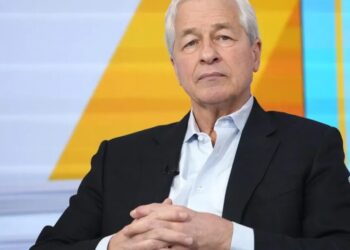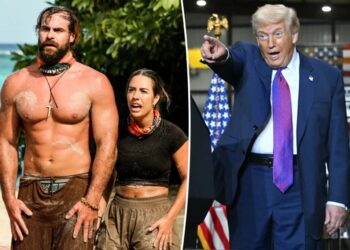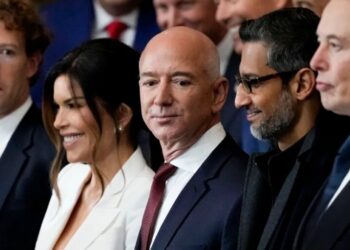
Gavin Newsom, Erika Kirk, Dario Amodei, Scott Bessent and other leaders from across the worlds of business and politics discussed tariffs, artificial intelligence, cryptocurrency and how President Trump is reshaping global trade and the economy.
At last year’s summit, tensions ran high ahead of Mr. Trump’s return to the White House. But a year later, some speakers on Wednesday defended many of the president’s recent policies.
Then there is Mr. Newsom. The governor of California, who has positioned himself as a foil to Mr. Trump and a potential presidential candidate himself in 2028, said the president acted like a “man child” and had pushed America back to “pre-1960s.”
The annual summit, hosted by Andrew Ross Sorkin, founder of DealBook, has taken place since 2011.
Here are five main themes that emerged.
The tariff debate rages on.
Scott Bessent, the U.S. Treasury secretary, said he was “very optimistic about the economy,” despite stubbornly high prices and signs of strain in the labor market. His solution to the affordability crunch: move to states led by Republicans where, he said, inflation was not as damaging. (Recent data mostly contradict that assertion.)
Mary Barra, the chief executive of General Motors, reaffirmed the company’s commitment to electric vehicles. She noted, however, that the future of E.V. sales in the United States remained uncertain. And there is a clear incentive for the industry to pivot away from its recent focus on electric vehicles: Mr. Trump’s tariffs have cost U.S. automakers billions of dollars, and a push from the White House to weaken fuel efficiency requirements could incentivize G.M. and other carmakers to sell more higher-margin pickups and sport utility vehicles.
Brian Armstrong, chief executive of Coinbase, brushed off the fallout from crypto prices’ recent collapse, which has been fueled partly by wider economic uneasiness like the threat of tariffs and speculation about interest rates. Mr. Armstrong instead expressed optimism about the economy, saying that America is in “kind of a golden age for freedom.”
We can’t agree that A.I. is a bubble.
The rapid rise of A.I., and the potential downside of that technology boom, was a big talking point among executives and business leaders at the summit. (So, too, was the growing popularity of prediction markets.)
When Mr. Sorkin asked Larry Fink, the chief executive of BlackRock, the $13.5 trillion asset management juggernaut, whether America was facing an A.I. bubble, Mr. Fink said that some industry leaders were divided on whether they were spending too much or too little on A.I.
Alex Karp, co-founder and chief executive of Palantir, defended his company’s technological advancements, asserting that the firm had become “an absolutely domineering juggernaut” in A.I. Mr. Karp pushed back aggressively against accusations that the company was building mass-surveillance tools.
To power the A.I. boom, technology companies are spending (and borrowing) huge sums to build data centers. There are now concerns among some on Wall Street that those companies are taking on too much financial risk.
Dario Amodei, co-founder and chief executive of Anthropic, the start-up behind the Claude chatbot and which in September completed a funding round that valued the company at $183 billion, acknowledged that the vast amounts of spending could eventually hurt some companies racing toward A.I. dominance. Mr. Amodei acknowledged that he and his executive team were entering a “cone of uncertainty” when deciding whether it was riskier to invest too much or too little on its computing facilities.
He also said that he saw the selling of advanced chips to China as a national security issue even more than a business decision. “Democracies need to get there first — it’s an absolute imperative,” Mr. Amodei said. “And if we sell the chips to China, it’s more likely they will get there first.”
Social media proves divisive.
The use of social media platforms was also a hot topic. Jimmy Donaldson, better known as MrBeast, who has more than 450 million subscribers on YouTube, appeared alongside Jeff Housenbold, the chief executive of Beast Industries. Built on the success of Mr. Donaldson’s videos, the company is now valued at $5.2 billion and the two men signaled they’re weighing an I.P.O.
When asked about the debate over children and smartphones, Mr. Donaldson said he hadn’t put “too much thought” into it. He added that TikTok, a company he previously tried to bid on, was more filled with “brain rot” content than YouTube.
Ms. Kirk, the widow of the conservative activist Charlie Kirk, said she had removed social media apps from her phone since her husband was killed in September. She depicted her husband as a proponent of dialogue to help change minds, promoting conversation even among those with whom he virulently disagreed. The way to push back against those you don’t agree with isn’t “by murdering someone because you don’t believe what they believe,” she said.
Trump is still a lightning rod.
While a number of speakers showed optimism about the direction of Mr. Trump’s second term, Mr. Newsom was not shy about voicing his criticism of the president. One beef: He rattled off the White House’s moves to take equity stakes in the chipmaker Intel and MP Materials, an operator of rare earth mines in California, and a “golden share” in U.S. Steel as signs that chief executives had grown too cozy with the administration. “What the hell happened to free enterprise?” he said. “A healthy horse pulling a sturdy wagon. What’s going on with this country?”
(Earlier, Mr. Newsom took some criticism himself. During a presentation, Halle Berry, the actress and founder of Respin, took a stance against Mr. Newsom for vetoing a menopause bill in two consecutive years and said, “He’s not going to be governor forever.”)
Mr. Karp, meanwhile, said he strongly supported the Trump administration’s border and immigration policy, along with its goal of beefing up America’s military strength. When asked whether the president is a fascist, Mr. Karp said “of course not,” and added that he thought it was “stupid” to suggest so.
A few speakers said their perspectives had changed since Mr. Trump took office in January. Mr. Bessent defended Mr. Trump’s use of tariffs and acknowledged that his mind-set around tariffs had “evolved” after expressing skepticism about them last year.
Speaking of changing minds, Mr. Fink, once a skeptic of crypto, said his feelings about digital currencies had evolved as his firm is now one of the biggest players in the industry. He had previously called crypto “the domain of money launderers and thieves.” Mr. Trump has taken a strong pro-crypto stance since his re-election campaign and into his second term.
Foreign leaders affirm their relationship with the U.S.
The ripple effects from Mr. Trump’s trade war and the administration’s diplomatic efforts can be felt across Asia, the Middle East and beyond.
Mr. Bessent addressed the administration’s position on Taiwan, a key ally and vital supplier of chips to Western businesses. The relationship between the United States and Taiwan, he said, remain “unchanged.” (He seemed to have misspoken, calling America “an ally” of China when the question had been about the United States’ relationship with Taiwan.)
In a pretaped interview, Lai Ching-te, the president of Taiwan, said that China was ramping up its military intimidation campaign toward the island. But, he added, the country is assured that the United States is committed to standing by Taiwan. “Since President Trump took office, cooperation with Taiwan has not only continued, but even expanded,” he said.
Prime Minister Benjamin Netanyahu of Israel also joined the summit via video — following his appearance in court, where he faces corruption charges. He reiterated that he would not let the legal matter, which Mr. Trump has assailed as the political persecution of an ally, distract him from keeping his grip on power.
Mr. Netanyahu also had a message for New York City’s mayor-elect, Zohran Mamdani, who has vowed to honor an arrest warrant for the Israeli prime minister issued by the International Criminal Court on charges of war crimes.
“I’ll come to New York,” Mr. Netanyahu said, adding, “Yes, of course I will.”
Kailyn Rhone is a Times business reporter and the 2025 David Carr fellow.
The post 5 Takeaways From the 2025 DealBook Summit appeared first on New York Times.