The Supreme Court on Tuesday concluded a momentous term that began in October and involved decisions in nearly 60 cases. Here are some themes that emerged from the court’s rulings.
The court expanded presidential power and handed conservatives lasting wins.
The justices were willing to put some limits on President Trump, but the court’s six-member majority of Republican nominees delivered long-sought wins for the conservative legal movement. The court expanded executive power by allowing Mr. Trump and future presidents to fire leaders of independent agencies for any reason or no reason at all. That decision, delivered Monday, overturned a 90-year precedent that had allowed Congress to protect such regulators from at-will removal, and to insulate the agencies from political pressure.
Ahead of the midterm elections, the conservative majority also significantly narrowed the Voting Rights Act, making it possible for Republicans throughout the South to redraw congressional maps and dismantle majority-Black districts. And in a pair of decisions decided on 6-to-3 votes, the court allowed the president to move forward with plans to expel hundreds of thousands of migrants from the country — and to turn away others at the U.S.-Mexico border.
The court at times checked Mr. Trump’s boundary-pushing agenda.
At the same time, the justices picked key moments to push back on some of Mr. Trump’s signature policies. An ideologically diverse set of justices invalidated the president’s sweeping tariffs on imports from nearly every U.S. trading partner.
In the final week of the term, they decisively rejected the president’s attempt to end birthright citizenship for babies born to undocumented immigrants and temporary foreign residents. And the court blocked Mr. Trump from immediately firing Lisa D. Cook, a Fed governor.
Mr. Trump’s nominees disappointed him.
Mr. Trump’s three nominees — Justices Neil M. Gorsuch, Brett M. Kavanaugh and Amy Coney Barrett — often supplied crucial votes to reject the president’s agenda by joining coalitions that included the chief justice and the court’s three Democratic appointees. Though Mr. Trump has over the years criticized all three justices, saying they had been disloyal, it has been Justice Barrett who has received the most blowback from the right.
She wrote the majority opinion in a 5-to-4 decision allowing some mailed ballots to be counted after Election Day, and she joined Chief Justice John G. Roberts Jr.’s majority opinion sustaining birthright citizenship on constitutional grounds. After Justices Barrett and Gorsuch voted to reject Mr. Trump’s tariffs program, he called them “fools and lap dogs,” and “an embarrassment to their families.”
Gun rights prevailed as L.G.B.T.Q. protections waned.
The court continued to expand Second Amendment rights, ruling that the federal government could not disarm a gun owner who was an occasional marijuana user, and that Hawaii could not require people carrying guns to have explicit permission from owners before entering private property that is otherwise open to the public.
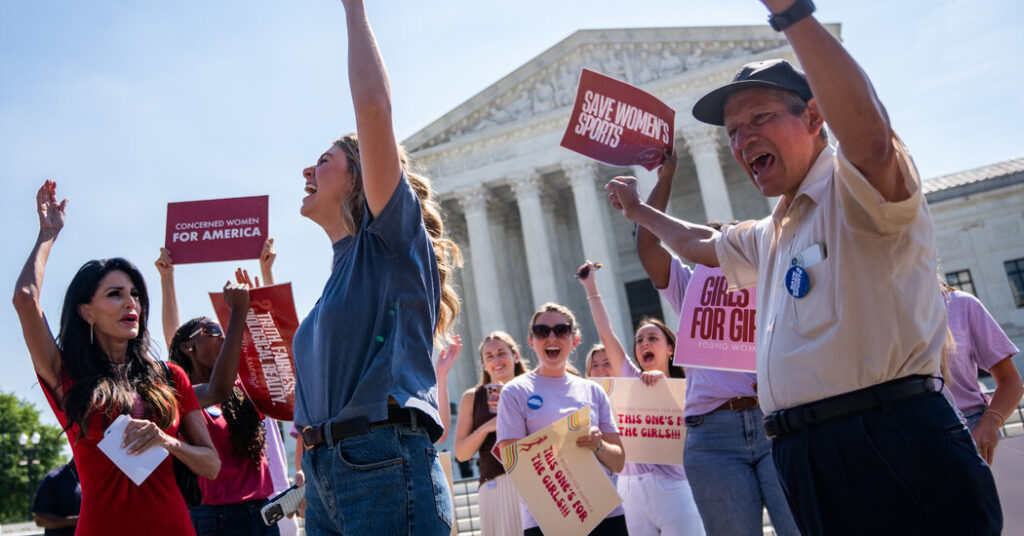
In cases on gay and transgender rights, the justices handed conservatives wins. They ruled that Colorado’s ban of “conversion therapy,” intended to change a minor’s gender identity or sexual orientation, violated the First Amendment. And they said states were free to bar transgender female athletes from competing in girls’ and women’s school sports.
The chief justice is in charge.
Chief Justice Roberts showed once again that he was in control of the court he joined more than 20 years ago. He voted in the majority more often than any of his colleagues. And he wrote for the majority in nearly all of the most significant cases this term, including the court’s decisions to block the president’s birthright citizenship order and his attempt to impose sweeping tariffs.
In those cases, the chief justice was able to assemble ideologically diverse coalitions with the liberal justices and one or more of the justices nominated by Mr. Trump in his first term.
The post Takeaways From a Transformative Supreme Court Term appeared first on New York Times.